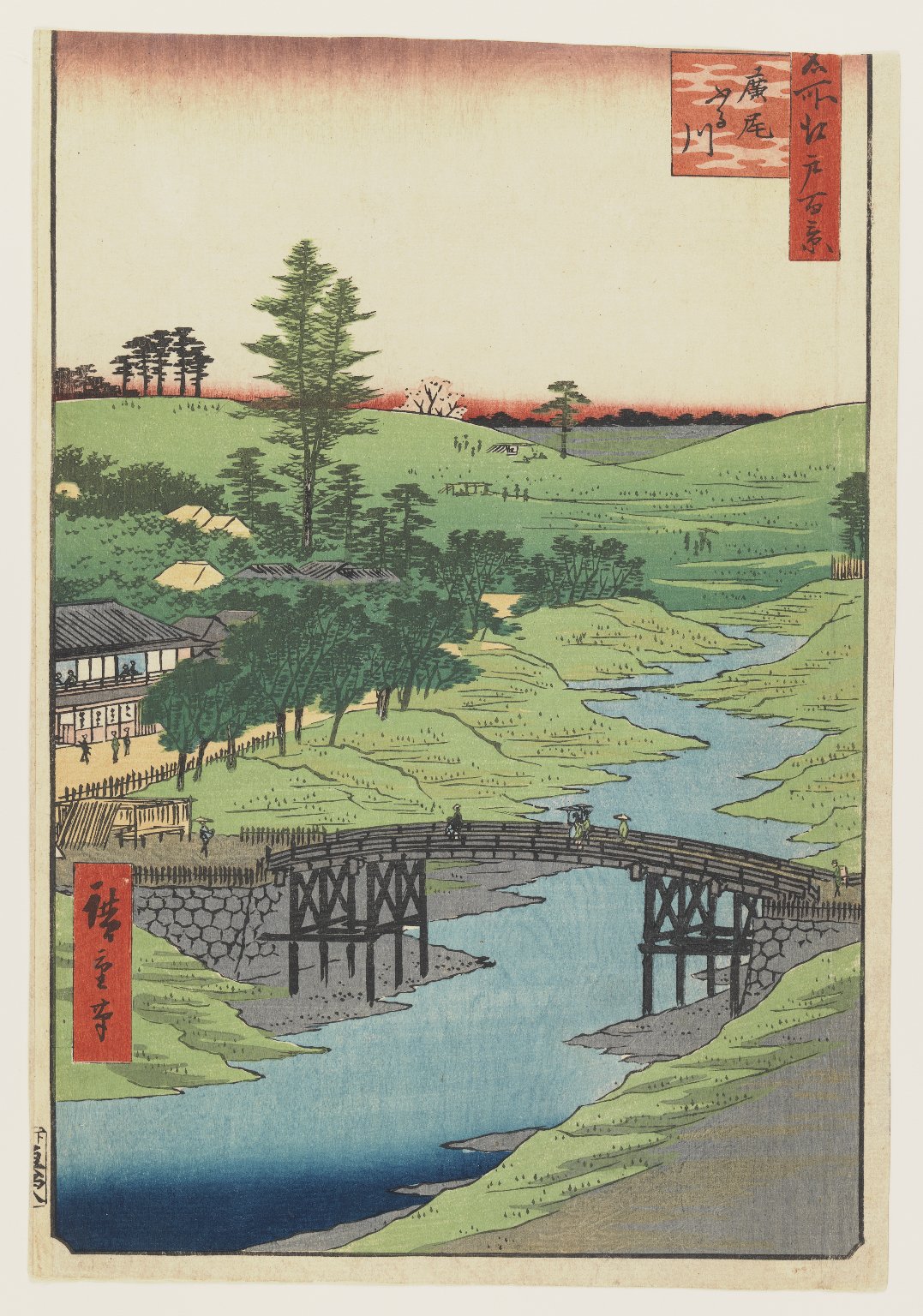
One Hundred Famous Views of Edo: The Prints That Changed Western Art
Vincent van Gogh owned more than four hundred Japanese woodblock prints. He organized exhibitions of them. And when he stood before print number 58 of Hiroshige's One Hundred Famous Views of Edo -- a scene of sudden rain slashing across the Shin-Ohashi bridge over the Sumida River -- he picked up his brushes and copied it in oil, stroke for stroke, adding a border of Japanese characters borrowed from other prints. He did the same with print number 30, a close-up view of a plum tree in Kameido, branches reaching across the frame like dark calligraphy. Van Gogh was not alone. Across Paris and beyond, artists and designers encountered Hiroshige's prints and saw a visual language that shattered every European convention of perspective, composition, and color. The One Hundred Famous Views of Edo did not just document a vanishing city. They rewired the way the Western world learned to see.
Pictures of the Floating World
Hiroshige began the series in 1856, already in his late fifties and one of the most prolific artists in the ukiyo-e tradition. Ukiyo-e -- 'pictures of the floating world' -- were woodblock prints produced collaboratively in 18th- and 19th-century Japan by artists, block cutters, and printers working under the direction of specialist publishers. The floating world was one of transient pleasures: licensed entertainment districts, kabuki theaters, seasonal festivals, famous teahouses. Hiroshige had already produced The Fifty-three Stations of the Tokaido and The Sixty-nine Stations of the Kisokaido. For this final great series, he turned inward -- to Edo itself, the city we now call Tokyo. Drawing partially on a seven-volume illustrated guidebook, Pictures of Famous Places of Edo, published between 1829 and 1836, Hiroshige mapped the capital's shrines, bridges, rivers, gardens, and pleasure quarters. But he went further than any guidebook, depicting casual views the guide never covered.
One Hundred and Nineteen Views
Despite its title, the series contains 119 prints, organized by season: spring, summer, autumn, winter. Hiroshige pioneered a vertical format for this series, a departure from the horizontal compositions of his earlier work, and the tall, narrow frames created dramatic possibilities -- foreground objects looming enormous while distant landscapes receded into atmospheric haze. A giant cherry tree trunk fills the left edge of one print while the Sumida River stretches to Mount Tsukuba behind it. A turtle dangles from a bucket handle in the foreground of another while Mount Fuji glimmers in the far distance. Carp streamers billow across Surugadai in a celebration of Boys' Day. Rain hammers a bridge. Snow blankets a canal. Hiroshige published the prints in serialized form beginning in 1856. He died on October 12, 1858, and his student and adopted son Hiroshige II completed several of the final prints, including the controversial number 119, a rain scene at Tameike Pond that scholars debate to this day.
Hidden Messages in the Ink
The prints are layered with references that rewarded Edo audiences far beyond the surface image. Print number 34 is the only image in the entire series to depict a large human figure -- purportedly Hiroshige's favorite geisha. Print number 86, showing Naito Shinjuku, was criticized for its vulgar depiction of horse dung, but Hiroshige was alluding to a 1775 literary reference about 'flowers thriving on the horse dung of Yotsuya' -- a coded reference to Shinjuku's prostitutes. In print number 75, the kanji on drying fabric spells 'sakana,' a nod to publisher Sakanaya Eikichi, while adjacent fabrics contain Hiroshige's own monogram. Print number 73, a view of Edo Castle and Mount Fuji, is the only one in the series without a place name in its title -- arguably the view from Hiroshige's own home. These layered meanings made each print a puzzle for viewers who knew where to look.
The Bridge Between Worlds
When the prints reached Europe in the second half of the nineteenth century, they struck artists like an electric current. Van Gogh copied prints 30 and 58 directly. Claude Monet collected Japanese prints and filled his home at Giverny with them. The iris garden print influenced European Art Nouveau. The bold cropping, flat color fields, asymmetric compositions, and radical use of foreground objects that Hiroshige employed contradicted everything Western academic painting taught about depth, balance, and perspective. Art historians credit the One Hundred Famous Views with profoundly influencing the development of modernism itself. Elements of Hiroshige's visual language surfaced in twentieth-century cinema and comics, including The Adventures of Tintin. Today, the sites Hiroshige depicted have transformed beyond recognition -- the Benten Shrine ground at the Tama River is now Haneda Airport -- but the prints endure as the definitive portrait of Edo in its final years before the Meiji Restoration swept the old world away.
From the Air
The prints depict locations across the historical boundaries of Edo (modern Tokyo), centered approximately at 35.684°N, 139.774°E. The views span from the Tama River (now Haneda Airport, RJTT) in the south to the Arakawa River in the north, and from Inokashira Pond in the west to the Nakagawa River in the east. Many depicted landmarks remain identifiable from the air: Sensoji Temple in Asakusa, the Sumida River and its bridges, Nihonbashi, Shinobazu Pond in Ueno, and the grounds of the former Edo Castle (now the Imperial Palace). Best appreciated at 3,000-5,000 feet AGL over central Tokyo. Tokyo Haneda Airport (RJTT) lies to the south; Tokyo Narita (RJAA) approximately 35 nautical miles east-northeast.