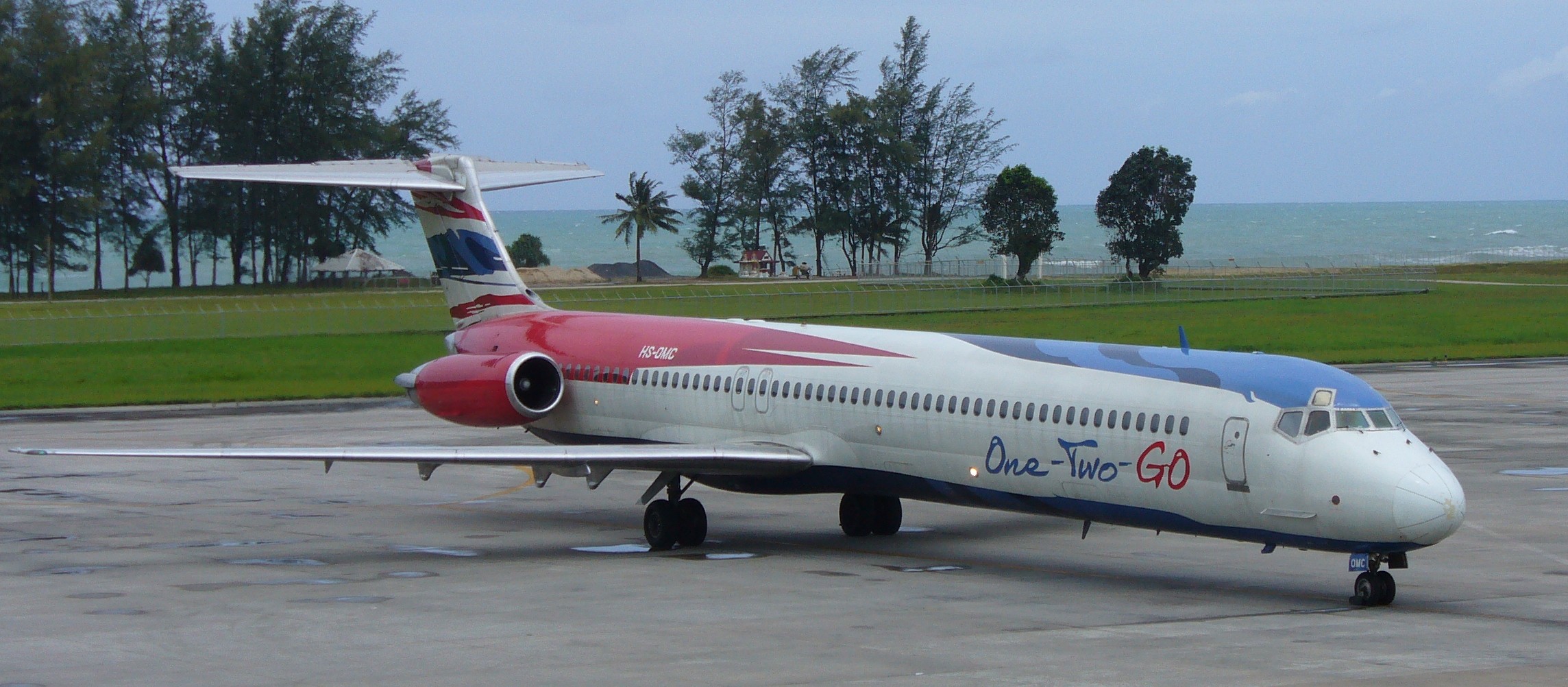
One-Two-Go Airlines Flight 269
The wind shear detection system at Phuket International Airport was not operational on 16 September 2007. Neither was much else that might have prevented what happened next. At 15:41 local time, One-Two-Go Airlines Flight 269 — a McDonnell Douglas MD-82 carrying 130 people from Bangkok — crashed into an embankment beside runway 27, burst into flames, and killed 90 of those on board. The investigation that followed would reveal not a freak accident but a cascade of systemic failures: overworked pilots, deficient training, deceptive safety records, and an airline whose oversight programs existed largely on paper.
A Routine Flight to Paradise
Flight OG269 departed Don Mueang International Airport in Bangkok at 14:31, bound for Phuket — a route flown daily by tourists heading to Thailand's most popular island destination. The passengers included citizens from at least ten countries: Iranians, Britons, Israelis, Americans, Swedes, Australians, Canadians, French, Germans, and Irish among them. The aircraft, registered HS-OMG, was one of several aging MD-82s in the One-Two-Go fleet, a budget carrier owned by Orient Thai Airlines. By the time the plane reached Phuket, weather conditions had deteriorated significantly. Rain and wind battered the airport, and the system designed to warn pilots of dangerous wind shear — sudden changes in wind speed or direction near the ground — sat silent and broken.
Twelve Seconds of Decision
On approach to runway 27, the crew deployed the landing gear. Then something went wrong. The pilots attempted a go-around — the standard procedure for aborting a landing and climbing back to a safe altitude. But the execution was fatally flawed. According to lead investigator Vutichai Singhamany of Thailand's Department of Civil Aviation, the pilot retracted the landing gear during the go-around attempt, and the wheels never touched the runway. The aircraft's nose pitched up, but it never gained enough altitude or speed to fly away. It struck an embankment beside the runway and erupted in flames. Survivors described chaos: dislodged baggage causing head injuries, passengers trapped in their seats as fire consumed the cabin. Many who escaped suffered severe burns. The NTSB's two-year investigation, incorporated into Thailand's official report, found that the first officer had attempted to transfer control to the captain during the go-around, but neither pilot had actually initiated the maneuver properly.
Fatigue Beyond the Legal Limit
Both the Thai Aircraft Accident Investigation Committee and the NTSB reached the same damning conclusion: the captain and first officer had been working hours in excess of Thailand's legal flight-time limits. Fatigued pilots make slower decisions, process information less accurately, and are more vulnerable to the kind of confusion that unfolded in OG269's final moments. But pilot fatigue was only one symptom of a deeper illness. The investigation found that One-Two-Go Airlines lacked adequate safety and oversight programs. Pilots were not properly trained or certified for the aircraft they flew. The airline had submitted deceptive check-ride reports for its MD-80 pilots — meaning the records that should have verified pilot competency were fabricated. The system designed to ensure pilots did not exceed duty-time limitations either did not exist or was not enforced.
An Airline Grounded, Then Erased
On 28 July 2008, Thailand's Department of Civil Aviation censured both Orient Thai Airlines and One-Two-Go over the litany of failures. The airline's air operator's certificate was revoked, grounding it for 30 days. Between 2009 and 2010, the European Union banned One-Two-Go from operating in EU airspace due to safety concerns. By September 2010, the One-Two-Go brand was quietly dropped and the airline merged fully into Orient Thai Airlines. The name disappeared, but the questions it raised about budget airline oversight in Southeast Asia lingered. For the families of the 90 people who died — 18 Iranians, 8 Britons, 8 Israelis, 5 Americans, 3 French nationals, 2 Swedes, and dozens of Thai citizens among them — the rebranding was no resolution. Thai PBS revisited the crash in a 2020 documentary titled "OG269 Dead Landing," a reminder that the story of Flight 269 is not about a moment of bad luck but about the institutional failures that made the crash, in the NTSB's words, entirely preventable.
From the Air
The crash site is at 8.11°N, 98.32°E, adjacent to runway 27 at Phuket International Airport (VTSP). The airport sits on the northern tip of Phuket Island, surrounded by the Andaman Sea to the west and Phang Nga Bay to the east. Approach to runway 27 comes from over the sea, making wind shear a persistent hazard during monsoon season. Nearby airports include Krabi Airport (VTSG) to the east. From 5,000–10,000 feet, the runway's proximity to the coastline embankment where the crash occurred is clearly visible.