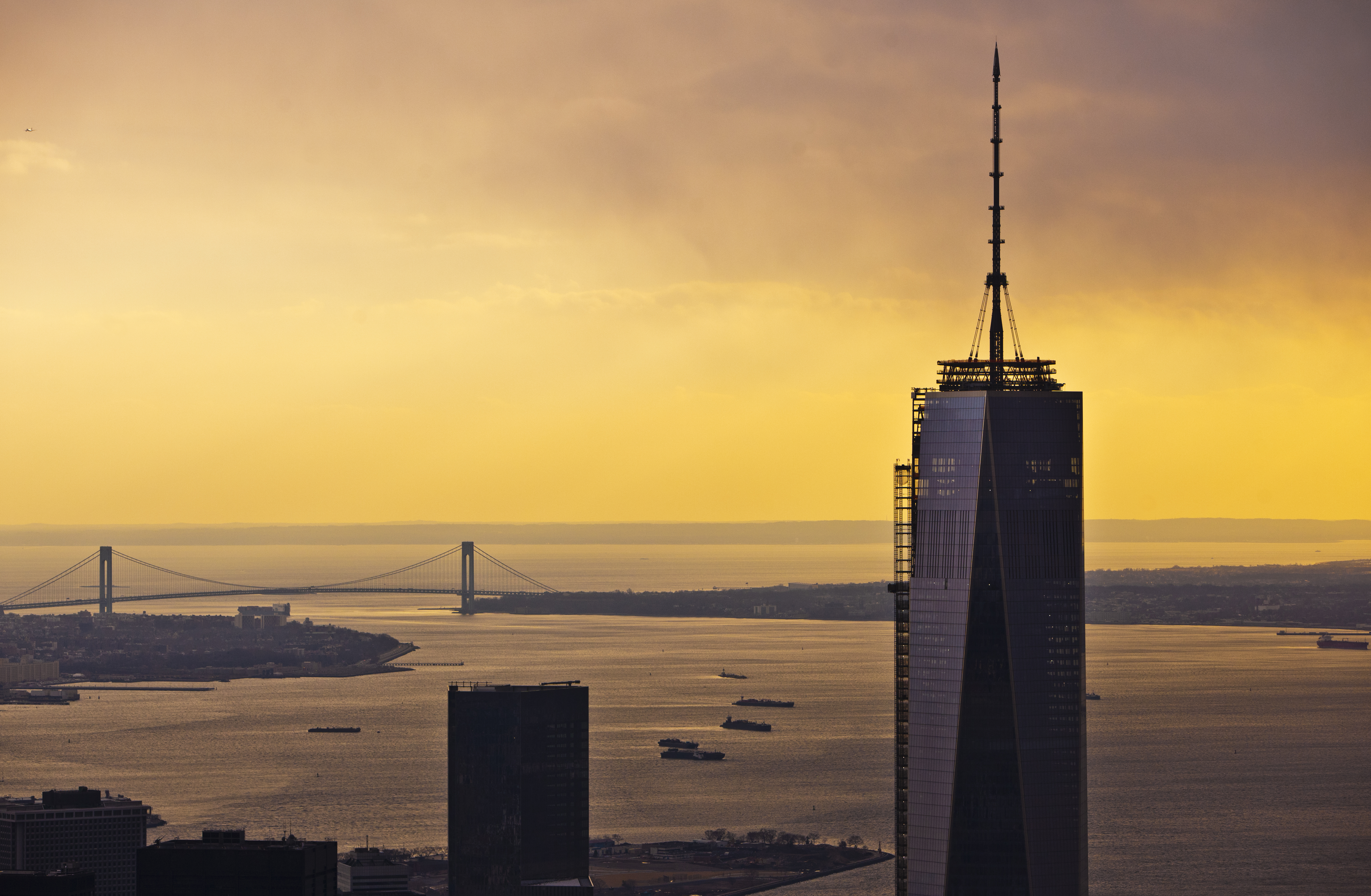
One World Trade Center: 1,776 Feet of Defiance
President Barack Obama picked up a marker on a visit to the construction site in June 2012 and wrote on a steel beam that would be hoisted to the top of the rising tower: "We remember, we rebuild, we come back stronger!" The sentence captured what One World Trade Center was always meant to be -- not just a skyscraper but an argument, a 1,776-foot declaration that the skyline would not stay broken. That symbolic height in feet matches the year the Declaration of Independence was signed, a detail the architects embedded deliberately into a building that took thirteen years of political fights, insurance disputes, design feuds, and an estimated three billion dollars to complete. Today it stands on the northwest corner of the World Trade Center site, the tallest building in the United States, the tallest in the Western Hemisphere, and the seventh-tallest in the world.
Before There Was a Tower, There Was a Hole
The original World Trade Center was conceived as an urban renewal project spearheaded by David Rockefeller and planned by the Port Authority of New York and New Jersey. Architect Minoru Yamasaki designed the twin towers as framed tube structures, each rising over 110 stories. Construction of the North Tower began in August 1966, and its first tenants moved in by October 1971, when it briefly held the title of tallest building in the world. The entire seven-building complex held a combined total of millions of square feet of office space. At 8:46 a.m. on September 11, 2001, five hijackers crashed American Airlines Flight 11 into the North Tower's northern facade. After burning for 102 minutes, the tower collapsed at 10:28 a.m. Together with the simultaneous attack on the Pentagon, the crash of United Airlines Flight 93 in Shanksville, Pennsylvania, and the collapse of the South Tower, the attacks killed 2,996 people. In the year that followed, the Ground Zero site became the most visited place in the United States.
The Freedom Tower That Changed Its Name
Debate over what to build began almost immediately. By 2002, the Lower Manhattan Development Corporation organized a design competition, and in February 2003, Daniel Libeskind's "Memory Foundations" plan was selected. Libeskind envisioned an asymmetrical tower with aerial gardens, windmills, and an off-center spire that would line up with the Statue of Liberty. David Childs of Skidmore, Owings & Merrill was hired to execute the design, and the two architects clashed -- Childs favoring symmetry, Libeskind favoring drama. After months of dispute, a preliminary design for the "Freedom Tower" was announced on December 19, 2003. A symbolic cornerstone was laid on July 4, 2004, but actual construction stalled until 2006 due to fights over money, security, and design. In 2009, the Port Authority quietly changed the building's name from "Freedom Tower" to "One World Trade Center," calling it "the easiest for people to identify with." Real estate agents agreed: it was simply easier to lease office space at a traditional street address than at a patriotic slogan.
Rising from Bedrock
Construction began in earnest when explosives cleared bedrock for the foundation and concrete was poured through 2007. A first steel beam was signed by members of the public at a December 2006 ceremony in Battery Park City and welded to the building's base the next day. Two cranes arrived in January 2008, and an advanced "cocoon" scaffolding system -- the first of its kind on a steel structure in New York City -- was installed to protect workers from falls. By December 2010, the tower had reached 52 floors. By the tenth anniversary of the September 11 attacks, it had grown to 80 floors. In April 2012, it surpassed the Empire State Building to become the tallest structure in New York City by roof height. The steel structure topped out at 94 physical stories in August 2012. The spire, shipped from Quebec, was installed in sections through early 2013. On May 10, 2013, the final piece was lifted into place, bringing the tower to its full height of 1,776 feet. The Council on Tall Buildings and Urban Habitat confirmed the structure as the tallest building in the United States.
Geometry of Resilience
The finished tower is a study in deliberate geometry. It sits on a square footprint nearly identical to those of the original Twin Towers. A windowless concrete base rises 20 stories, designed to withstand truck bombs and ground-level attacks -- a feature that drew criticism from some architects who called it fortress-like. New York Times critic Nicolai Ouroussoff labeled the base a "grotesque attempt to disguise its underlying paranoia." From the 20th floor upward, the square edges chamfer back, shaping the building into eight isosceles triangles. At the midpoint, the cross-section forms a perfect octagon. At the top, a glass parapet completes the rotation: a square oriented 45 degrees from the base. The building earned LEED Gold Certification for its sustainable features, including phosphoric acid fuel cells generating 4.8 megawatts of power, rainwater harvesting for cooling systems, ultra-clear glass that maximizes daylight, and automatic lighting dimmers. The observation deck on the 100th floor -- operated by Legends Hospitality -- offers the highest vantage point in New York City.
A Skyline Restored
One World Trade Center opened on November 3, 2014. Conde Nast became its anchor tenant, occupying floors 20 through 44. The New York Times noted that the neighborhood around the World Trade Center had transformed from a purely financial district into a mixed-use area of tech firms, residences, and luxury shops. By March 2022, the building was 95 percent leased -- a higher occupancy rate than before the COVID-19 pandemic, and notably higher than the original Twin Towers ever achieved before the September 11 attacks. Critics remain divided on the architecture. Michael Kimmelman of the New York Times called it "opaque, shellacked, monomaniacal." Blair Kamin of the Chicago Tribune called it "a bold but flawed giant." Architectural Digest, in 2024, wrote that "when viewing One World Trade Center from a relatively close distance, it becomes an event." The building's central spire draws visual lineage from the Empire State Building and the Chrysler Building. Workers left post-9/11 graffiti on steel beams during construction -- messages of rebirth and resilience that are now sealed inside the walls of the tallest building in the Western Hemisphere.
From the Air
One World Trade Center (40.7131N, 74.0133W) dominates the Lower Manhattan skyline from every approach. At 1,776 feet including its spire, it is the tallest building in the Western Hemisphere and unmistakable from the air. The tower sits on the northwest corner of the World Trade Center site, with the 9/11 Memorial reflecting pools visible directly to the south and the wing-shaped Oculus transportation hub to the east. Nearby airports: KEWR (Newark Liberty, 14km W), KJFK (John F. Kennedy, 22km SE), KLGA (LaGuardia, 14km NE). Best viewed at 3,000-6,000 feet AGL approaching from the south over New York Harbor, where the tower rises in alignment with the Statue of Liberty -- a sightline the architects intentionally preserved. The building's octagonal mid-section and glass spire are most dramatic when sunlight catches the facade from the west in late afternoon.