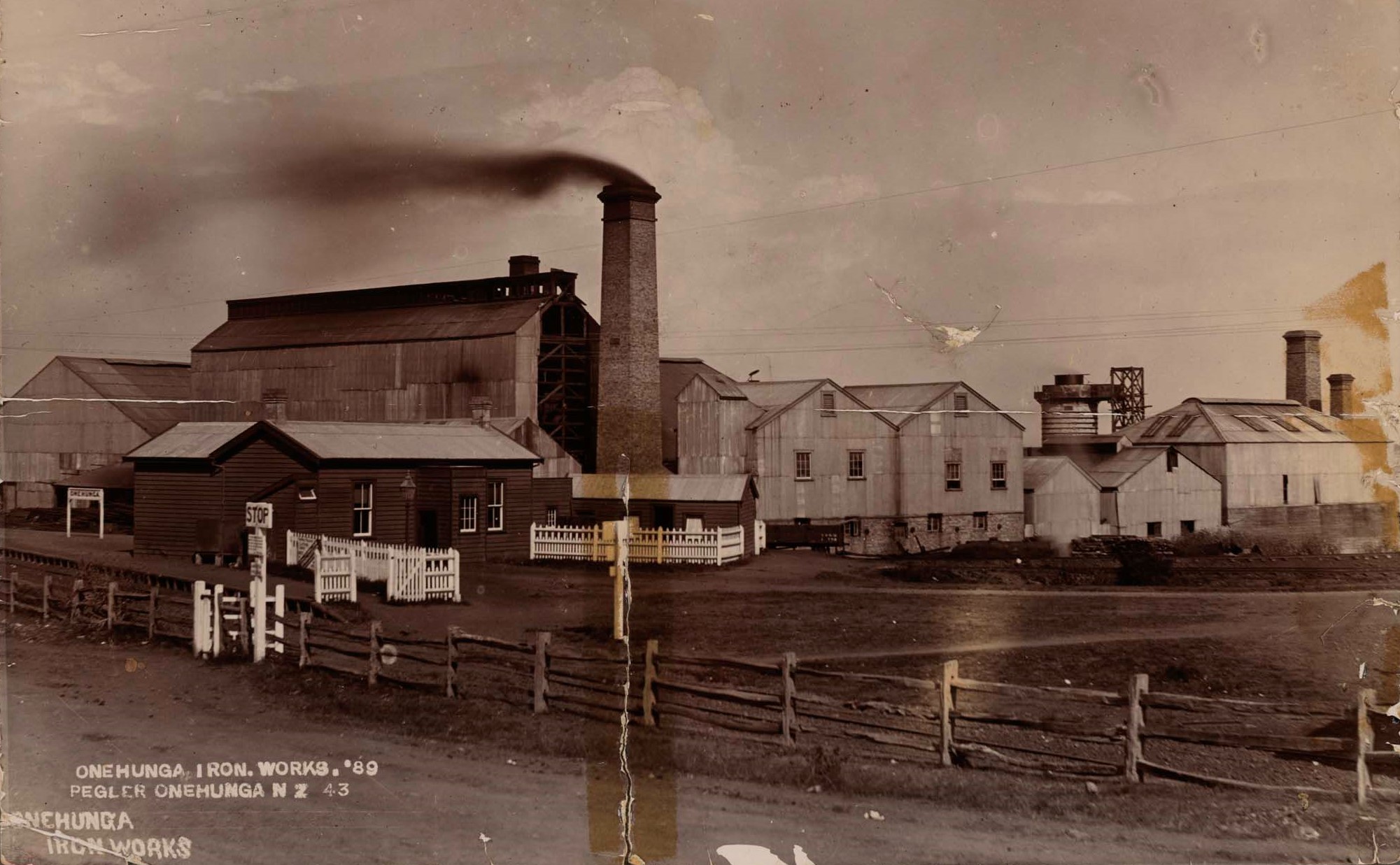
Onehunga Ironworks
On 27 February 1883, the first billets of wrought iron smelted from New Zealand's black iron-sand emerged from a furnace at Onehunga, on the southern shore of Auckland's Manukau Harbour. It was a triumph seventy years in the making. Captain James Cook had recorded the dark sands of the North Island's west coast during his first voyage in 1769, and geologists had spent decades cataloguing the titanomagnetite mineral locked within them. Turning that mineral into iron, however, proved far harder than finding it. The Onehunga Ironworks would spend twelve years wrestling with the problem before falling silent for good.
Black Sands, Bright Ambitions
The raw material was staggering in scale. Vast deposits of iron-sand stretch over 480 kilometres of the North Island's coast, from Kaipara Harbour down to Whanganui, concentrated by rivers, currents, and wind into dark ribbons along beaches and dunes. The Japanese had smelted similar iron-sand for centuries in their tatara furnaces, producing small batches of tamahagane steel for sword-making. But nobody had managed the trick at industrial scale. Before Onehunga, the most notable attempt was the New Zealand Titanic Steel and Iron Company, which erected a blast furnace at Te Henui near New Plymouth. It failed. Entrepreneur John Chambers travelled to England and America in 1876, shopping the iron-sand to sceptical ironmakers. None were interested, but in America he discovered a furnace design patented by Joel Wilson of Dover, New Jersey, which claimed to produce wrought iron from iron-sand through direct reduction. Chambers bought the New Zealand patent rights and staked everything on Wilson's design.
The Ironmaster's Crime
Wilson's furnace was ingenious, combining three processes within a single structure fired by one grate: iron-sand mixed with fine coal was heated to red heat, reduced to sponge iron, then puddled into wrought iron. Under the works' first ironmaster, a man named Jones, the process actually worked. But Jones was convicted and sentenced to fourteen years in prison in April 1884, and nobody who replaced him could replicate his results. Three successive ironmasters tried and left, two of them citing ill health. The fundamental problem was incomplete reduction: grains of partially processed iron-sand became trapped in the finished metal, making it hard and brittle. By November 1886, the company had run through all its capital and accumulated liabilities of twenty thousand pounds. The shareholders refused to invest further, and the mortgagee seized the assets.
The Man from Lithgow
New owners Thomas and Samuel Morrin brought in Enoch Hughes, an experienced but controversial ironman from the Eskbank Ironworks at Lithgow in New South Wales. Hughes had left Eskbank under bitter circumstances and had been blamed for a failed blast furnace at Mittagong. What he did know was rolling mills. Within months of arriving in 1887, he had the bar mill running and produced at least 400 tons of iron bars, mostly from scrap iron already on hand. Skilled workers arrived from Pennsylvania to operate a new sheet mill for corrugated iron. Hughes then turned his attention to the problem everyone else had failed to solve. He built a blast furnace 45 feet tall, 16 feet in external diameter, with a steam winch to lift raw material to a 26-foot platform at the top. In July 1890, it produced its first pig iron, but apparently from conventional ore rather than iron-sand. When the furnace cooled in September, ostensibly due to coal shortages from a miners' strike, the real reason was simpler: Hughes had built a furnace that could not smelt iron-sand. He quietly tried to sell his shares and returned to Australia.
Last Light at Onehunga
By 1891, the Onehunga Works was claimed to be the largest ironworks in the Southern Hemisphere, a distinction earned by accumulating equipment rather than profits. Thomas Heskett took over as manager and trialled smelting limonite ore from Onekaka in Golden Bay. His grandson John would later establish the Onekaka Ironworks, which ran from 1924 to 1935 using conventional blast furnace technology. At Onehunga, the works limped along, reopening and closing as each new scheme ran aground. In January 1894 the workforce was dismissed. A group of ironworkers from Lithgow, sent across the Tasman by their employer William Sandford because his own mill was short of orders, reopened the plant as a cooperative. They survived by rolling scrap iron into bars, but struggled to find enough scrap. One by one, the Lithgow men drifted home. By August 1895, the Onehunga Ironworks shut down for the last time.
The Seed That Took a Century
The works were sold in 1899. Equipment was auctioned in 1903, and the site was partially demolished, though its tall brick chimney still stood as late as the 1960s. By the 1940s, the site housed Duroid Products, and today no trace of the ironworks remains. But the direct-reduction principle that Onehunga had pioneered in 1883 turned out to be the right idea pursued with the wrong technology. In the 1950s, the Department of Scientific and Industrial Research developed a commercially viable process that used direct reduction of an iron-sand and coal mixture, with the resulting sponge iron melted in an electric arc furnace. That process became the foundation of New Zealand Steel, the modern steel industry of New Zealand. The ironworkers at Onehunga never knew it, but they had been running the first rough draft of a process that would take another seven decades to perfect.
From the Air
Located at 36.93°S, 174.79°E in Onehunga, a southern Auckland suburb on the Manukau Harbour. The ironworks site was adjacent to the original Onehunga railway station; no structures remain today. Nearby airports: Auckland International (NZAA) approximately 8 km south, Ardmore (NZAR) 20 km southeast. Recommended viewing altitude: 2,000-3,000 ft for context of Manukau Harbour's industrial shoreline. The dark iron-sand beaches that supplied the works are visible along the North Island's western coast.