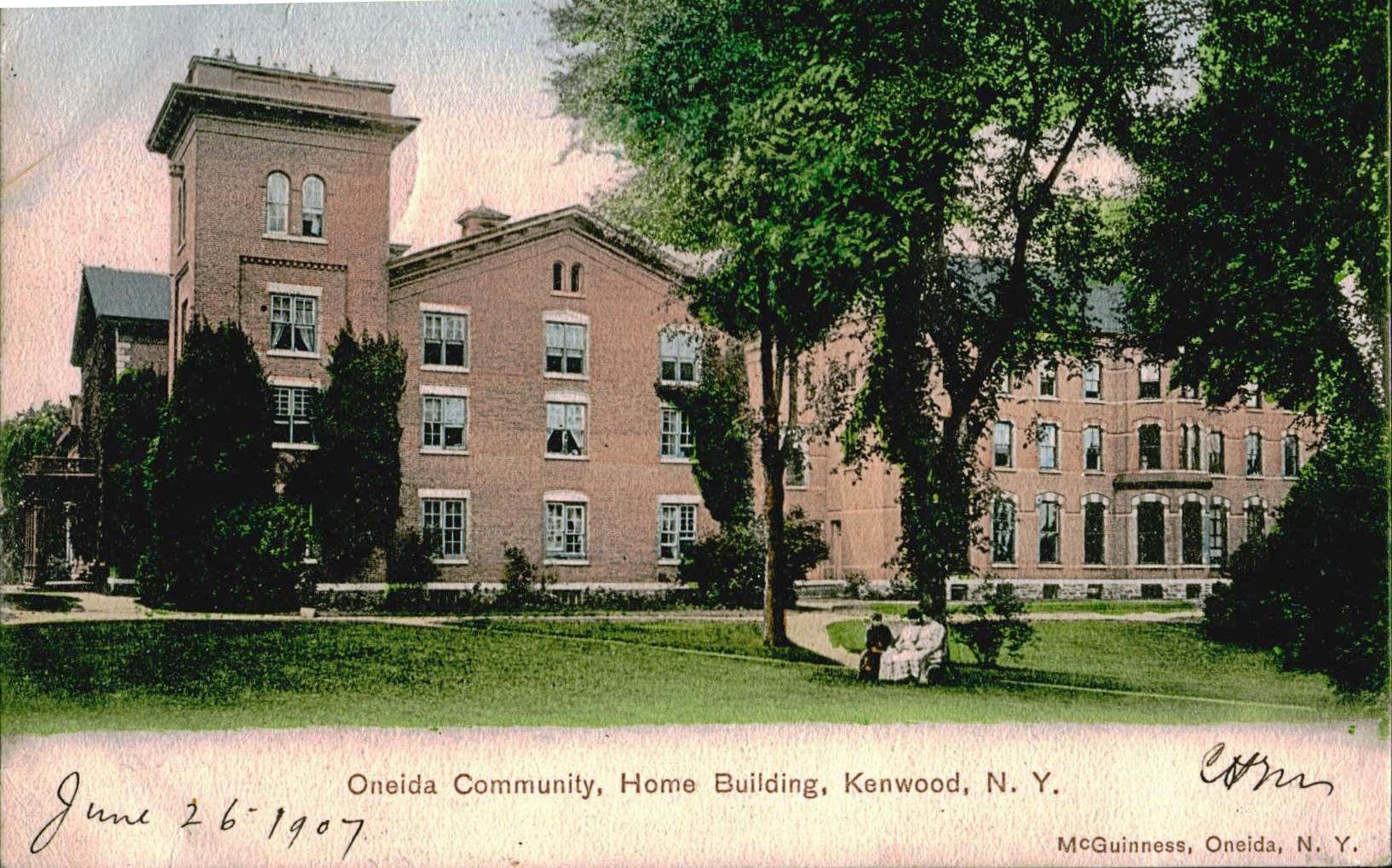
Oneida Community
Charles Guiteau spent five years at the Oneida Community before leaving in frustration. He would later assassinate President James Garfield. It is a strange footnote to an already strange story -- a Christian commune in the rolling hills of central New York where 300 people shared property, work, and sexual partners under a system they called "Bible communism." Founded in 1848 by John Humphrey Noyes, the Oneida Community was one of the most radical social experiments in American history. When it finally collapsed in 1881, its members did what any good utopians would do: they formed a joint-stock corporation and started selling silverware.
A Fugitive's Fresh Start
John Humphrey Noyes was a Yale-trained theologian with a conviction that would get him run out of Vermont: he believed Jesus had already returned in AD 70, and that perfection -- freedom from sin -- was achievable in the here and now. In Putney, Vermont, Noyes gathered followers who lived communally and practiced what he called "complex marriage," where any member could have sexual relations with any consenting other. When Vermont authorities charged Noyes with adultery, he fled. In March 1848, he and his followers arrived at a 160-acre farmstead near Oneida Creek in Madison County, New York. The land had been purchased by Jonathan Burt, an early convert, on territory the State of New York had acquired from the Oneida Indian Nation in agreements made in 1840 and 1842. The group began with 87 members. By 1878, they numbered 306.
The Machinery of Utopia
For a community that never exceeded 300 souls, Oneida ran with remarkable bureaucratic precision: 27 standing committees and 48 administrative sections governed daily life. Members rotated through unskilled labor -- fieldwork, housekeeping, cooking -- while specialists held permanent posts like financial manager. The community manufactured steel animal traps (invented by member Sewell Newhouse), wove palm frond hats, built rustic garden furniture, and welcomed tourists curious about their unusual arrangements. By 1870, Oneida employed approximately 200 outside workers. Silverware manufacturing began in 1877, relatively late in the community's life, but it would prove to be their most enduring enterprise. The practice of "mutual criticism" kept social order: any member could be summoned before a committee or the full community and subjected to frank assessment of their character flaws. The goal was spiritual improvement, though the experience could be searing.
Radical Arrangements
Oneida's sexual practices scandalized 19th-century America and fascinate historians to this day. Complex marriage meant no exclusive pairings; possessiveness was frowned upon. Noyes developed a system of "male continence" -- a form of birth control through coitus reservatus -- that proved remarkably effective: only twelve unplanned births occurred among roughly 200 adults over twenty years. In 1869, Noyes introduced "stirpiculture," a selective breeding program where a committee approved parenting matches based on spiritual and moral qualities. Fifty-three women and thirty-eight men participated; the experiment produced 58 children, nine fathered by Noyes himself. Children were raised communally in a dedicated wing of the Mansion House from about age one. Parents could visit, but if bonds grew too close, enforced separations followed. Women at Oneida wore functional Bloomer-style clothing, kept their hair short, participated in business decisions, and had their sexual satisfaction explicitly recognized as important -- radical positions for the era.
The Unraveling
The community's decline began when Noyes tried to pass leadership to his son Theodore, an agnostic who lacked his father's charisma. Internal factions emerged. Younger members, raised in the community, increasingly wanted traditional marriages. Professor John Mears of nearby Hamilton College organized forty-seven clergy members in protest against Oneida's practices. In June 1879, Noyes learned that a warrant for his arrest on charges of statutory rape was imminent. He fled to Canada in the middle of the night and never returned to the United States. From exile, he wrote to his followers recommending that complex marriage be abandoned. It was, that same year. Over seventy members entered traditional marriages, typically with whomever they were cohabiting at the time. One breakaway faction, led by James W. Towner, moved to California and helped create Orange County.
From Commune to Corporation
In 1881, the community reorganized as Oneida Community Limited, a joint-stock company. The trap business was sold in 1912, silk in 1916, canning discontinued in 1915. What remained was silverware -- and it thrived. Oneida Limited became one of the world's largest cutlery producers. In 1947, Noyes's embarrassed descendants burned many of the community's records. The last original member, Ella Florence Underwood, died in 1950 at the age of 100 in nearby Kenwood, New York. The Mansion House, a sprawling complex of five buildings on a 33-acre site continuously occupied since 1848, was designated a National Historic Landmark in 1965. Today it operates as a nonprofit museum with guided tours, residential apartments, and meeting spaces. Oneida Limited, meanwhile, ceased all U.S. manufacturing in 2005, ending a 124-year tradition. The silverware is still sold, but it is made overseas now. The utopia is long gone, but the forks endure.
From the Air
Located at 43.06N, 75.61W in Madison County, central New York. The Oneida Community Mansion House complex sits on a 33-acre site near Oneida Creek, visible as a cluster of large Victorian-era buildings surrounded by open land. Nearest airports: Griffiss International Airport (KRME) in Rome, NY approximately 15nm northeast; Syracuse Hancock International Airport (KSYR) approximately 25nm west. The terrain is gently rolling farmland in the Mohawk Valley at approximately 450ft elevation. Best viewed at 2,000-3,000ft AGL for context of the site within the surrounding countryside.