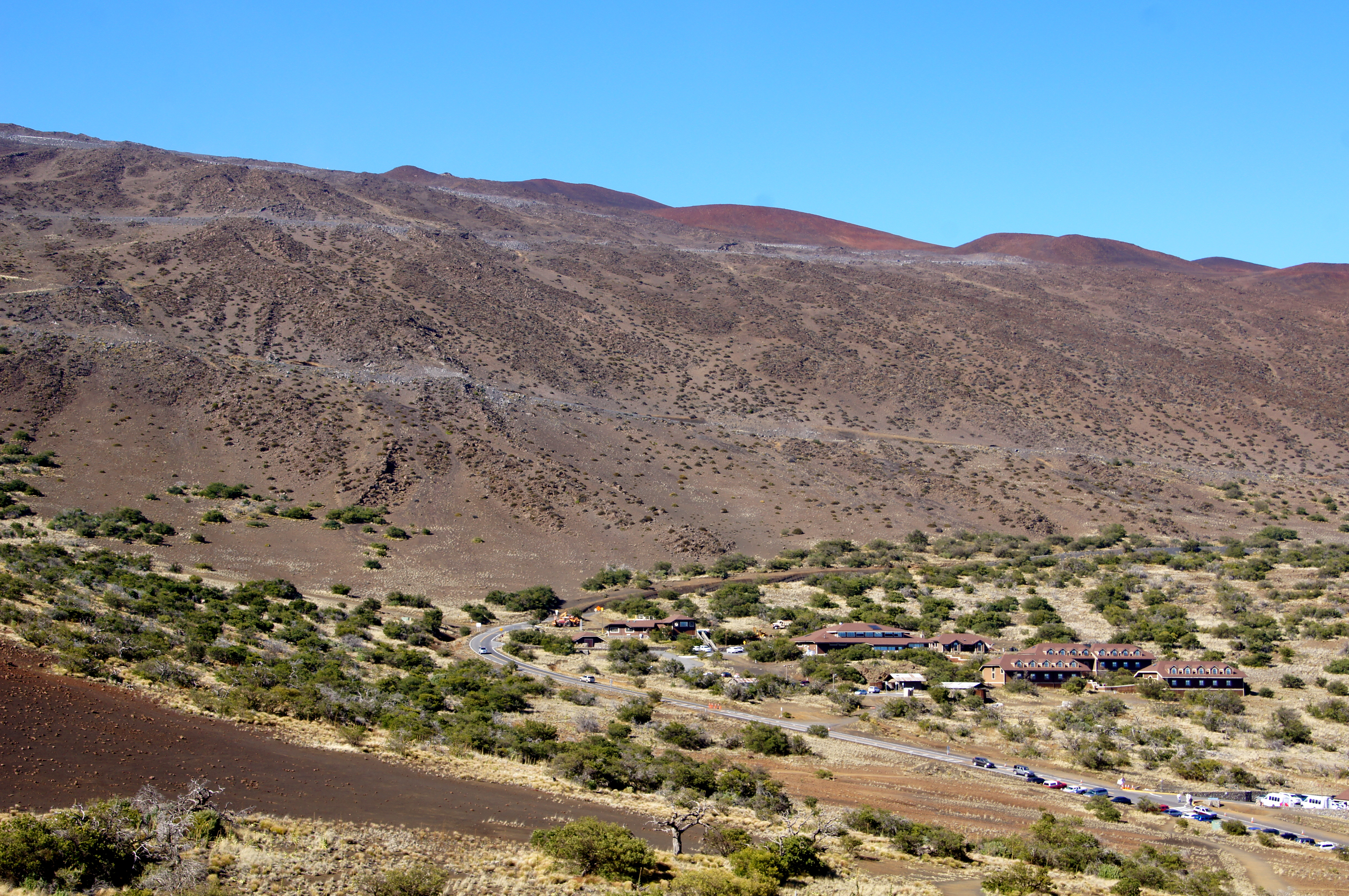
Onizuka Center for International Astronomy
Before you can look through the most powerful telescopes on Earth, you have to learn to breathe. Hale Pohaku, the "stone house" perched at roughly 9,200 feet on Mauna Kea's southern slope, exists because the human body cannot safely leap from sea level to nearly 14,000 feet without pause. Astronomers arriving for summit observations typically spend up to 24 hours here, eating in the cafeteria, sleeping in the dormitories, letting their blood adjust to the thinning air. The facility is named for Ellison Onizuka, the Big Island native and NASA astronaut who died in the Challenger disaster in 1986, and it operates as both a practical base camp for one of the world's great observatory complexes and a place where visitors can touch the edges of professional astronomy without climbing all the way to the top.
From Hunting Cabins to Base Camp
The site's history predates the telescopes by decades. In the 1930s, the Civilian Conservation Corps built a few rustic cabins on Mauna Kea's slopes for hunters tracking feral game across the volcanic landscape. The name Hale Pohaku, meaning "stone house" in Hawaiian, stuck long after the original structures were replaced. In 1964, Governor John A. Burns authorized a rough jeep trail up the mountain, and a small test telescope confirmed what atmospheric scientists had suspected: Mauna Kea's summit offered some of the finest astronomical seeing conditions on the planet. Through the 1970s, the area served as a construction camp for the observatories rising above. The road was realigned in 1975, and in 1983 the current permanent complex was built, creating the Mid-Level Facility that astronomers and technicians know today. It houses dormitories with sleeping accommodation for 72, a cafeteria, laundry facilities, and a common room.
The Astronomer's Day in Reverse
Life at Hale Pohaku runs on an inverted clock. Scientists work at the summit during the night and return to sleep during the day, while construction crews and tour groups are restricted to daylight hours. The three populations, astronomers, maintenance workers, and visitors, are kept deliberately separate. A construction workers' camp sits below the visitor station, buffered by enough distance to keep daytime noise from disturbing sleeping observers. Originally, every astronomer had to be physically present for their allocated telescope time. That changed as remote observing technology matured. By 2002, the W. M. Keck Observatory reported that 90 percent of its observations were conducted remotely, many from its facility in Waimea on the plateau north of the mountain, and some from as far away as California. First-time users are still encouraged to visit the summit in person, but the physical presence that once defined observational astronomy has become optional.
Where Visitors Meet the Sky
Just below the support complex, a Visitor Information Station offers something rare: a taste of the Mauna Kea experience without the danger of altitude sickness or the need for a four-wheel-drive vehicle. The station houses displays on the history of the observatories, the geology and ecology of the mountain, and the cultural significance of Mauna Kea to Native Hawaiians. On clear evenings, staff or volunteers lead star tours, tracing constellations with a small laser pointer against a sky already far darker and steadier than anything visible from lower elevations. Amateur astronomers bring their own telescopes to take advantage of conditions that, even at 9,200 feet, surpass most observing sites on the mainland. The visitor station marks the end of the paved road. Beyond it, the summit road turns to steep, winding gravel, and visitors are advised to acclimatize for at least 30 minutes, ideally several hours, before attempting the final climb.
A Name That Carries Weight
The center's formal name honors Ellison Onizuka, who grew up in Kealakekua on the Big Island and became the first Asian American and the first person from Hawaii to reach space. He flew on the Space Shuttle Discovery in January 1985 before perishing aboard Challenger on January 28, 1986. A small museum dedicated to Onizuka once operated at Kona International Airport, though it was scheduled to close in March 2016. The Imiloa Astronomy Center in Hilo, on the University of Hawaii at Hilo campus, offers a larger museum and planetarium for visitors seeking a more accessible introduction to the science conducted on the mountain above. But Hale Pohaku remains the place where the name is most meaningful, where the facility that bears it serves the same purpose Onizuka himself embodied: bridging the distance between the ground and the sky.
From the Air
Located at 19.761N, 155.456W on the southern slope of Mauna Kea, Big Island of Hawaii, at approximately 9,200 feet elevation. The complex is visible below the summit observatory cluster, along the access road that climbs from Saddle Road (Route 200). Nearest airports: Ellison Onizuka Kona International at Keahole (PHKO) about 30 nm west-southwest, Hilo International (PHTO) about 25 nm east. The facility sits below the typical trade wind inversion layer, so cloud cover is common at this elevation.