The Iron Wanderer: A Floating Dock's Sixty-Year Odyssey
Seventeen firms bid on the contract. On February 3, 1863, the Dutch ministry of the navy opened the tenders in The Hague, and the proposals ranged from 366,685 guilders to a staggering 695,700 -- offered by Randolf Elder of Glasgow, who apparently misread the room. Van Vlissingen en Dudok van Heel won with the lowest bid, and so began one of the more improbable construction projects of the colonial era: an iron floating dry dock, built in Amsterdam on a bed of compacted factory ash, assembled just enough to prove it worked, then taken apart and shipped to the other side of the world. The Onrust Dock of 3,000 tons would spend the next sixty-odd years being towed from island to island across the Dutch East Indies, serving whichever port needed it most and whichever war demanded its attention.
Why an Iron Dock Changed Everything
The introduction of screw-propelled ships in the mid-19th century created a problem that wooden docks could not solve. Traditional methods of ship maintenance required hauling vessels ashore, but even the slightest deformation of a screw ship's hull could jam the propeller axle -- a risk that made beaching unacceptable. In a floating dry dock, the ship rested on its keel, the hull stayed true, and an inspection that once took days could be completed in one. By the 1850s the Dutch East Indies had two wooden floating docks, one at Onrust Island near Batavia and another at Surabaya, but neither could handle the navy's largest warships. The wooden dock at Surabaya struggled to receive Groningen-class corvettes of 1,780 tons. A bigger, iron dock was not a luxury. It was a necessity -- one that would define the colony's naval capability for decades.
Built on Ash, Shipped in Pieces
Van Vlissingen en Dudok van Heel chose an unconventional building site: a patch of ground between their boiler factory and their warehouses, where years of dumped bottom ash had formed a layer two meters deep. Workers compacted this industrial residue into a foundation solid enough to support the dock's construction, though part of it sagged under the weight. A network of railroad tracks with turntables connected the site to the firm's workshops, ferrying iron plates supplied by the Belgian firm Societe des hauts-fourneaux de Marcinelle et Couillet. The dock was assembled in Amsterdam but not fully riveted -- the plan was always to take it apart and ship it to the Indies for final construction. A lavish brass model, complete with functioning steam engine miniatures, pumps, piping, and thousands of drilled rivet holes, was built as a gift for the principal. In 1867 this model represented the Netherlands at the International Exposition in Paris, where the French Vice Admiral Edmond Paris noted it as the largest piece in the Dutch section. That model now resides in the Rijksmuseum, restored in the 1990s after decades in storage.
A Dock That Never Stayed Put
The dock's career reads like a shipping itinerary. It arrived at Surabaya in pieces, was assembled and tested there on October 3, 1869, then towed to Onrust Island on October 27 by the warship Timor and two tugboats. For a decade it served at Onrust, docking everything from the corvettes it was designed for to commercial steamers needing emergency screw repairs. In 1877 a complicated swap began: three steamships towed the old wooden dock from Onrust to Surabaya, then returned with the iron dock. By 1891 it was towed to Tanjung Priok, Batavia's new harbor, where the entrepreneur David Croll leased it for 6 percent of its book value to establish a private repair yard. There it worked furiously -- 76 ships in 1893, 85 in 1894, and in 1895 an almost impossible 83 ships across 385 docking days, averaging more than one ship per day. When a newer 4,000-ton dock arrived, the old workhorse was towed back to Surabaya in 1896 for its own repairs.
The Aceh War and Sabang's Strategic Harbor
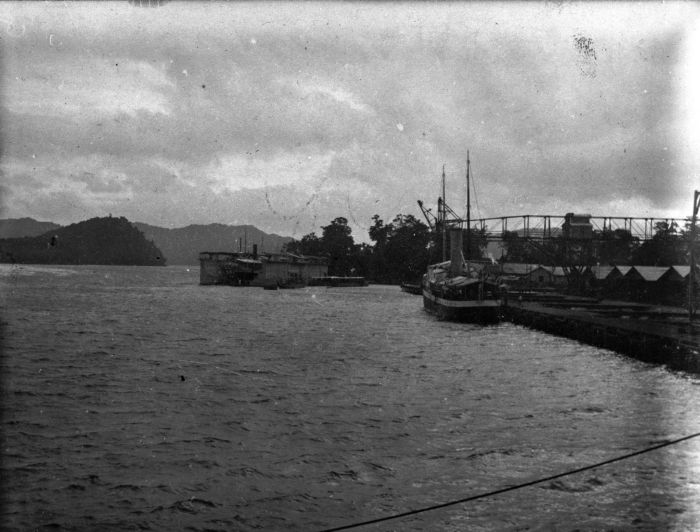
The dock's final major posting was Sabang, a harbor at the northern tip of Sumatra. The logic was military: the Aceh War, a brutal colonial conflict that dragged on from 1873 to 1914, required the Dutch to maintain warships far from their main bases. Sending vessels 2,500 kilometers from Aceh to Batavia for a routine hull inspection was prohibitively expensive and left ships out of action for weeks. Sabang offered a forward base, and Onrust Dock of 3,000 tons, though aging and too small for the navy's largest cruisers, could handle the smaller warships conducting operations along Aceh's coast. The dock arrived at Sabang in 1898 and was leased to the commercial company Zeehaven en Kolenstation Sabang from 1900 onward. By 1910 the navy had written it off for demolition, but the company kept it running. Even after a new 5,000-ton dock arrived in 1924, the old iron dock lingered, reportedly still operational as late as 1933 -- over six decades after its first trial run at Surabaya.
Ninety Meters of Forgotten Engineering
At 90 meters long with a beam of 24 meters and a height of 10.55 meters, the Onrust Dock was a substantial piece of industrial engineering for its era. Its interior narrowed toward the floor, where the width was 14.55 meters, then widened to 18 meters at the top of the side walls. Two Cornish steam engines powered the pumps that emptied the dock, and the structure could be divided into three independent sections, each with its own pumping capacity -- a design that allowed partial submersion and flexible operation. The dock consumed about 2.5 tons of coal per docking. None of this was revolutionary by European standards, but in the colonial context it was transformative: it gave the Dutch East Indies a self-contained ship repair capability that could be positioned wherever strategic need demanded. The dock was not a building. It was infrastructure that floated, and that distinction made it indispensable across an archipelago of 17,000 islands where the nearest European shipyard was months away by sea.
From the Air
Onrust Island is located at approximately 6.03S, 106.73E in the Bay of Jakarta, part of the Thousand Islands (Kepulauan Seribu) chain visible northwest of Jakarta's waterfront. The island itself is small and largely archaeological today. Nearest major airport is Soekarno-Hatta International (WIII/CGK), approximately 15 km to the southwest. From the air, the Thousand Islands scatter northward into the Java Sea as a chain of low coral islands. Best viewed at medium altitude where the archipelago pattern is clear against the turquoise shallows.