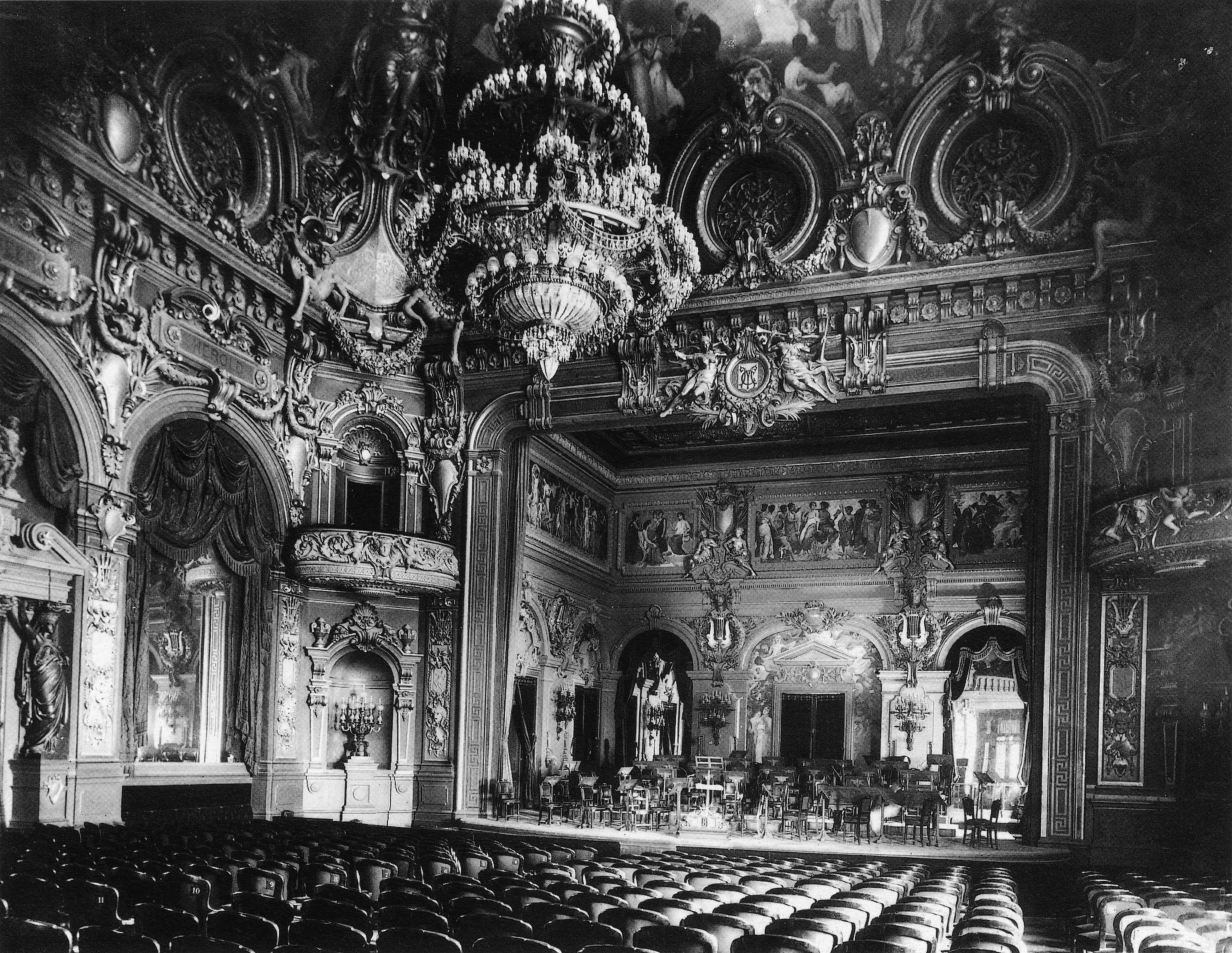
Opera de Monte-Carlo
Sarah Bernhardt appeared dressed as a nymph. It was 25 January 1879, and the hall that would become one of Europe's most storied opera houses was being inaugurated not with an opera but with a performance by the most famous actress in France. The first opera, Robert Planquette's Le Chevalier Gaston, followed two weeks later on 8 February. Charles Garnier, the architect who had spent fourteen years on the monumental Paris Opera, had designed this intimate theater in just eight and a half months -- a jewel box hidden inside the Monte Carlo Casino.
A Casino's Concert Hall
In the 1870s, Monaco offered its wealthy visitors gambling and little else. Prince Charles III and the Societe des Bains de Mer decided the casino needed cultural diversions, and they commissioned Garnier to add a concert hall. The main entrance opened from the casino floor; Charles III maintained a private entrance on the western side. The Salle Garnier seats only 524 -- a fraction of the nearly 2,000 capacity of its Parisian cousin -- but Garnier lavished the same ornate style on the smaller space. Many of the same artists worked on both theaters, including the painter Gustave Boulanger. Although the hall was not originally intended for opera, it was soon pressed into service for that purpose and was remodeled in 1898-99 by architect Henri Schmit to accommodate the demands of staged productions.
Gunsbourg's Sixty-Year Reign
The opera company's trajectory changed with two arrivals: Raoul Gunsbourg, who became director in 1892, and Princess Alice, the opera-loving American wife of Prince Albert I. Gunsbourg remained for sixty years, an astonishing tenure during which the Salle Garnier became a genuine force in the operatic world. He staged the premiere of Berlioz's La damnation de Faust in 1893 and brought the heroic Italian tenor Francesco Tamagno to Monte Carlo in January 1894 to reprise the title role in Verdi's Otello, which Tamagno had created at the opera's Italian premiere. In 1909, Gunsbourg presented the French-language version of Wagner's complete Ring of the Nibelung. Composers including Saint-Saens, Mascagni, and Puccini chose Monte Carlo for world premieres -- Puccini's La rondine debuted here in 1917.
Voices in a Small Room
The Salle Garnier's intimate scale meant that audiences heard the greatest voices of the twentieth century at close range. Nellie Melba and Enrico Caruso sang La boheme and Rigoletto here in 1902. Feodor Chaliapin created the title role in Massenet's Don Quichotte in 1910, part of a long association between the company and Massenet that continued with posthumous premieres of his works. Titta Ruffo, Geraldine Farrar, Mary Garden, Tito Schipa, Beniamino Gigli, and Lily Pons all performed on this tiny stage. Since its inauguration, the theater has hosted 45 world premiere productions of operas. Rene Blum founded the Ballets Russes de Monte-Carlo here, extending the hall's influence into dance.
Gala Nights and Quiet Seasons
Three times in its history, the opera house has been transformed into a spectacular gala dining venue: in 1966 for the centenary of Monte Carlo, hosted by Grace Kelly and Rainier III; for the royal wedding of Prince Albert II and Princess Charlene; and in 2013 for the Love Ball, a fundraiser organized by the Naked Heart Foundation. The golden age of lavish productions has passed -- small companies with small houses cannot mount the expensive spectacles that major opera houses offer -- but the Opera de Monte-Carlo still presents five or six operas each season. Garnier's original facade and much of his auditorium design survive intact, a reminder that this improbable theater, conceived as a casino amenity, became one of the most important operatic stages in Europe.
From the Air
Located at 43.74N, 7.43E, attached to the Monte Carlo Casino complex. The Salle Garnier's seaside facade is visible from the harbor approach. Nice Cote d'Azur Airport (LFMN) is 12 km west. Monaco Heliport (LNMC) nearby. Best viewed at 2,000-3,000 ft from the south over the Mediterranean.