Opera San Jose
Most opera companies hire singers for a production and send them home. Opera San Jose buys them apartments. Since 1988, the company has maintained a resident artist program modeled on the German Stadttheater tradition, identifying early-career singers, awarding them annual contracts, and housing them rent-free in company-owned apartment buildings in San Jose. It is a strikingly old-world arrangement in the heart of Silicon Valley, and it was the brainchild of a mezzo-soprano who had lived the European system herself.
The Mezzo Who Built a Company
Irene Dalis spent her performing career on the world's great stages, singing at the Metropolitan Opera and across Europe before returning to the Bay Area. In 1984, she founded Opera San Jose with a conviction that young American singers needed what European opera houses had always provided: sustained performance experience in a single company, with coaching from conductors and directors over multiple seasons, not scattered gig work. She directed the company for thirty years, stepping down in June 2014 at the age of 88 — she died later that December. By then, generations of artists had passed through her residency program and gone on to careers at larger houses. The company she built outlived the model that inspired it -- many German regional houses have since cut their own permanent ensembles.
A Vaudeville Palace Reborn
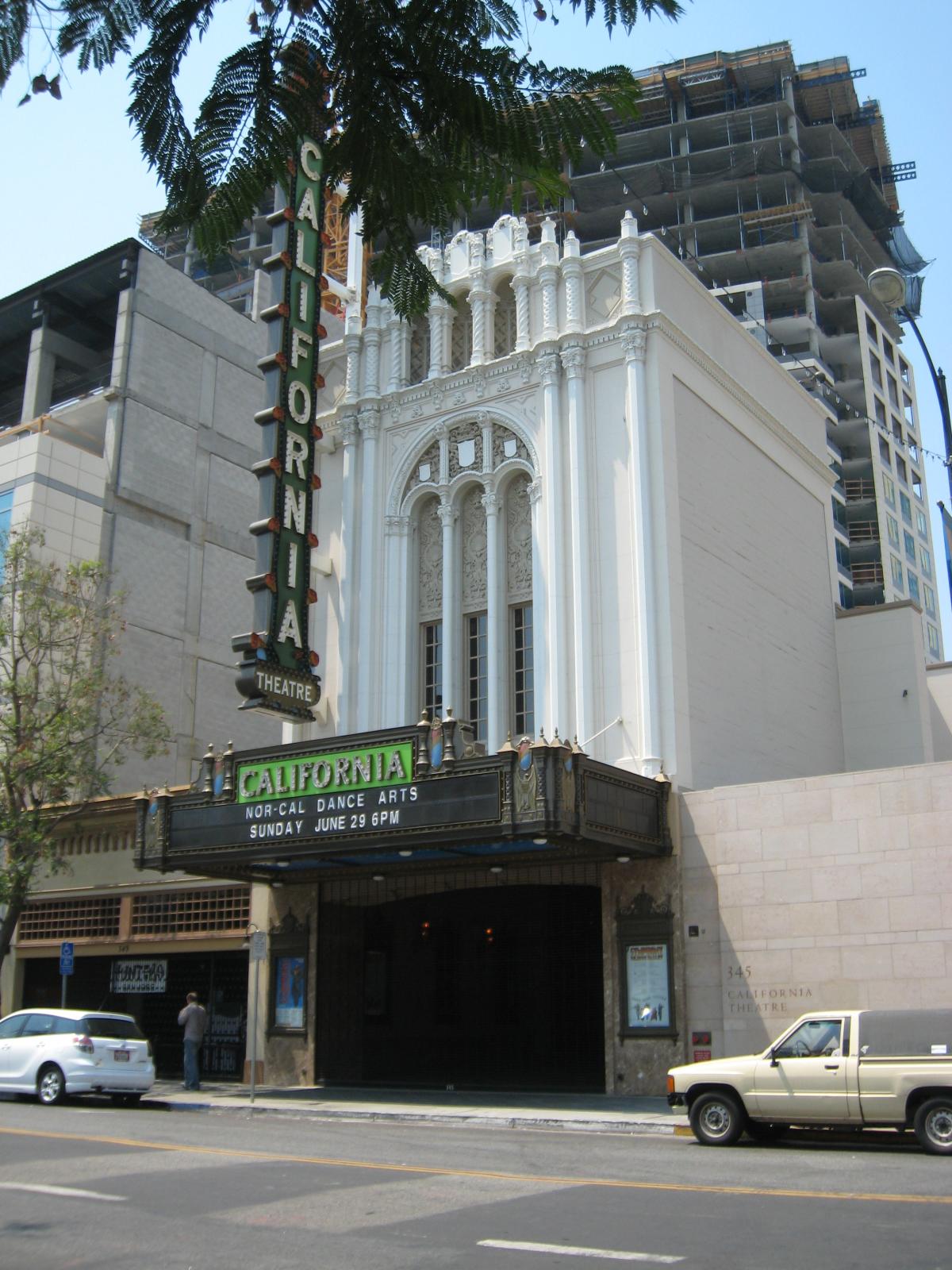
For its first two decades, Opera San Jose performed at the Montgomery Theater in the civic auditorium complex. Then, in 2004, the company moved into the California Theatre, a 1,100-seat house on South First Street that had opened in 1927 as a vaudeville and movie palace. The theater had been dark since 1973, its ornate interior deteriorating for nearly three decades before a restoration brought it back to life. The premiere season opened on September 18, 2004, and the fit was natural: an art form rooted in spectacle, inside a building designed for exactly that. The California Theatre became one of the most significant performing venues in the South Bay, its restored architecture lending the kind of visual grandeur that modern performing arts centers rarely achieve.
Pandemic, Pixels, and Persistence
When COVID-19 shut down live performance in 2020, Opera San Jose pivoted faster than most. In June of that year, the company unveiled the Heiman Digital Media Studio, a performance and film space funded by trustee Peggy Heiman in honor of her late husband Fred. On July 11, 2020, baritone Eugene Brancoveanu and conductor Christopher James Ray launched the digital series with Schumann's Dichterliebe -- streamed in English with Spanish and Vietnamese translations, a nod to San Jose's multilingual reality. Fully staged productions followed, including Jake Heggie's chamber opera Three Decembers featuring mezzo-soprano Susan Graham. The company turned a crisis into an experiment, reaching audiences who had never set foot in the California Theatre.
One Hundred Fifty Productions and Counting
By the time Opera San Jose tallied its history, the numbers told a story of quiet ambition: 150 productions, 64 titles, five world premieres. The repertoire has ranged from Mozart's Idomeneo, jointly produced with the Packard Humanities Institute in 2011, to the American premiere of child prodigy Alma Deutscher's Cinderella in 2017 and Jake Heggie's Moby-Dick in 2019. Educational outreach has exceeded 2,300 K-12 performances and 3,200 community programs for adults. In its last complete pre-pandemic season, the company reached approximately 113,000 people. Charity Navigator has given it four-star ratings for fiscal management. Funders include the city of San Jose, Applied Materials, the Hewlett Foundation, and the David and Lucile Packard Foundation -- Silicon Valley's corporate and philanthropic establishment lending its weight to an art form invented in Renaissance Florence.
From the Air
Located at 37.334N, 121.887W in downtown San Jose, at the California Theatre on South First Street. The theater is part of the dense downtown grid near the SoFA district, south of the I-280/US-87 interchange. Nearest airports: San Jose International (KSJC, 3nm NW), Reid-Hillview (KRHV, 5nm E), Moffett Federal Airfield (KNUQ, 8nm NW). The downtown cultural corridor is visible at 2,000-3,000 feet AGL.