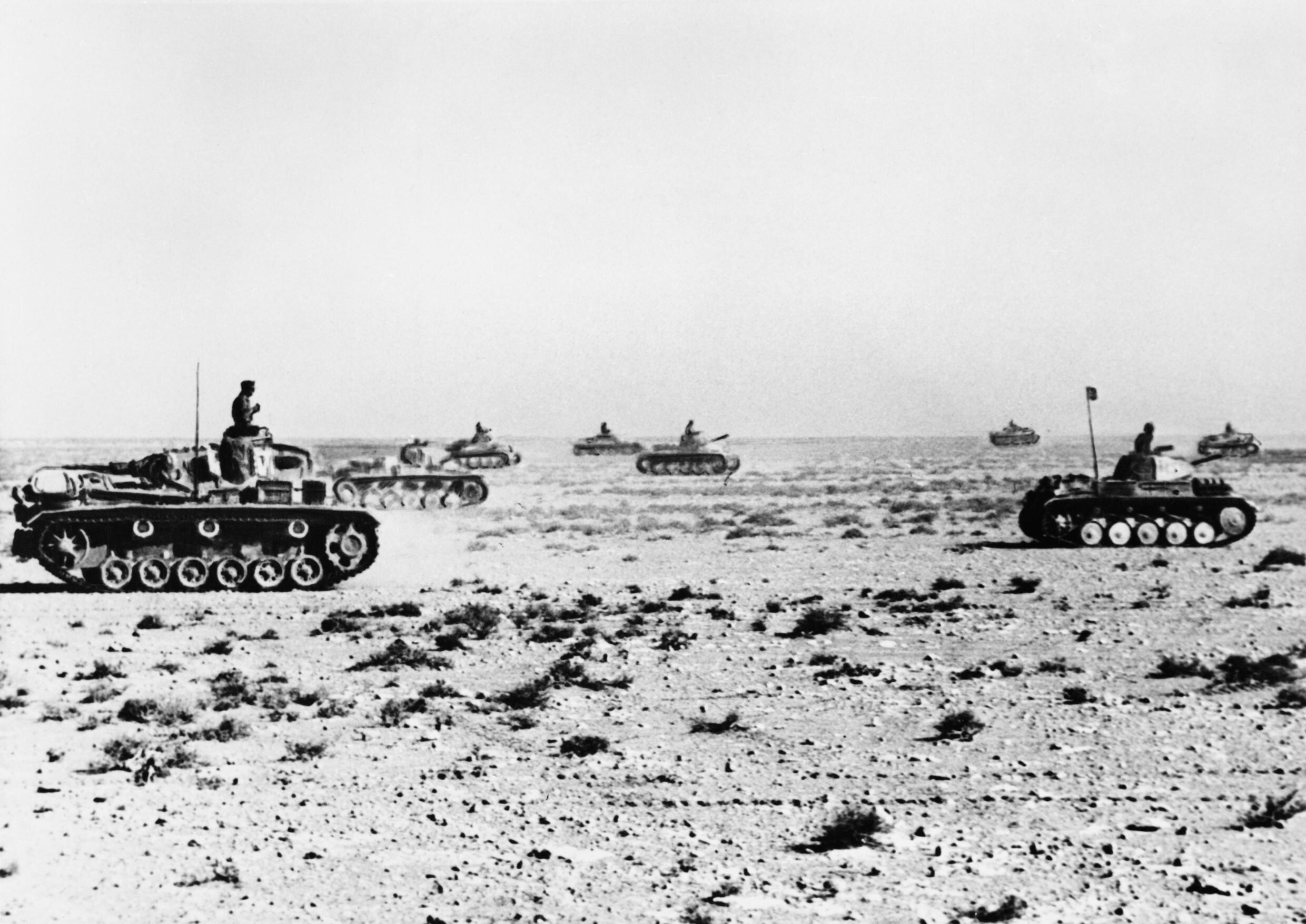
Operation Battleaxe
Churchill called them his "Tiger Cubs" -- 238 tanks rushed through the submarine-infested Mediterranean on a gamble to save forty days of sailing time. They arrived in Egypt in May 1941 with the weight of an empire's expectations riding on their armor. Within weeks, most would be burning hulks scattered across the Libyan-Egyptian borderlands, and the general who sent them into battle would be relieved of command.
The Desert Gambit
By mid-1941, the Western Desert campaign had reached a crisis. Rommel's Afrika Korps, arriving in Tripoli in late March, had swept eastward with startling speed, pushing the British from El Agheila all the way to Sallum on the Egyptian border. Tobruk held out behind its perimeter defenses, but the besieged garrison was bleeding supplies. Churchill, impatient and alarmed, ordered Operation Tiger -- a convoy of tanks and Hawker Hurricanes sailed through the Mediterranean rather than around the Cape of Good Hope, cutting forty days off the journey but risking everything on a single roll through waters dominated by Axis aircraft and Italian warships. The tanks reached Alexandria, and General Archibald Wavell began planning the offensive that would use them. The plan was straightforward: smash through the Axis defensive positions along the frontier and drive west to lift the siege of Tobruk.
Three Columns, Three Failures
Operation Battleaxe launched on 15 June 1941, the first time during the war that a significant German force fought on the defensive in North Africa. The British attacked in three columns -- one aimed at Halfaya Pass on the coast, another at fortified positions on Hafid Ridge, and a third sweeping around the southern flank. The results were catastrophic almost immediately. At Halfaya Pass, dug-in German 88mm anti-aircraft guns, repurposed as anti-tank weapons, shattered the British armor. The pass earned a grim nickname among British troops: "Hellfire Pass." Only the center column achieved any success, and that was partial at best. By the end of the first day, the British had lost over half their tanks. The speed with which carefully hoarded armor could be destroyed by well-positioned anti-tank guns was a lesson the desert would teach again and again.
Rommel's Counterstroke
The second day brought mixed fortunes that leaned increasingly toward disaster. On the western flank, German counterattacks pushed the British back. In the center, a major German armored thrust was repulsed, but at terrible cost in machines and men. Rommel, reading the battle with the tactical intuition that had already made him feared, sensed the moment to strike. On the third day, 17 June, he launched an encircling movement aimed at cutting off the entire British force. The maneuver came within hours of succeeding. British commanders, recognizing the danger almost too late, ordered a withdrawal that barely outpaced the closing jaws of the German pincer. The retreat preserved most of the surviving troops but left the battlefield, and any hope of relieving Tobruk, firmly in Axis hands.
The Price of Failure
Battleaxe's three-day span belied its consequences. The British lost 91 tanks destroyed and dozens more damaged, against relatively modest German losses. More than a thousand British soldiers were killed, wounded, or captured. The strategic cost was equally severe: Tobruk remained under siege, and the Axis grip on the frontier tightened. Churchill's frustration found its target in General Wavell, who was removed as Commander-in-Chief Middle East and sent to India. His replacement, General Claude Auchinleck, inherited the task of rebuilding a shattered armored force and planning a new offensive. The swap was not a demotion in name -- Wavell took Auchinleck's former post as Commander-in-Chief India -- but no one mistook it for anything other than what it was.
Lessons Carved in Steel
Operation Battleaxe exposed fundamental problems in British desert tactics that would take months to correct. The piecemeal commitment of armor, the underestimation of German anti-tank defenses, and the failure to coordinate infantry and tanks into the combined-arms formations that made the Afrika Korps effective -- all of these failures would be studied, debated, and slowly addressed. The German 88mm gun, originally designed to shoot down aircraft, had proved devastating against tanks, and the British had no equivalent weapon. It would take five more months, a new commander, and Operation Crusader before the British could mount another serious attempt to relieve Tobruk. The desert between Sallum and Halfaya Pass, where the wreckage of Churchill's Tiger Cubs rusted in the sun, became a monument to the cost of learning warfare the hard way.
From the Air
Located at 31.50°N, 25.11°E along the Libyan-Egyptian border. The battlefield stretches across flat desert terrain between Halfaya Pass on the Mediterranean coast and the escarpment inland near Sidi Omar. Nearest airports include Tobruk/El Adem (HLTQ) approximately 100 km west. Best viewed at 5,000-8,000 ft to appreciate the terrain features -- the coastal escarpment, the passes, and the vast open desert that defined armored warfare. The Halfaya Pass area is visible as a break in the escarpment near the coast.