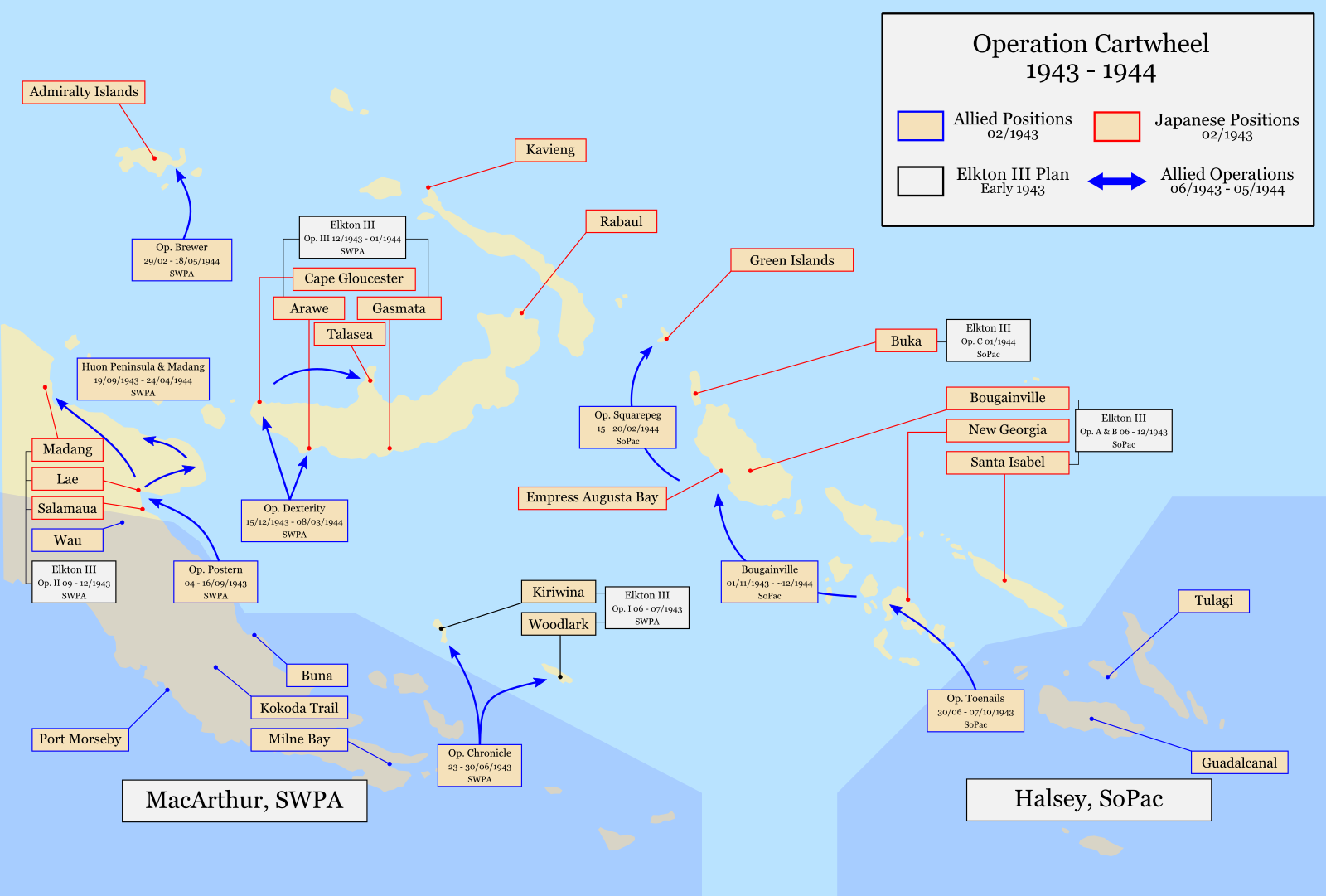
Operation Cartwheel
By the summer of 1943, Rabaul was a problem with no clean answer. The Japanese had turned the New Britain harbor into a fortress of tens of thousands of troops, hundreds of aircraft, and some of the longest runways in the South Pacific, all aimed south at Australia. Douglas MacArthur wanted it taken. Ernest King wanted it taken his way. George Marshall, whose eye was fixed on Nazi Germany across the Atlantic, wanted it dealt with cheaply. The compromise they stitched together was called Operation Cartwheel - a pincer of Army and Marine and Navy and Commonwealth forces that would close on Rabaul from both the New Guinea coast and the Solomons chain. But Cartwheel's most important decision, made partway through the campaign, was the one nobody had planned at the start: don't take Rabaul. Walk around it, cut its arteries, and let it wither.
Two Generals, One Objective
Operation Cartwheel was not really one plan but two, pressed together at their seams. MacArthur's forces, under the New Guinea Force command of Australian General Thomas Blamey and the US 6th Army under Walter Krueger, would grind northeastward along the coast of New Guinea, taking Kiriwina, Woodlark, and Cape Gloucester. Admiral William Halsey's South Pacific forces would push up through the Solomons from Guadalcanal, taking New Georgia and Bougainville. The air war belonged to Lieutenant General George Kenney. The sea lanes to Vice Admiral Arthur Carpender. The theory was that these two arcs would meet somewhere near Rabaul in 1944 and squeeze. The theory left something out: what to do when you arrived.
Munda, Manus, and the Cost of Islands
The island campaigns that made up Cartwheel were each their own war. On New Georgia, 10,500 Japanese defenders held an airfield at Munda Point, and what the planners had imagined as a quick seizure became a month of heat and rain and jungle that cost the Allies 1,094 dead and 3,873 wounded before the 43rd Division took the field on 5 August 1943. The Japanese lost 2,483 men there. In the Admiralty Islands in February and March 1944, the 1st Cavalry Division under Brigadier General William Chase landed at Hyane Harbor on Los Negros and seized the beaches within four hours, with MacArthur himself watching from a destroyer and decorating soldiers on the shore. Three hundred twenty-six Allied troops died in the Admiralties. The Japanese lost 3,280. These are numbers, but they were men - Americans from the farms of the Midwest and the mills of New England, Japanese conscripts from villages most of them would never see again, all of them fighting for a rock in the sea they had never heard of before the war.
The Decision at Quebec
In August 1943, while the fighting was still underway, Roosevelt and Churchill met with their combined chiefs at the Quadrant Conference in Quebec City. The question on the table was whether Rabaul was worth the cost of storming. The garrison had swelled past 70,000 troops. The caldera harbor was ringed with anti-aircraft guns and tunneled into ridges. An amphibious assault would be a bloodbath. The alternative was leapfrogging - the strategy of bypassing fortified positions to strike weaker points beyond them, letting the strong points starve. MacArthur did not love it. His Elkton Plan had been built around capturing Rabaul. But he came around when he saw the arithmetic, and by the time the next invasions went in, the target had changed. Kavieng was bypassed too. The lightly held Emirau was taken instead in March 1944, with the 4th Marines walking ashore unopposed. The war had found a cheaper path.
The Slow Strangling
The Japanese Navy tried, in December 1943, to save Rabaul by stripping carrier air groups from Truk and flinging them into the defense. Between 200 and 300 of those aircraft were shot down in the raids that followed, taking with them a generation of veteran carrier pilots that Japan's small, selective training program could not replace. The consequences rippled forward. When American carriers met Japanese carriers at the Battle of the Philippine Sea in June 1944, the pilots who had been killed over Rabaul were among the ones Japan now missed. From February 1944 onward, Tokyo wrote off Rabaul's air defense entirely. Allied bombers operating from the ring of captured airfields pounded the base continuously. The Japanese sent valuable aircraft mechanics out by transport ship on 21 February, and Allied bombers sank it. The 70,000 soldiers trapped in the tunnels at Rabaul were not defeated. They were simply, and methodically, made irrelevant.
A War That Walked Around
By the time Japan surrendered in August 1945, the garrison at Rabaul was still there - hungry, disease-stricken, growing vegetables in the volcanic soil to supplement shrinking rations. They had not been beaten in battle. They had been bypassed. Operation Cartwheel became the template for how the rest of the Pacific War would be fought. Iwo Jima and Okinawa would come, but the bigger pattern was leapfrogging - the choice to let strength wither rather than confront it head-on. For the men at Rabaul, the price was three years of waiting in the tunnels. For the Allied planners, it was the realization that sometimes the boldest strategic choice is the one that declines to fight.
From the Air
Operation Cartwheel's geography stretched from the north coast of New Guinea (Lae, Saidor, around 6-7 degrees south) up through the Solomon Islands chain (Guadalcanal, New Georgia, Bougainville) to Rabaul at 4.20 degrees south, 152.17 degrees east. The Admiralties campaign added Manus Island at 2 degrees south, 147 degrees east. Visible landmarks from altitude: the twin volcanic cones of the Rabaul caldera on New Britain's northern tip, Bougainville's mountainous spine, and the chain of green islands stepping northwest. Nearest modern airports - Tokua (AYTK, code RAB) for Rabaul, Henderson Field (AGGH) on Guadalcanal, Momote (AYMO) on Los Negros. Most of the WWII airstrips built during Cartwheel are still visible from the air as faint scars in the jungle.