Operation Cockpit
Twenty-seven warships from six nations steamed out of Trincomalee on April 16, 1944, bound for a volcanic island most of their crews had never heard of. British battleships, an American carrier, a French battleship, Dutch and New Zealand cruisers, Australian destroyers - historian H.P. Willmott would later call Operation Cockpit "perhaps the most cosmopolitan naval operation of the war." Their target was Sabang, a speck of land off the northern tip of Sumatra that the Imperial Japanese Navy used as a base at the entrance to the Strait of Malacca. The irony of the operation would only become clear afterward: the Japanese considered the Eastern Fleet too weak to worry about, and never redeployed a single aircraft in response.
A Fleet Reborn from the Mediterranean
For nearly two years, the British-led Eastern Fleet had been a navy in name only. From mid-1942, Admiral James Somerville's force lacked aircraft carriers entirely, and by late 1943 even its elderly battleships had been transferred away. The fleet could protect convoys and hunt submarines, but offensive operations were out of the question. What changed the equation was Italy's surrender in September 1943, which freed up Royal Navy assets from the Mediterranean. The Admiralty dispatched 146 warships eastward - battleships, carriers, cruisers, destroyers - and by early 1944 the Eastern Fleet was finally becoming a fighting force again. The Americans sweetened the pot by temporarily loaning the carrier USS Saratoga and three destroyers, a gesture that allowed the British to proceed with Operation Cockpit without canceling a planned carrier raid against the German battleship Tirpitz in Norway.
Sabang in the Crosshairs
The decision to strike Sabang came from Admiral Ernest King, head of the U.S. Navy. On April 22, Allied forces were scheduled to land at Hollandia in New Guinea, and King wanted the Eastern Fleet to keep Japanese naval aircraft in southern Malaya pinned down so they could not interfere. Sabang made an attractive target: strategically positioned at the northern mouth of the Strait of Malacca, garrisoned by an estimated 9,000 Japanese personnel under Rear Admiral Hirose Sueto, and equipped with oil storage tanks, harbor installations, and an airfield. Allied intelligence was thin - limited to a handful of aerial reconnaissance photographs - and Somerville deliberately avoided further overflights to keep the element of surprise. Codebreakers filled in some gaps, tracking Japanese ship and air unit movements, while the Far East Combined Bureau crafted a radio deception plan that successfully masked the fleet's approach.
Dawn Over Weh Island
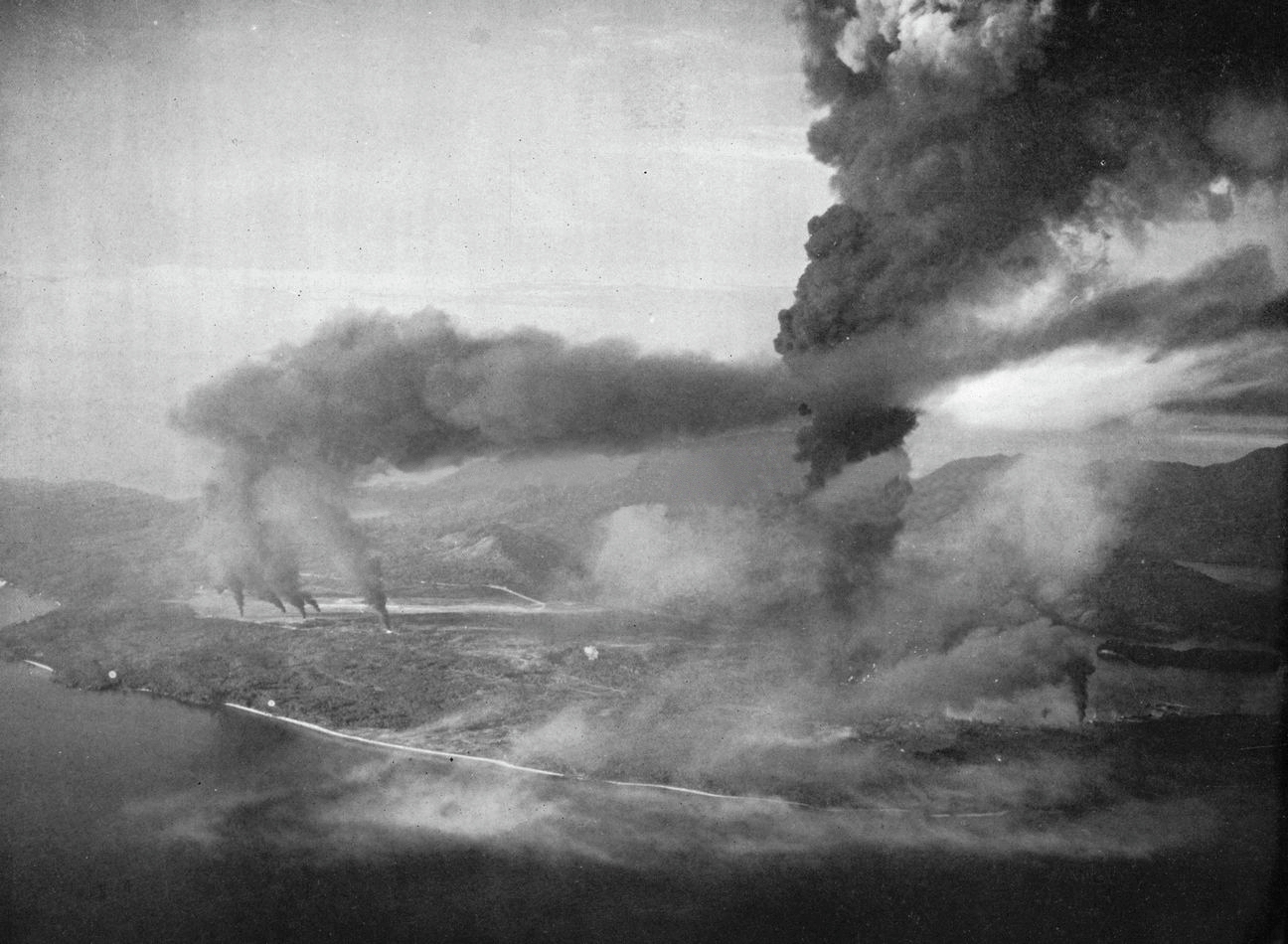
The strike force launched at 5:30 a.m. on April 19 from a point 100 miles southwest of Sabang. HMS Illustrious sent up 17 Fairey Barracuda bombers and 13 Corsair fighters. Saratoga contributed 24 Hellcats, 18 Dauntless dive bombers, and 11 Avenger torpedo bombers, all under the command of Commander Joseph C. Clifton, who led both carriers' air wings. By 7 a.m., the aircraft were over the island. Saratoga's planes struck from one direction, Illustrious's from another a minute later. Three of Sabang's four oil storage tanks erupted in flames. Harbor installations took heavy damage. Pilots claimed 24 Japanese aircraft destroyed on the ground at Sabang and Lho Nga airfields. The defenders, caught completely off guard, managed only belated anti-aircraft fire. A single Hellcat went down, and its pilot was plucked from the water by the submarine HMS Tactician while Japanese coastal guns fired on the rescue - until Clifton personally led fighters to drive off a torpedo boat threatening the submarine.
Friendly Fire and Rainstorms
The withdrawal proved almost as eventful as the attack. Three Japanese torpedo bombers found the fleet and were promptly shot down by Hellcats. That night, destroyers opened fire on what turned out to be an Allied DC-3 transport flying from the Cocos Islands with its identification-friend-or-foe system switched off. The following afternoon, during a rain squall that cut visibility to almost nothing, the battlecruiser HMS Renown mistook an Australian destroyer for a Japanese warship and briefly engaged it with secondary armament. No one was killed in either incident, but the episodes underscored how taut nerves were on a fleet conducting its first carrier offensive. The force reached Ceylon on April 21, having lost one aircraft and damaged eleven others.
A Rehearsal That Changed Nothing
The Allies declared Operation Cockpit a success, and in tactical terms it was: oil burned, aircraft destroyed, harbor facilities wrecked, surprise achieved. The Royal Navy learned valuable lessons from watching Saratoga's crew manage flight operations with an efficiency the British could not yet match, and Clifton received an honorary Distinguished Service Order for his leadership. But the strategic aim - diverting Japanese aircraft from contesting the Hollandia landings - failed entirely. The Japanese had already decided the Eastern Fleet posed no real threat and kept their forces in Malaya untouched. Saratoga soon sailed home for refit, pausing on her way to help strike Surabaya in Operation Transom. The Eastern Fleet returned to Sabang on July 25 for Operation Crimson, this time adding a battleship bombardment. Operation Cockpit had been, in the end, a dress rehearsal - proof that a multinational fleet could coordinate a carrier strike, even if the enemy declined to be impressed.
From the Air
Centered on Sabang (Weh Island) at approximately 5.89°N, 95.32°E, off the northern tip of Sumatra. The island sits at the entrance to the Strait of Malacca, visible from altitude as a distinct volcanic island separated from Sumatra by a narrow strait. Maimun Saleh Airport (WITA) is on Weh Island; Sultan Iskandar Muda International Airport (WITT) in Banda Aceh is the nearest major field, approximately 30 km south. The former Japanese airfield site and harbor installations that were targeted are along the island's northern and eastern shores. Best appreciated at 5,000-8,000 feet to see the island's strategic position controlling the strait.