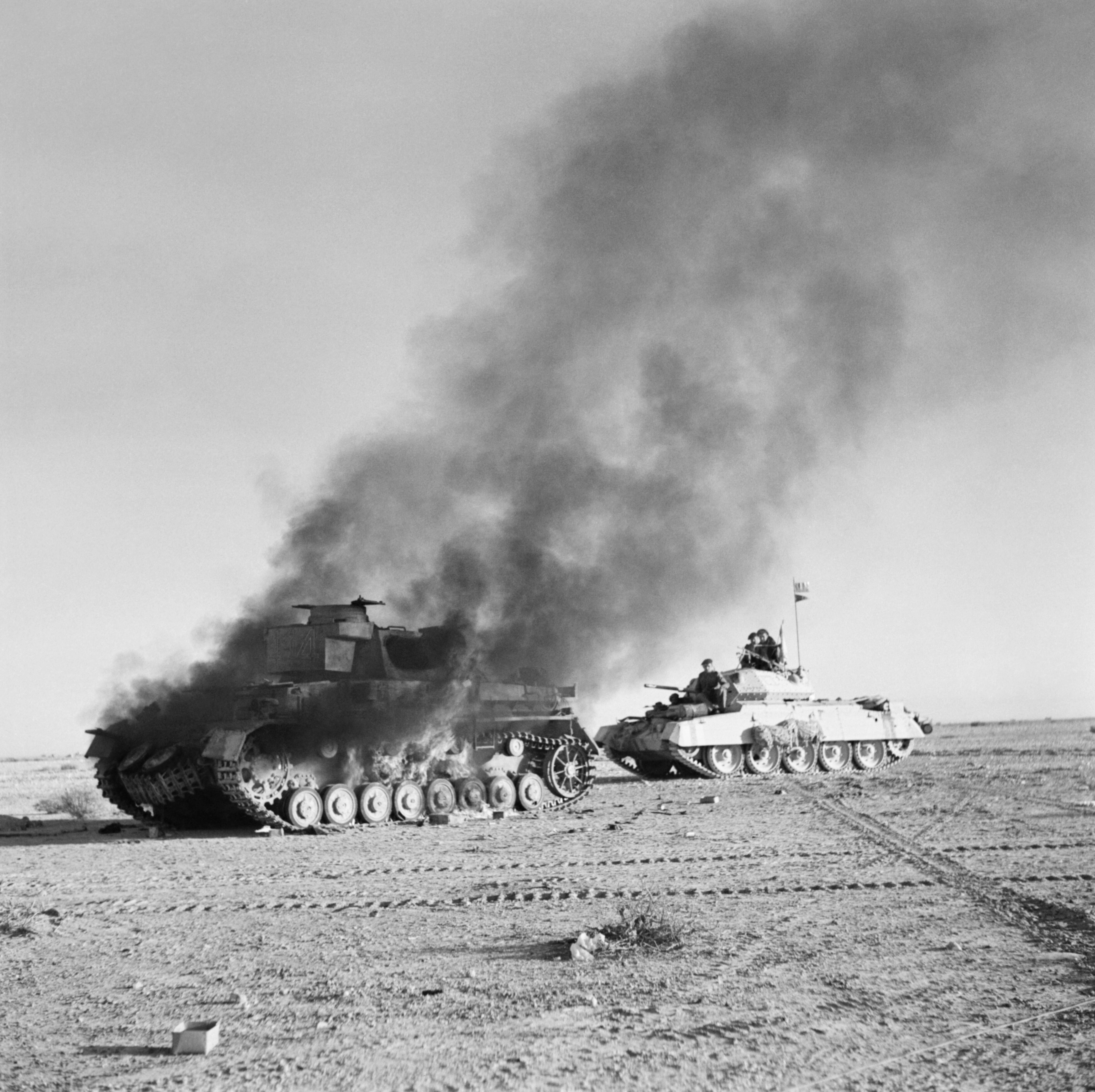
Operation Crusader
Rommel was not even in Africa when the blow fell. So thoroughly had British deception convinced him that no attack was imminent -- perhaps not until December, perhaps as a flanking move through the distant oasis of Jarabub -- that on 18 November 1941, when the Eighth Army crossed the Libyan frontier with more than 700 tanks, the commander of the Afrika Korps was hundreds of miles away. It was the kind of advantage that wins wars. What followed instead was six weeks of the most confused, desperate, and costly fighting the Western Desert had yet seen.
An Army Divided Against Itself
Operation Crusader's plan was ambitious: XXX Corps, built around the 7th Armoured Division, would sweep south of the Axis frontier defenses, find and destroy Rommel's Panzer forces near Tobruk, then link up with the besieged garrison breaking out from the port. XIII Corps would pin the Axis border garrisons while the New Zealand Division swung west toward Tobruk. The problem was dispersion. On the first day, the 7th Armoured Division's three brigades moved in different directions -- one toward Bir el Gubi, one to Sidi Rezegh airfield, one covering the flank at Gabr Saleh. Each met the enemy separately, and each paid for the isolation. At Bir el Gubi, the Italian Ariete Division destroyed 25 newly arrived Crusader tanks. At Gabr Saleh, a battlegroup of the 21st Panzer Division knocked out 23 Stuarts. By allowing his armor to scatter before it had found and concentrated against the main Axis force, General Alan Cunningham had invited exactly the kind of piecemeal destruction that Rommel excelled at delivering.
The Cauldron at Sidi Rezegh
Sidi Rezegh airfield, a flat stretch of desert south of Tobruk, became the battle's pivot -- and its killing ground. The 7th Armoured Brigade reached it on 19 November and captured 19 aircraft on the ground, but sat exposed and unsupported. When the Panzers arrived, the consequences were devastating. On 23 November, Totensonntag -- the German Sunday of the Dead -- the 5th South African Infantry Brigade was overrun in a desperate fight south of the airfield. The South Africans had dug in with 100 guns and fought the Panzers to a standstill before being overwhelmed, inflicting losses the Afrika Korps could not afford: 72 of its 162 tanks. General Norrie later said their sacrifice was the turning point, giving the Allies the upper hand. In four days of fighting around Sidi Rezegh, the Eighth Army lost 530 tanks against roughly 100 Axis losses. The 7th Armoured Brigade was reduced from 150 operational tanks to four.
Rommel's Dash to the Wire
What Rommel did next was either brilliant or reckless -- the debate has never been settled. On 24 November, he personally led the Afrika Korps and the Ariete Division on a headlong drive toward the Egyptian frontier, aiming to destroy the British rear echelons and trap XIII Corps. The armored columns scattered supply units, split XXX Corps, and spread panic through headquarters far behind the lines. But the gamble failed. The Panzers found mostly empty desert where they expected fuel dumps and command posts. At Sidi Omar, Panzer Regiment 5 attacked the 7th Indian Brigade and was repulsed by field guns firing over open sights. The 15th Panzer Division, down to 53 operational tanks, reached Bardia for supplies before limping back toward Tobruk. Meanwhile, the New Zealanders seized the opportunity. The 6th New Zealand Brigade captured much of the Afrika Korps staff and its wireless units on the Trigh Capuzzo, then advanced to Sidi Rezegh. On 27 November, elements of the New Zealand Division linked with the Tobruk garrison at Ed Duda. After 231 days, the siege was broken.
Command Under Pressure
The human cost of Crusader extended to the top. General Cunningham, alarmed by tank losses that left XXX Corps with just 44 tanks against 120 Axis machines, wanted to call off the offensive on 23 November. Auchinleck flew to the Eighth Army headquarters and, in a meeting that was more order than discussion, insisted the operation continue regardless of losses. He spent three days at the front reinforcing his directive before returning to Cairo, where Air Marshal Tedder persuaded him to relieve Cunningham entirely. Major-General Neil Ritchie, Auchinleck's deputy chief of staff, was promoted to acting lieutenant-general and given command mid-battle -- an extraordinary measure that reflected how close the campaign had come to collapse. The Germans, too, were suffering at the command level: the 6th New Zealand Brigade had overrun the Afrika Korps headquarters at Bir el Chleta, capturing most of the staff and severing communications at a critical moment.
A Victory That Didn't Last
Rommel's supply situation, always precarious, became impossible after a five-ship convoy was sunk during the battle and daylight road movements were halted by air attacks. On 7 December, the Axis began withdrawing to the Gazala position, then retreated further to El Agheila by mid-December. The 2nd South African Division mopped up the frontier, capturing Bardia on 2 January 1942, Sollum on the 12th, and the Halfaya garrison -- which had held out since the start -- on the 17th, taking 13,800 prisoners. Tobruk was free, Cyrenaica was retaken, and the British had their first clear victory over a German-led force. It lasted barely a month. On 21 January 1942, Rommel counterattacked and drove the Eighth Army all the way back to Gazala. The Battle of Gazala that followed in May 1942 would see Tobruk fall again -- this time for good. Crusader had proved the British could fight and win in the desert, but it had also proved how fragile such victories could be.
From the Air
Located at 32.08°N, 23.96°E near Tobruk, Libya. The battle sprawled across an enormous area from the Egyptian frontier near Sidi Omar (31.4°N, 25.3°E) westward to Tobruk and south to Bir el Gubi. Sidi Rezegh airfield, the battle's focal point, lies about 20 km southeast of Tobruk. Nearest airport: Tobruk/El Adem (HLTQ). Best viewed at 8,000-15,000 ft to grasp the vast distances over which armored formations maneuvered. The terrain is flat, featureless desert punctuated by escarpments and wadis that served as defensive positions.