Operation Hot Rock
The Marines painted a cartoon logo on their helicopters. They called it Operation Volcano Buster, though the official Navy paperwork read Operation Hot Rock. Either name captured something absurd and true: in April 1992, the United States military deployed heavy-lift helicopters to drop concrete blocks into the lava tubes of Mount Etna, one of the world's most active volcanoes, in an attempt to save the Sicilian town of Zafferana Etnea from destruction. "Everything is easier when no one is shooting at you," quipped one Navy officer. But flying over rivers of molten rock at 2,000 meters elevation carried its own kind of danger.
A River of Fire Bearing Down
Mount Etna had begun erupting from new fissures on December 14, 1991. By early January 1992, lava was flowing steadily toward Zafferana Etnea, a town perched on the volcano's eastern flank. Italian civil protection authorities and the army scrambled to build an earthen embankment in the Val Calanna basin above the town -- 234 meters long, 21 meters high, constructed from 370,000 cubic meters of earth and rock. It held the lava back for about a month. When the flow breached the basin and resumed its descent, emergency crews built three more dams in quick succession. The lava overran them all. On April 13, explosives were detonated on the hardened crust in a last-ditch effort to create an artificial dam. The effect was temporary. Zafferana's roughly 8,000 residents watched as the glowing front crept closer.
Concrete Against Magma
Marine Medium Helicopter Squadron 266, embarked with the 24th Marine Expeditionary Unit off the Italian coast, received the call. Many of the pilots and crew were Gulf War veterans, experienced in hostile conditions but not in flying near erupting volcanoes. Their CH-53E Super Stallion helicopters, designed to carry tanks and artillery, now hauled concrete blocks weighing two to four tons each. Navy Seabees fabricated metal mesh platforms to bundle the blocks for transport. The target was a skylight -- an opening in the roof of the main lava tube at about 2,000 meters elevation on Etna's flank, through which the flowing lava was visible. The pilots had to hover with precision while Italian military escorts guided them through volcanic terrain. High winds forced at least one helicopter to jettison its cargo prematurely. The U.S. Navy's Sixth Fleet provided additional support, and joint Italian-American command centers coordinated the timing of aerial drops with ground-level explosive blasts.
Blowing Open the Mountain
The concrete drops alone could not stop the eruption. Italian authorities, with input from American specialists, devised a four-phase plan to redirect all lava from the main tube into a man-made channel. Bulldozers and explosives carved an artificial spillway high on the slope in the upper Valle del Bove, leading away from the natural lava tube and into an uninhabited part of the valley. When the tube wall was blasted open, an estimated 80 percent of the lava gushed out through the rupture. The volcano's own energy was turned sideways, away from Zafferana. Starved of its supply, the lava front bearing down on the town slowed, stagnated, and stopped. By May 30, 1992, observers confirmed that no lava was flowing toward the town. Volcanologist Franco Barberi had warned in mid-April that if the eruption continued indefinitely, "no scientist, Rambo or marine will be able to resist it." The eruption did continue -- for another ten months, until March 30, 1993 -- but the diversion held.
What the Lava Left Behind
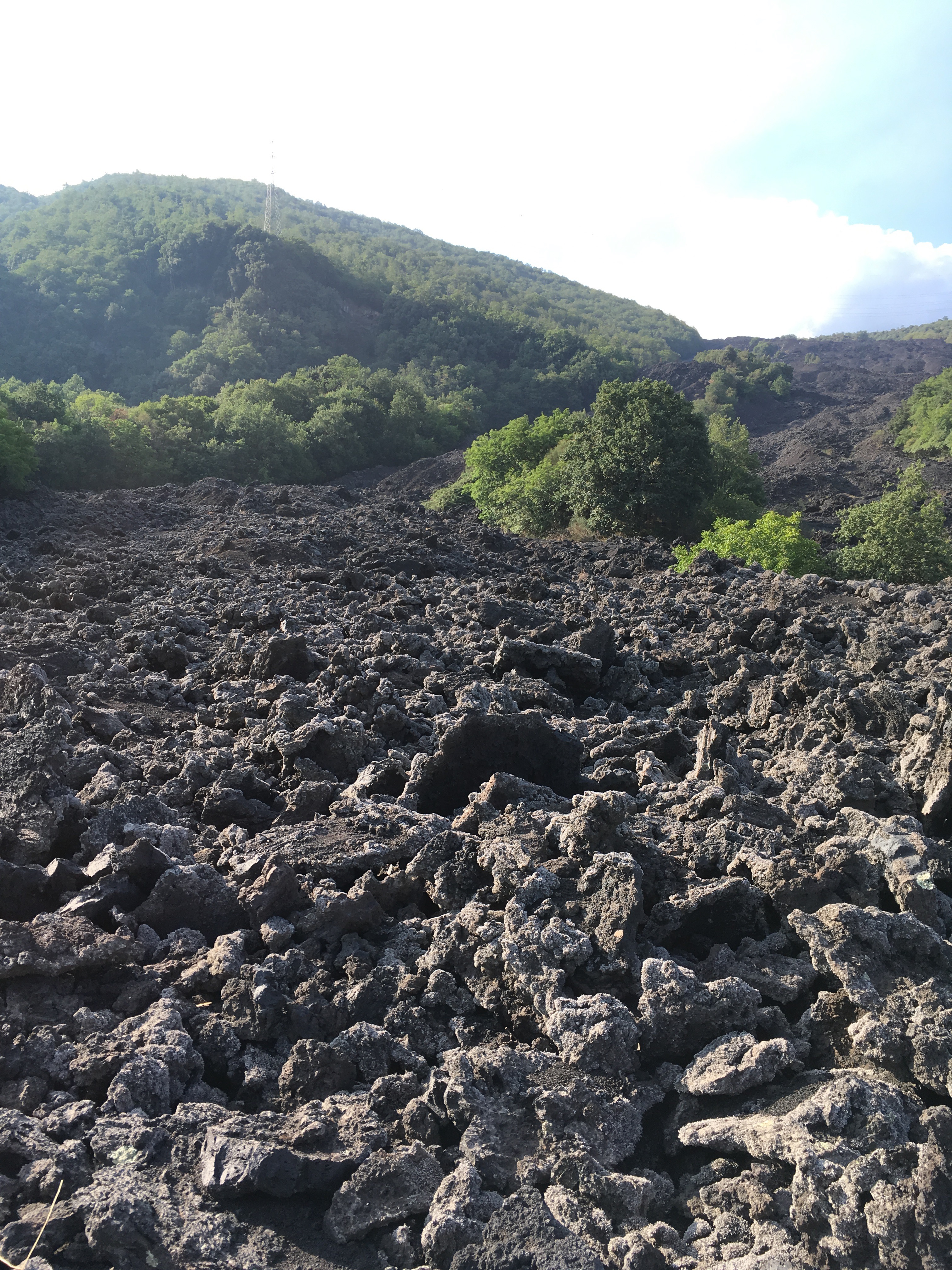
Zafferana Etnea survived. Residents who had spent months under the shadow of advancing lava returned to normal life by summer 1992. The cooled lava flows remain visible in the landscape above the town, and a monument plaque commemorates the successful diversion. For the Marines of HMM-266, the mission became unit legend -- the time they fought a volcano and won. The operation has since been studied in volcanology and civil engineering as a case study in disaster mitigation. Italian civil protection agencies incorporated the lessons into contingency planning for future eruptions. The Etna intervention demonstrated that while lava flows can be altered by human action, success depends on sustained effort, international cooperation, and the eruption eventually cooperating by not lasting forever. The name 'Volcano Buster' stuck in popular memory, evoking the unlikely image of Marines in combat gear waging war against nature itself.
From the Air
Operation Hot Rock took place on Mount Etna in Sicily, Italy, at approximately 37.75N, 15.00E. The town of Zafferana Etnea sits on Etna's eastern flank at about 37.68N, 15.10E. Mount Etna rises to 3,357 meters and is highly visible from any altitude. The Valle del Bove, where the lava diversion occurred, is a large horseshoe-shaped depression on the eastern side. Nearest airport is Catania-Fontanarossa (LICC). Note: the raw article's catalog geohash places this in northwest Iran due to a coordinate error in the source data, but the actual event occurred in Sicily. Caution near active volcanic terrain.