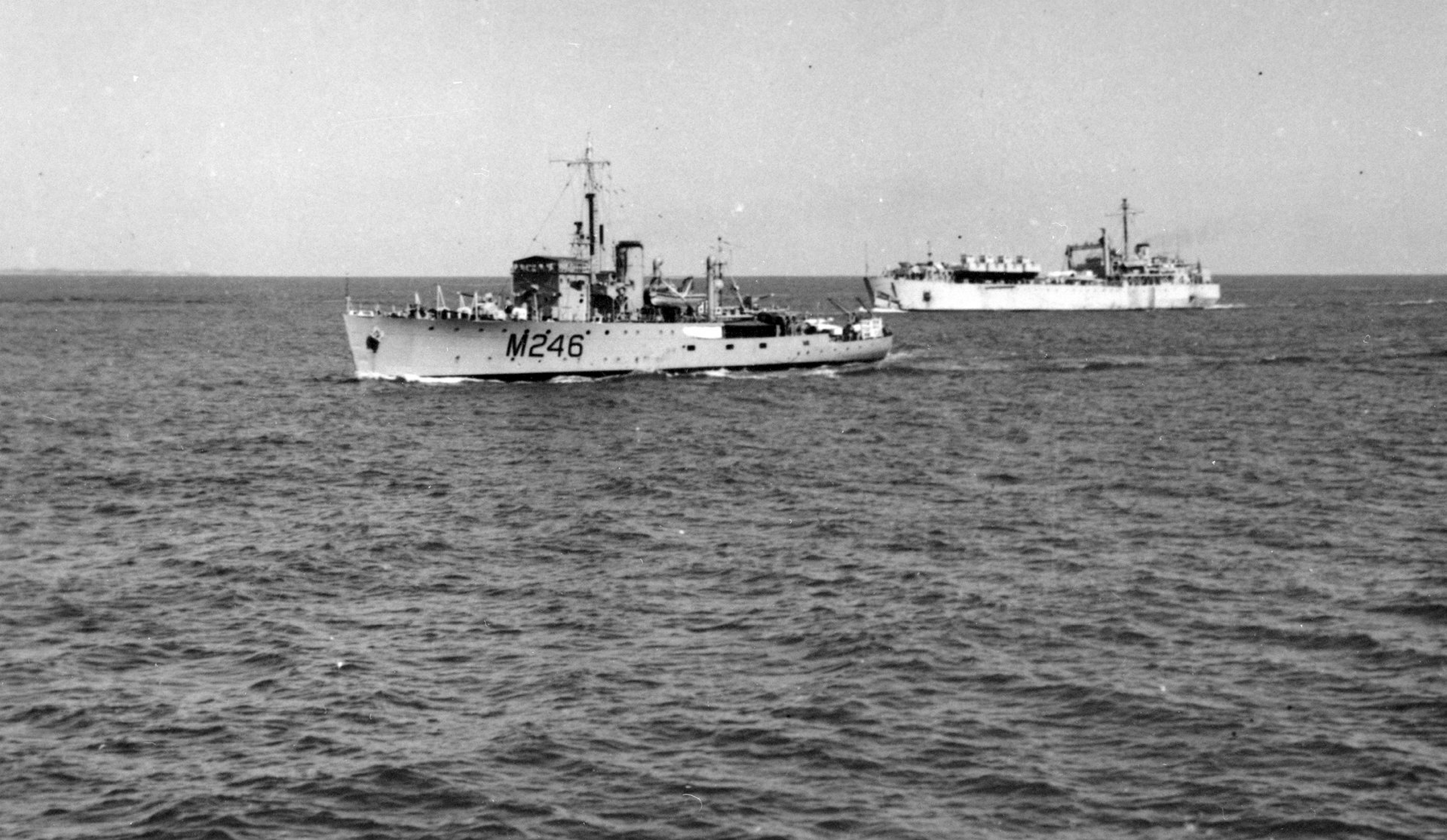
Operation Mosaic
Four years after Operation Hurricane turned the Montebello Islands into a nuclear test site, the British returned. This time they brought two devices, codenamed G1 and G2, and a question that cut to the heart of Cold War weapons design: could the yield of a fission bomb be dramatically increased by adding small quantities of lithium-6 and deuterium? The answer, delivered across two detonations in May and June 1956, would help pave the way toward Britain's hydrogen bomb programme -- and leave the remote Western Australian archipelago bearing the scars of the largest nuclear explosion ever conducted in Australia.
The Road Back to the Montebellos
By the mid-1950s, Britain's nuclear weapons programme was accelerating. The Operation Totem tests of 1953 had been conducted at Emu Field in the South Australian desert, but that site was considered unsuitable for what came next. A new permanent test facility was under construction at Maralinga, also in South Australia, but it would not be ready until September 1956. The scientists could not wait. The experiments they planned involved boosted fission weapons -- devices that used lithium-6 and deuterium to enhance the nuclear chain reaction and dramatically increase explosive yield. Although a boosted fission weapon is not a hydrogen bomb, the technology was directly connected to Britain's hydrogen bomb programme. The Montebello Islands, already contaminated from Operation Hurricane, offered a ready-made test site far from population centres. The decision was made to return.
G1: The First Shot
On 16 May 1956, the first device, G1, was detonated on Trimouille Island -- the same island that had absorbed the Operation Hurricane blast four years earlier. G1 was a tower-mounted device with a yield of approximately 15 kilotons. The test confirmed the viability of certain design principles that British weapons scientists needed to validate, but it was the second shot that would prove more significant and more controversial. Between the two tests, the task force worked under mounting time pressure. The flagship, a tank landing ship, needed to return to the United Kingdom and refit in time for Operation Grapple, the planned first test of a British thermonuclear weapon. A proposed international moratorium on nuclear testing loomed on the horizon, and the British government was determined that Grapple should proceed before any ban took effect.
G2: The Largest Blast on Australian Soil
On 19 June 1956, the second device, G2, was detonated on Alpha Island in the Montebello group. The official yield was reported as 60 kilotons -- four times larger than G1 and more than twice the size of the Operation Hurricane blast. But during the Royal Commission into British nuclear tests in Australia, claims emerged that the true yield was closer to 98 kilotons, nearly matching the destructive power of the largest weapon dropped in wartime. The British government disputed this figure, and the discrepancy has never been definitively resolved. What is beyond dispute is that G2 incorporated a natural uranium tamper and experimental boosting technology that directly informed the design of Britain's hydrogen bombs. The blast was enormous by Montebello standards, and its effects on the small, flat islands of the archipelago were correspondingly severe.
Contested Legacy
Operation Mosaic left the Montebello Islands with the accumulated contamination of three nuclear detonations in four years. Service personnel from both Britain and Australia were present during the tests, and their long-term health outcomes became a matter of bitter dispute in the decades that followed. The Royal Commission into British nuclear tests in Australia, which reported in 1985, examined allegations of inadequate safety precautions, fallout exposure among military personnel and nearby communities, and the environmental damage to the islands. The Montebello Islands are today a marine conservation reserve, their turquoise waters popular with recreational boaters. But certain areas remain off-limits, and radiation monitoring continues. The legacy of Operation Mosaic extends beyond the physical scars on the landscape. The tests represented a critical stepping stone in Britain's nuclear journey -- from the first crude device of 1952 to the thermonuclear weapons tested at Christmas Island during Operation Grapple the following year. For Australia, they raised enduring questions about sovereignty, informed consent, and the price paid by a distant ally's territory for the ambitions of a fading empire's nuclear programme.
From the Air
The Montebello Islands lie at approximately 20.39S, 115.54E, about 130 km northwest of Onslow, Western Australia. The archipelago is a scatter of low limestone islands surrounded by shallow reef waters. Trimouille Island (G1 site) and Alpha Island (G2 site) are in the southern portion of the group. Nearest airports: Learmonth (ICAO: YPLM) and Onslow (ICAO: YOSN). Best viewed from 3,000-8,000 ft. The islands are a marine conservation reserve with no airstrips.