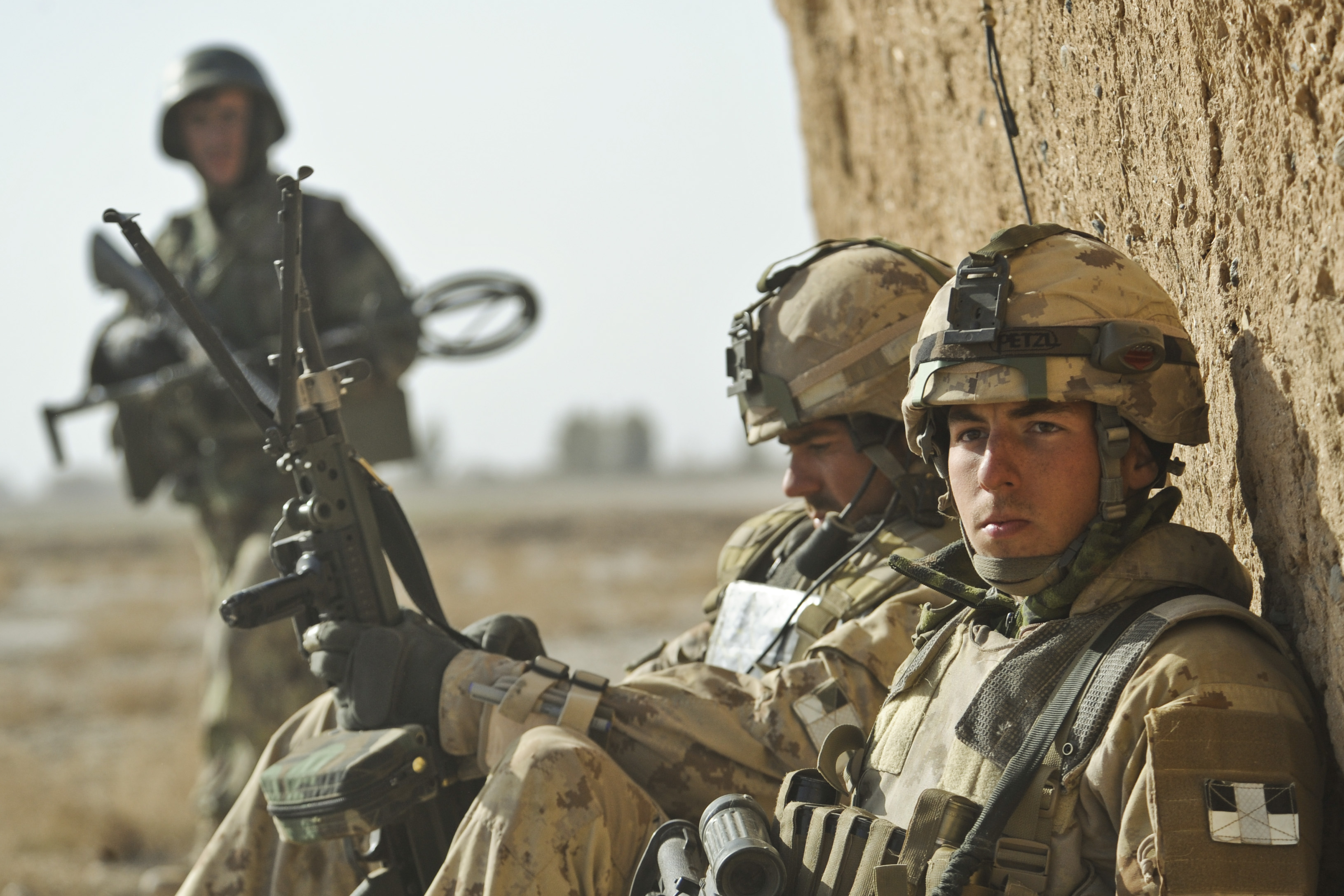
Operation Moshtarak
General Stanley McChrystal had a phrase he liked: "government in a box, ready to roll in." The idea was simple enough. Fifteen thousand coalition and Afghan troops would sweep into Marjah, a dusty town in Helmand Province that the Taliban and opium traffickers had controlled for years, and behind the soldiers would come administrators, police, engineers -- an instant functioning state. It was February 2010, and Operation Moshtarak (Dari for "Together") was being sold as the prototype for winning the war in Afghanistan. What arrived instead was a lesson in the distance between ambition and reality.
The Loudest Secret in Afghanistan
In a war defined by surprise raids and drone strikes, Moshtarak was deliberately announced in advance. ISAF commanders compared it to the 2004 Second Battle of Fallujah and broadcast their intentions weeks before the assault, hoping Taliban fighters would simply leave rather than face 15,000 troops. Leaflets rained on Marjah: "Do not allow the Taliban to enter your home." The gamble was a calculated one -- McChrystal's doctrine of "courageous restraint" prioritized protecting Afghan civilians over destroying the enemy. Whether the Taliban actually fled or merely buried their weapons and blended into the population would become the central question of everything that followed. Hundreds of civilian families did flee, though, displaced from homes that sat atop what military planners suspected was one of the most heavily mined areas NATO had ever faced.
Dawn Over the Poppy Fields
At four in the morning on February 13, 2010, the first of ninety helicopters began disgorging troops across central Helmand. U.S. Army Special Forces ODA 1231 and Afghan commandos from the 3rd Commando Kandak had already been on the ground for hours, seizing the southern tip of the city. RAF Chinooks carried soldiers from the 1st Battalion Royal Welsh toward the Taliban stronghold of Showal. Marines from the 1st and 3rd Battalions of the 6th Marine Regiment pushed into the center and north of Marjah. The greatest obstacle was not gunfire but what lay beneath the soil -- an extensive network of mines and booby traps that forced engineers forward in 72-ton Assault Breacher Vehicles, plowing safety lanes through the fields with 7,000 pounds of explosives. By nightfall, ISAF sources claimed Marines appeared to control the center of Marjah. The next day, among the seizures were 17 tons of black tar opium and 443 pounds of heroin.
The Bleeding Ulcer
The initial assault succeeded by every military metric, but the war McChrystal was trying to fight was not purely military. The promised "government in a box" never materialized as planned. The Afghan district governor installed after the fighting had limited authority, and the Taliban -- many of whom had simply melted into the civilian population -- began reasserting control through intimidation and targeted killings. Ninety days into the offensive, McChrystal himself called Marjah a "bleeding ulcer." By October 2010, the situation was described as "troubling," though by December the fighting was declared "essentially over." It was a distinction without much difference. The second day of the operation had already foreshadowed the problem: twelve civilians, ten from a single family, were killed when NATO HIMARS rockets struck their homes. McChrystal personally called President Karzai to apologize. The gap between the operation's military success and its political failure would prove unbridgeable.
A War's Turning Point
Moshtarak was supposed to be a prelude -- the warm-up for a much larger offensive in Kandahar that would break the Taliban's back. Instead, it became the operation that changed the trajectory of America's longest war. The failure to hold Marjah politically, even after holding it militarily, convinced the Obama administration that the strategy of surging troops for a decisive victory was not working. The shift toward deescalation and eventual withdrawal began here, in the irrigation canals and poppy fields of a town most Americans had never heard of. Shortly after NATO soldiers departed Marjah, the Taliban regained control. U.S. Army analysts described the operation's goals as a failure. Brigadier James Cowan of the British forces had predicted Moshtarak would mark "the start of the end of this insurgency." He was right about the ending, but not the way he meant. The insurgency outlasted the coalition's will to fight it.
What Remains
The names on the casualty lists tell the story of a truly multinational effort that fell short. American Marines, British Guardsmen, Canadian infantry from Princess Patricia's Light Infantry, Danish and Estonian soldiers, Afghan commandos and police -- all fought in Marjah. Some, like U.S. Army Captain Matthew Golsteyn, earned Silver Stars for valor. Seventy-six Marines were killed in Afghanistan in the five months following the operation's start. The Afghan families who returned to Marjah after being displaced found a landscape scarred by IEDs and contested by forces that would keep fighting for another decade. Moshtarak's legacy is not a single battle but a question: whether any military operation, however well-executed, can build a nation from the outside. The poppy fields of Helmand offered one answer.
From the Air
Coordinates: 31.52N, 64.12E in Helmand Province, southern Afghanistan. The flat agricultural terrain of Marjah sits along irrigation canals fed by the Helmand River. Viewing altitude 8,000-12,000 ft AGL reveals the grid of canals and poppy fields. Nearest major airfield is Camp Bastion/Shorabak (OABT), approximately 50 nm northwest. Kandahar Airfield (OAKN) lies roughly 100 nm east. Terrain is flat desert and irrigated farmland -- clear visibility most of the year with occasional dust storms.