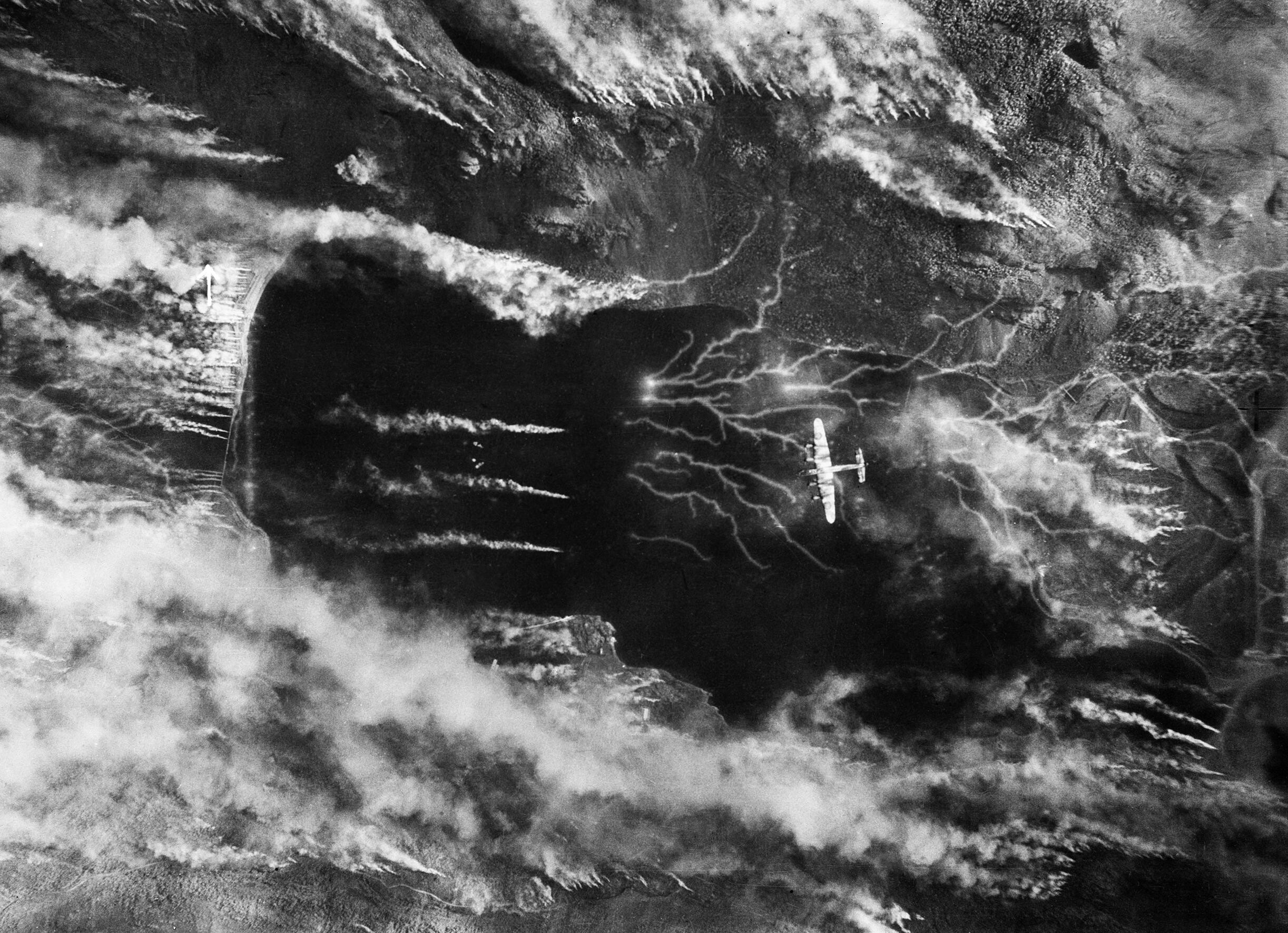
Operation Paravane
The bomb dropped from Wing Commander Willy Tait's Lancaster was the only one to hit Tirpitz squarely, but it was enough. The 12,000-pound Tallboy punched through the battleship's foredeck, passed through her hull, and detonated in the water on the starboard side of her bow. The explosion wrecked the forward compartments and flooded them with 2,000 tons of seawater. After two years of failed carrier raids, midget submarine attacks, and frustrated dive-bombing sorties over smoke-filled fjords, it was a single bomb from Operation Paravane on 15 September 1944 that rendered the most feared warship in the Arctic permanently unfit for combat.
What the Fleet Air Arm Could Not Finish
Tirpitz had tied down Allied resources since her arrival in Norway in January 1942. Anchored in fjords, she forced the British Home Fleet to keep capital ships at constant readiness against a sortie that never came. The Royal Navy attacked the battleship repeatedly throughout 1943 and 1944. Midget submarines damaged her in September 1943 during Operation Source. Carrier aircraft struck fifteen times during Operation Tungsten in April 1944, killing 122 of her crew but failing to sink her. Four more carrier raids between April and July achieved nothing, defeated by bad weather and smoke generators that hid the ship before the slow Fairey Barracudas could arrive overhead. Operation Goodwood, the Fleet Air Arm's largest operation of the war, sent waves of aircraft against Kaafjord across four days in late August and scored only two superficial hits. The conclusion was inescapable: the Barracudas could not carry bombs heavy enough to destroy a battleship, and they were too slow to beat the smokescreen.
Lancasters Over the Arctic
Air Chief Marshal Arthur Harris had a plan ready. Thirty-eight Lancasters from Bomber Command's two elite squadrons, No. 9 and No. 617, would fly armed with Tallboy bombs, the largest weapons then in RAF service. Kaafjord lay beyond Lancaster range from Scotland for a round trip, so the bombers would refuel at Yagodnik airstrip near Arkhangelsk in the Soviet Union. The crews departed their English bases on 11 September, flying north to Shetland and then east over neutral Sweden, where the sight of cities lit up at night startled airmen accustomed to blackouts. Crossing Finland, they ran into thick cloud. Only 26 of 39 Lancasters found Yagodnik; the rest crash-landed at other fields or in open terrain. Remarkably, no one was killed. At Yagodnik the men slept in overcrowded, bedbug-infested underground huts while Soviet ground crews helped refuel and repair the aircraft over the next three days.
Ten Minutes of Smoke
By morning on 15 September, 27 Lancasters were ready. A reconnaissance Mosquito confirmed clear skies over Kaafjord, and the bombers lifted off for the 1,000-mile flight to the target. Approaching from the southeast at high altitude, they avoided detection until roughly ten minutes before arrival, at which point the fjord's smoke generators began firing. Tait's formation, leading the attack, was the only group to see Tirpitz before the haze swallowed her. His Tallboy struck the ship; the rest of the first group's bombs landed in the water nearby, and their near-miss explosions buckled hull plates and bulkheads. All subsequent aircraft aimed at the anti-aircraft fire rising through the smoke. Six Lancasters carrying experimental JW walking mines dropped them on Tirpitz's estimated position, but these weapons caused no damage. Despite 98 anti-aircraft guns firing from shore batteries and warships, only four Lancasters were hit, and all 21 bombers returned safely to Yagodnik.
A Ship Beyond Saving
The damage assessment took weeks to assemble. Norwegian intelligence agents Knut Moe and Anton Arild, who had parachuted into the wilderness near Kaafjord on 8 September and set up an observation post overlooking the anchorage, radioed reports that Tirpitz had been struck and appeared damaged. Decoded German signals confirmed a single hit from a large bomb. A 17-meter gash in the bow made repairs impossible without a major dry dock, and sailing to one would expose the crippled ship to further attack. Grand Admiral Karl Donitz convened a meeting in Berlin on 23 September and accepted the inevitable: Tirpitz would never fight again at sea. Instead, he ordered the battleship towed to an anchorage near Tromso to serve as a floating artillery battery. She arrived there on 15 October. One Lancaster was lost during the return from Yagodnik, crashing into a Norwegian mountainside near Nesbyen and killing all eleven men aboard, the only Allied fatalities of Operation Paravane. The Allies, uncertain how badly Tirpitz was hurt, sent the Lancasters back twice more. On 12 November, during Operation Catechism, several Tallboys capsized the battleship with heavy loss of life, ending the saga at last.
From the Air
Coordinates: 69.94°N, 23.05°E, at Kaafjord in Altafjord, northern Norway. The Lancasters approached from the southeast at altitudes between 14,000 and 20,000 feet. Nearest airports: Alta (ENAT) approximately 10 km southwest; Lakselv/Banak (ENNA) approximately 100 km east. The fjord system is clearly visible from altitude, with Kaafjord branching south from the main Altafjord. The attack route overland from the southeast avoided the coastal radar network.