Operation Pegasus
Major Digby Tatham-Warter walked out of a German military hospital on 21 September 1944, lay low for a week, and then began organising. Within a fortnight he had a brigade headquarters in hiding among the farms and villages north of the Lower Rhine - a 'Brigade HQ in hiding', someone called it - made up of British paratroopers who had not been captured at Arnhem and Dutch civilians who were risking their lives to feed them. A month later, on the night of 22-23 October, that hidden brigade walked down to the river in the dark and crossed back to Allied territory. They were 138 men. Without the Dutch families who hid and fed them, none of them would have made it.
What Was Left After Arnhem
When the British 1st Airborne Division was pulled out of Oosterbeek on the night of 25-26 September, 7,900 men had to be left behind. Nearly 1,500 of them were dead. More than 6,000 were captured. But about 500 paratroopers - exhausted, wounded, scattered through the woods and villages north of the river - simply went into hiding. Dutch civilians took them in. At first the men hoped it would be brief. They believed the British 2nd Army would resume the advance and rescue them in days. When it became clear that the Allies would not cross the Rhine again that year, the hidden soldiers began thinking about how to get themselves out.
MI9, a Telephone Line, and a Reckless Decision
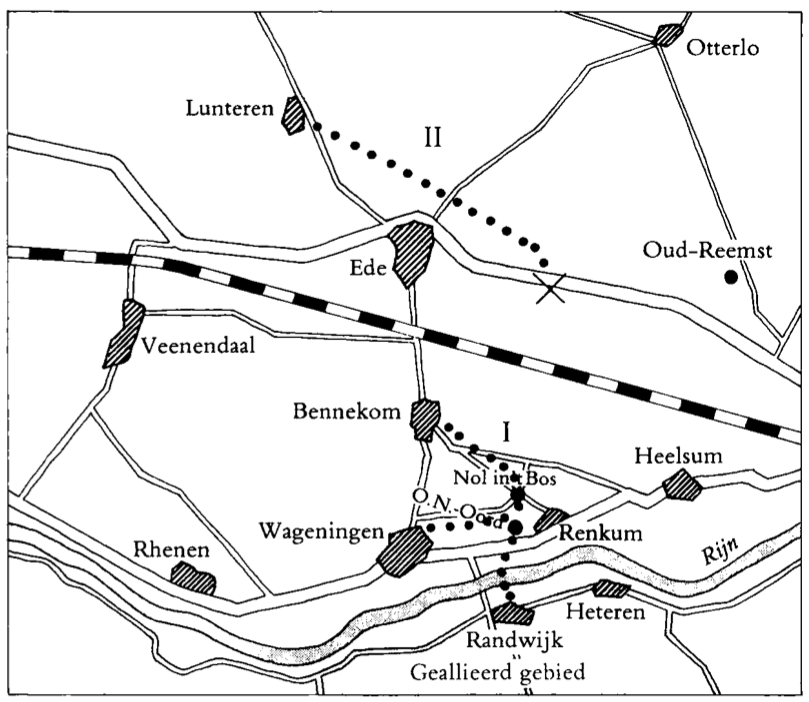
British military intelligence had been preparing for exactly this kind of work for years. In June 1943, MI9 - the unit that helped Allied servicemen escape from German-occupied Europe - had parachuted an agent named Dick Kragt into the Netherlands. By the time of Arnhem, Kragt and his deputy Joop Piller had an experienced Dutch escape network already running. In early October Airey Neave of MI9 arrived in newly liberated Nijmegen, with Major Hugh Fraser of the SAS as his second-in-command, and they discovered that telephone lines from Nijmegen could still reach the Dutch Resistance in Ede - twenty kilometres into German-held territory. Nightly reports of casualties and evaders came through the wires. The telephone link made the whole operation possible. Neave then made a decision he later admitted was poor: he sent Captain Peter Baker across the lines to make personal contact with the Resistance. Baker, who 'fancied himself as a secret agent', disobeyed orders and was captured on 16 October. He survived the war. The Ebbens family who had sheltered him were executed.
The Crossing
On 20 October the Germans ordered residents of the villages near Arnhem to leave their homes by the 22nd. The Resistance and the hidden British saw their chance: the confusion of an enforced evacuation would mask the movement of 138 men through the woods to the river. They brought the date forward to the night of 22-23 October. They moved quietly. There was one brief encounter with a German patrol and a short exchange of fire - no one was hurt. They reached the riverbank near Renkum and waited. Twenty minutes - anxious, freezing - passed before the boats came across from the south side, sent by the American 101st Airborne and Canadian engineers. Then, in ninety minutes of careful work, all 138 men were ferried over. Within days they were flown back to England, rejoining the comrades who had escaped in Operation Berlin a month earlier.
Pegasus II - and What It Cost
The success of the first crossing led to a second attempt, planned for late November. This time the security broke. A reporter, posing as an intelligence officer, interviewed several of the Pegasus I escapees, and the resulting newspaper story alerted the Germans. They strengthened patrols along the river. When Major Hugh Maguire's evaders moved toward the crossing point, they were detected and forced to scatter. No one crossed that night. Seven men slipped over in the days that followed. The Germans then combed the area with patrols and spotter planes, capturing many of the remaining evaders. The Dutch families who had hidden them paid the price. Despite this, the Resistance kept helping. Through the long winter that followed, individual British soldiers and small groups continued to make their way south in ones and twos, hidden under hay, ferried in fishing boats, walked across frozen fields by farmers who knew the consequences if they were caught.
Who Took the Greater Risk
The crucial fact about Operation Pegasus - and about the larger story of evasion after Arnhem - is who carried which risk. A captured British paratrooper was sent to a prisoner of war camp under the Geneva Conventions, harsh but survivable. A Dutch civilian caught hiding one was usually executed. Whole families were shot for sheltering a single man. In some villages the Resistance lost more people in the months after Arnhem than the British lost in the battle itself. The 138 men who slipped across the river on the night of 22-23 October owed their lives to a network of Dutch farmers, schoolteachers, and shopkeepers who had every reason to refuse and refused anyway. Some of those Dutch civilians are buried in the Airborne Cemetery at Oosterbeek alongside the soldiers they tried to save.
From the Air
Operation Pegasus's main crossing point was on the Lower Rhine near Renkum, at roughly 51.98 N, 5.73 E - about 8 km west of Arnhem and 6 km southeast of Wageningen. The river here is 200 metres wide, with low banks and willow marshes on the north shore. The hidden 'Brigade HQ' worked out of villages including Ede, 10 km north. Nearest airport is Schiphol (EHAM) 80 km west; Dusseldorf (EDDL) 100 km southeast.