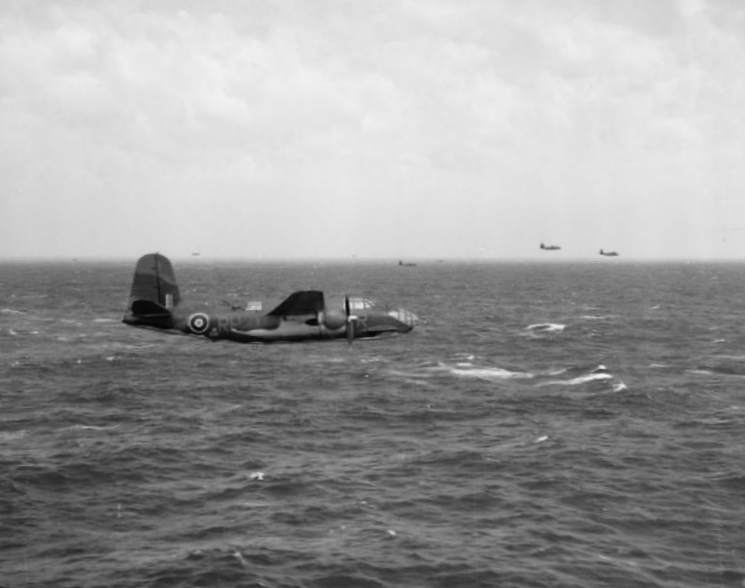
Operation Ramrod 16
It was supposed to be the diversion. On the warm clear afternoon of 3 May 1943, six Boston bombers of 107 Squadron set out from England to hit the Royal Blast Furnaces at IJmuiden on the Dutch coast. Twelve Lockheed Ventura Mk II bombers of 487 Squadron, Royal New Zealand Air Force, took off from RAF Methwold in Norfolk to bomb the Hemweg power station at the north end of Amsterdam, drawing German fighters away from the steelworks. Thirteen Spitfire squadrons flew yet another decoy mission toward Vlissingen. Everything that could go wrong went wrong, and forty minutes after the Venturas crossed the Dutch coast eleven of them were gone, scattered across polders and the cold North Sea.
The Coin Toss
At RAF Methwold that morning the air crews of 487 Squadron were briefed in bright blue skies. The stated purpose of the raid was to encourage Dutch civilians to resist German pressure, by demonstrating that the RAF could strike industrial targets near Amsterdam in broad daylight. Squadron Leader Leonard Trent's B Flight would lead, followed by Squadron Leader Jack Meakin's A Flight. The choice of which flight led had been settled by a coin toss the morning before. Trent won the toss. He would later survive the day; many of Meakin's crews would not. The crews were told to expect determined opposition and to press on at all costs. The Venturas would cross the North Sea at wave-top height, climb hard ten minutes from the Dutch coast, fly straight to the power station, drop, and run for home in the gathering dusk.
Bad Luck Compounded
Two coincidences sealed what followed. First, the thirteen Spitfire squadrons flying the Rodeo 212 diversion arrived over Vlissingen thirty minutes early, at altitude, on German radar. The diversion that was supposed to confuse the German defenses instead alerted them. Second, the Reichskommissar of the Netherlands, Arthur Seyss-Inquart, happened to be visiting Haarlem that afternoon, with a Luftwaffe conference scheduled at Schiphol airfield for the same day. A great many experienced German fighter pilots from other parts of the Western Front were therefore on the ground at fields just south of where the Venturas were heading. When German radar caught the inbound formations, the Luftwaffe scrambled twenty-four Focke-Wulf 190s of Jagdgeschwader 1 and eight Messerschmitt 109s of Jagdgeschwader 27, led by Hauptmann Dietrich Wickop, far more fighters than the planners had expected.
Forty Minutes
One Ventura, Q-Queenie, turned back five minutes after takeoff with a faulty escape hatch. The remaining eleven met their Spitfire escort over RAF Coltishall and climbed for the Dutch coast. The close-escort Spitfire Mk Vs of 504 Squadron were lagging behind, still climbing, when the German fighters fell on the formation. The commander of the Coltishall Wing, Wing Commander Howard Blatchford, tried to warn the Venturas by radio but they were already surrounded. Blatchford's Spitfire was hit; he came down in the North Sea off Mundesley and his body was never recovered. Flight Lieutenant A. V. Duffill's Ventura took cannon fire to both engines and turned for home in flames, gunners wounded; he somehow nursed it back to Methwold. The other Venturas of 487 Squadron, one by one, fell in flames or shattered in midair over the polders south of Amsterdam.
Trent's Last Run
Trent watched his wingmen die and kept pressing toward the power station. Approaching the target, one of the Messerschmitts overshot and crossed in front of his nose; Trent fired his fixed twin nose guns, the Bf 109 caught the burst and went down in flames. He was, by all accounts, surprised the Germans would chase him through their own anti-aircraft fire. He released his bombs over the Hemweg target, turned for home, and was hit again. The Ventura went into a sharp spin and broke apart in the air over Kometon Polder. Trent and his navigator, Flight Lieutenant Vivian Phillips, were thrown clear and pulled their parachute cords. The two gunners could not get out. Trent and Phillips landed in a Dutch field and were taken prisoner. Of the twelve Venturas that had taken off that afternoon, only Q-Queenie and Duffill's wreck returned to England. Few of the men in the nine aircraft shot down survived. JG 1 lost three Fw 190s and two pilots, including the leading ace of II./JG 1, Oberfeldwebel Ernst Heesen, credited with thirty-two aerial victories.
Stalag Luft III and the Great Escape
Trent spent the rest of the war in Stalag Luft III in Sagan, the camp made famous by the mass tunnel escape of March 1944. He helped dispose of sand from the tunnel and worked as a security officer to keep the guards from noticing the operation. On the night of the breakout he crawled through the tunnel and was actually outside the wire, waiting to slip into the woods, when a patrolling sentry stumbled on the men queued behind him and raised the alarm. Trent was caught at the tunnel mouth. Fifty of the escapees who got further were shot by the Gestapo on Hitler's orders. Trent survived the war, was repatriated in 1945, and only then could the full story of Ramrod 16 be told. He was awarded the Victoria Cross at Buckingham Palace on 12 April 1946. Phillips received the Distinguished Service Order. The other men of 487 Squadron are remembered on graves and memorials across the polders south of Amsterdam, in villages whose names appeared in the squadron diary that evening: Bennebroek, Vijfhuizen, Bornstrasse, Hernbrug, Kominten Polder.
What the Squadron Did Next
When 487 Squadron's roll was called on 6 May, only six crews and eight aircraft remained. The squadron diarist's entry is terse. Morale in 464 Squadron, the sister Ventura unit, suffered nearly as badly: by the toss of a coin, it had not been their turn that day. Squadron Leader Alan Wilson took command of 487 Squadron and rebuilt it to a complement of twenty-one crews. By 23 May they were attacking coking ovens at Zeebrugge. On 28 May King George VI visited Methwold to meet fourteen crews from each squadron on the base. In August 487 Squadron re-equipped with de Havilland Mosquitos, joined 140 Wing, and went on to participate in the Amiens prison raid, Operation Jericho, in February 1944. The Hemweg power station kept generating electricity. The Royal Blast Furnaces at IJmuiden, hit by the diversion that turned out to be the more successful attack, kept making steel until the end of the war.
From the Air
The Ventura formation's target was the Hemweg power station at approximately 52.398 N, 4.900 E in northern Amsterdam, while crashes were scattered south and west across the polders between Haarlem and Amsterdam. Trent's aircraft crashed at Kometon Polder; other Venturas came down at Bennebroek, Vijfhuizen, Bornstrasse and Hernbrug. The route departed Norfolk via RAF Methwold and RAF Coltishall, crossing the North Sea at wave-top height. Visible from cruising altitude in clear weather, the area lies between Amsterdam Schiphol (EHAM, 8 km south of crash sites) and the IJ waterway.