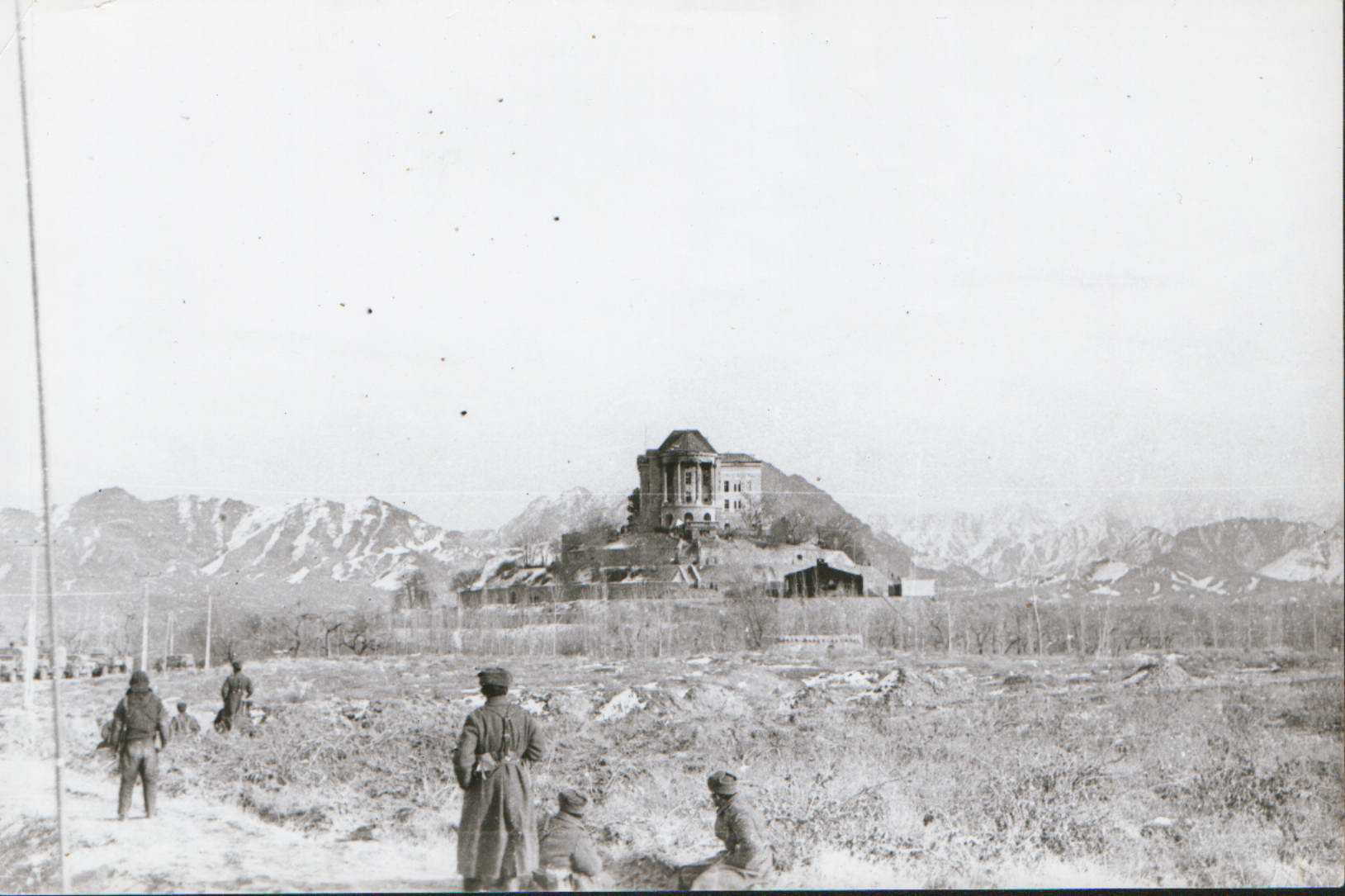
Operation Storm-333
The palace guards never had a reason to suspect the soldiers protecting them. The 154th Separate Spetsnaz Detachment -- known informally as the "Muslim Battalion" because its 520 men had been recruited exclusively from the Soviet Union's Central Asian republics -- had been stationed at the Tajbeg Palace at the personal request of Afghan leader Hafizullah Amin. He did not trust his own troops. So he invited soldiers who looked like Afghans, spoke Turkic and Persian languages, and answered to Moscow. On the evening of December 27, 1979, those soldiers turned their weapons on the palace they had been hired to protect.
A Puppet Who Cut His Strings
The road to the Tajbeg Palace began with a revolution. In April 1978, the Saur Revolution brought the People's Democratic Party of Afghanistan to power under Nur Muhammad Taraki, a Marxist who aligned closely with the Soviet Union. Moscow was pleased. But the party was split between two factions -- the Khalq and the Parcham -- and the rivalry proved fatal. In September 1979, Hafizullah Amin, a Khalqist hardliner, deposed Taraki and almost certainly ordered his murder. Soviet-Afghan relations deteriorated immediately. The KGB branded Amin a "smooth-talking fascist who was secretly pro-western" and claimed he was collaborating with the CIA -- an allegation later discredited by the Soviet archives themselves, which revealed that the KGB had fabricated the story. Whether or not Moscow believed its own disinformation, the conclusion was the same: Amin had to go. By December, Soviet leadership had allied with the exiled Parchamist Babrak Karmal and made the decision to intervene. On December 12, 1979, the plan was authorized.
Thunder and Zenith
Operation Storm-333 was the spearhead of a larger campaign called Operation Baikal-79, which aimed to seize roughly 20 key installations in and around Kabul -- military headquarters, communications centers, prisons. But Storm-333 had only one target: the Tajbeg Palace and the man inside it. The assault force was built from the Soviet Union's most elite units. Twenty-five operators from Alpha Group's Grom ("Thunder") team and 30 from the KGB's Zenit ("Zenith") unit -- later reconstituted as the legendary Vympel -- formed the core. Behind them came 87 paratroopers from the 345th Independent Guards Airborne Regiment and the 520 men of the Muslim Battalion. The Alpha team's mission was to find and kill Amin. Vympel's task was different: they were to collect evidence that Amin had been collaborating with the United States. According to Oleg Balashov, second in command of the assault group, both elite units infiltrated Afghanistan secretly and blended into the Muslim Battalion to create the impression that Afghan forces were conducting the operation. In reality, Alpha and Vympel did nearly all the work.
The Assault on the Hill
The Tajbeg Palace sat on a high, steep hill in Kabul -- a naturally defensible position that Amin had reinforced with a substantial guard force. Soviet historian Aleksandr Lyakhovskiy, who later documented the operation in detail, noted the ferocity on both sides. The defenders fought hard. Thirty palace guards were killed in the fighting, along with more than 300 army guards stationed around the perimeter. Another 150 were captured. The human cost extended beyond combatants. Two of Amin's sons -- an eleven-year-old and a nine-year-old -- died from shrapnel wounds during the clashes. Amin himself was killed, though the precise circumstances of his death remained a matter of conflicting accounts for years. In the operation's aftermath, 1,700 Afghan soldiers who had surrendered to Soviet forces were taken prisoner. While Soviet troops crossed the Amu Darya river and flew into airbases across the country with exiled Parchamists aboard, the palace assault had already decided the political outcome. Babrak Karmal was installed as Afghanistan's new leader before the bodies were cold.
The War That Followed
Operation Storm-333 lasted hours. The war it started lasted a decade. The Soviet-Afghan War, which officially began on December 27, 1979, would kill an estimated 15,000 Soviet soldiers and over one million Afghans before the last Soviet troops withdrew in February 1989. The invasion drew international condemnation, triggered a U.S.-led boycott of the 1980 Moscow Olympics, and channeled billions of dollars in covert American aid to the mujahideen resistance through Pakistan's intelligence services. The conflict became one of the defining proxy wars of the Cold War, a grinding occupation that bled Soviet resources and morale until the empire itself began to crack. For Afghanistan, the consequences were even more devastating. The war destroyed the country's infrastructure, displaced millions, and created the conditions for the rise of the Taliban in the 1990s and the eventual American intervention after September 11, 2001. All of it can be traced back to a single night on a hilltop in Kabul, when a few dozen elite soldiers stormed a palace and changed the trajectory of nations.
From the Air
The Tajbeg Palace is located at approximately 34.45N, 69.11E on a prominent hilltop in southwestern Kabul, near the Darul Aman Palace. The hill is visible from the air as a fortified compound elevated above the surrounding terrain. Nearest airport is Kabul International Airport (OAKB), approximately 12 km to the northeast. Elevation of the area is roughly 1,800 meters (5,900 feet), with the palace sitting higher on its hill. The Kabul valley is surrounded by mountains, and the palace's defensive hilltop position is apparent from above.