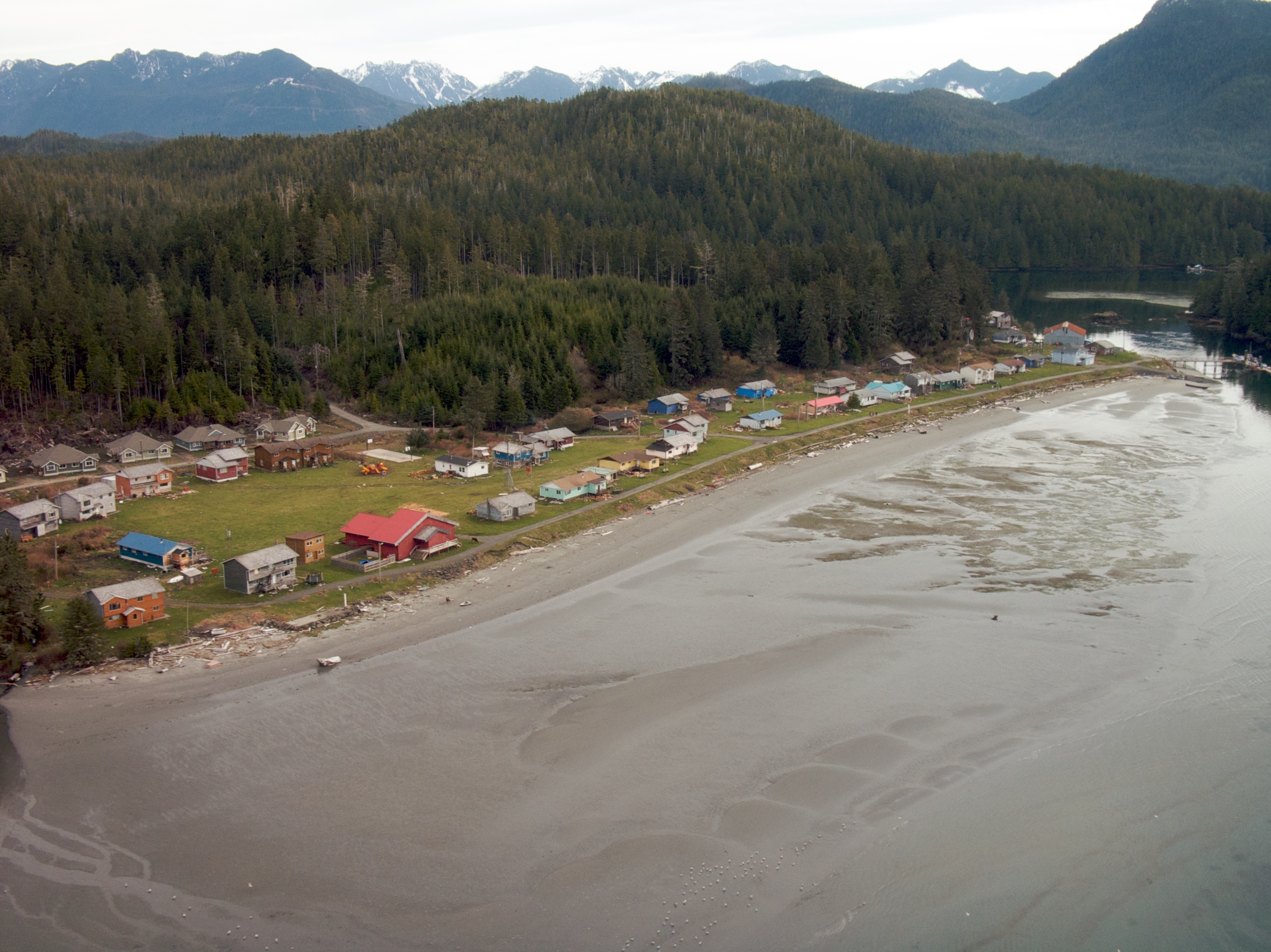
Opitsaht
In 1792, 200 ornately carved longhouses stood at Opitsaht, each sheltering 50 to 100 people. By the time the American captain Robert Gray finished with them, they were kindling. Gray turned the cannons of the Columbia Rediviva on the village during a falling-out with the Tla-o-qui-aht, destroying the seat of Chief Wickaninnish and erasing one of the most impressive settlements on the Pacific Northwest coast. Today, Opitsaht still occupies its ancient site on Meares Island, directly across the water from Tofino, and the Tla-o-qui-aht are still here.
Wickaninnish's Domain
During the era of the Maritime Fur Trade, Opitsaht was the political and ceremonial center of the Tla-o-qui-aht, a people of the Nuu-chah-nulth nation whose territory encompassed much of Clayoquot Sound. In 1791, the Spanish explorer Francisco de Eliza estimated a population of roughly 2,500 at Opitsaht. The following year, the American sailor John Boit counted 200 buildings, their posts and beams carved in the elaborate style characteristic of Nuu-chah-nulth villages. Chief Wickaninnish commanded alliances and trade networks that stretched along the coast. The American sea captain John Kendrick forged a strong partnership with Wickaninnish in the summer of 1791, but the goodwill that Kendrick had cultivated was shattered by his former partner, Robert Gray. When Gray evacuated his trading post on Meares Island, known as Fort Defiance, he ordered his ship's cannons to destroy the unoccupied village. The longhouses were empty at the time, but the destruction was total.
Island of Abundance
Opitsaht sits on a flat peninsula on the southwest corner of Meares Island, ringed by the smaller Arakun, Stockham, and Monas islands. Dense forests of evergreen conifers and shore pines crowd the shoreline, and the understory produces berries and other food plants. Historically, the waters around Meares Island teemed with salmon, sea otters, and whales -- resources that formed the backbone of Tla-o-qui-aht life and the currency of their trade with European and American fur traders. The Clayoquot Sound Canning Company later industrialized salmon harvesting in the area, and the local salmon population declined sharply. One unexpected legacy of the colonial period lingers on the island: feral cattle, introduced but never incorporated into Tla-o-qui-aht cuisine, have adapted to the marshy terrain and still graze along the beaches, wandering freely through a landscape otherwise shaped by forest and tide.
Forced Transformation
The 19th century brought waves of European settlers who reshaped Indigenous life across Vancouver Island. Tla-o-qui-aht people were confined to reserves and subjected to residential schools, instruments of the Indian Act's campaign to suppress Indigenous culture and governance. The Nuu-chah-nulth ceremonial tradition, centered on the Potlatch -- gatherings for the redistribution of wealth, the negotiation of treaties, and the performance of songs, dances, and contests -- was explicitly banned by the federal government from 1884 to 1951. Despite these pressures, Tla-o-qui-aht governance persisted through the Ha'wiih, the hereditary chiefs who held rights to specific ceremonies, stories, and territories. The Ha'wiih continued to lead alongside the elected band government, maintaining a thread of continuity through decades of enforced disruption.
The Forest Stands
When the British Columbia government moved to log the old-growth forests of Clayoquot Sound in 1984, the Tla-o-qui-aht were ready. The ancient cedar and spruce forests of Meares Island were not just timber to them; they were Ha-houlthee, the territory of the Ha'wiih, and the living foundation of cultural identity. The resistance that followed -- blockades, court injunctions, and the massive 1993 protests known as the 'War in the Woods' -- drew international attention and ultimately forced the government to reconsider. In 2000, UNESCO designated Clayoquot Sound a Biosphere Reserve, shielding it from industrial development. Today, Opitsaht remains accessible only by boat or water taxi from Tofino, a five-minute ride across the harbor that bridges centuries. The Tla-o-qui-aht are engaged in ongoing negotiations with the federal government toward self-governance, working to rebuild what the Indian Act dismantled.
From the Air
Located at 49.17N, 125.92W on the southwest shore of Meares Island, directly across the harbor from Tofino. Opitsaht is visible as a small settlement on the island's waterfront, facing Tofino across a narrow channel. Nearest airport is Tofino/Long Beach Airport (CYAZ). Meares Island's forested bulk dominates the view north of Tofino. The settlement is accessible only by water.