Opryland USA
The decision that still haunts Nashville happened on November 4, 1997, when Gaylord Entertainment announced it would tear down Opryland USA and build a shopping mall. The park was profitable. It had been profitable every year since it opened on May 27, 1972. At its peak in the late 1980s, nearly 2.5 million people walked through its gates annually. Former CEO Bud Wendell would later say, bluntly: "Opryland was successful. And it was successful when they shut it down. We weren't losing money." He called the decision "the dumbest thing I've ever seen." By July 1998, the entire site had been scraped to bare concrete. Where the Wabash Cannonball once roared and live bands played jazz in a French Quarter replica, there is now Opry Mills, an outlet shopping mall.
Born from a Visit to Houston
Opryland's origin story begins in 1969, when WSM, Inc. President Irving Waugh visited the Astrodomain complex in Houston, Texas, and noticed something: AstroWorld, the adjacent theme park, drew visitors on days when the Astrodome sat empty. Waugh's company ran the Grand Ole Opry out of the aging Ryman Auditorium downtown, a 3,000-seat venue that was falling apart amid the neighborhood's urban decay. The Opry was growing more popular, not less, and the crowds had outgrown the building. Waugh saw a chance to solve two problems at once -- build a modern Opry House with air conditioning and ample parking, and surround it with an amusement park to fill the property on the five days a week the Opry was dark. WSM purchased Rudy's Farm, a large tract in Nashville's Pennington Bend along the Cumberland River, and announced plans for the Opryland complex on October 13, 1969.
The Showpark That Celebrated American Music
Opryland opened two years before the Grand Ole Opry House itself, which debuted on March 16, 1974, with a visit from President Richard Nixon. Despite its name -- borrowed from WSM disc jockey Grant Turner's radio show -- the park was never solely about country music. Nine themed areas celebrated jazz, gospel, bluegrass, pop, rock and roll, and the American frontier. Doo Wah Diddy City honored 1950s rock and roll. The New Orleans Area featured Dixieland jazz with buildings modeled after the French Quarter. The American West Area was designed to resemble 1870s El Paso. What truly set Opryland apart was its emphasis on live musical productions over thrill rides, earning it the label "showpark" rather than theme park. The band Diamond Rio got its start here: originally called the Grizzly River Boys, they were hired to promote a water ride and became so popular they never stopped performing.
Country Music's Living Room
Gaylord Broadcasting Company of Oklahoma City purchased the entire WSM package -- the radio stations, The Nashville Network cable channel, the Grand Ole Opry, the Ryman Auditorium, Opryland Hotel, and the theme park -- in September 1983. Ed Gaylord's close friendship with Sarah Cannon, the actress who portrayed Minnie Pearl, heavily influenced the deal. Under Gaylord's ownership, Opryland became intertwined with the country music industry. The Nashville Network broadcast a nightly variety show live from the Gaslight Theatre inside the park gates. In 1994, Alabama, George Jones, Tammy Wynette, Tanya Tucker, and The Oak Ridge Boys took up summer residencies across the park's theaters. Family Feud taped episodes at Opryland in 1993 -- the only time in the show's long history that episodes were taped on location -- featuring country stars like Porter Wagoner, Charley Pride, and the Statler Brothers. The Grizzly River Rampage even hosted the NationsBank Whitewater Championships in 1995, which served as a qualifier for the 1996 Summer Olympics.
Hemmed In by Water and Asphalt
From its first day, Opryland's geography was a slow-burning problem. The park occupied a triangular tract bounded by the Cumberland River on one side and Briley Parkway on another, with Opryland Hotel filling the third edge. In 1975, the Cumberland flooded most of the park before the season could even open, killing animals in the petting zoo. When consumer tastes demanded new attractions, the park had to demolish old rides to make room: the Raft Ride was torn out in 1986 for the Old Mill Scream, and the Tin Lizzies vanished in 1994 for The Hangman, the last major ride ever installed. The Delta hotel expansion in 1996 consumed all remaining contiguous land. Nashville's winters made year-round operation impossible, and a booming local economy made seasonal workers scarce. When Terry London replaced the retiring Bud Wendell as CEO in 1997, he saw a property with no room to grow and too many idle months. He chose the mall.
What Remains at Pennington Bend
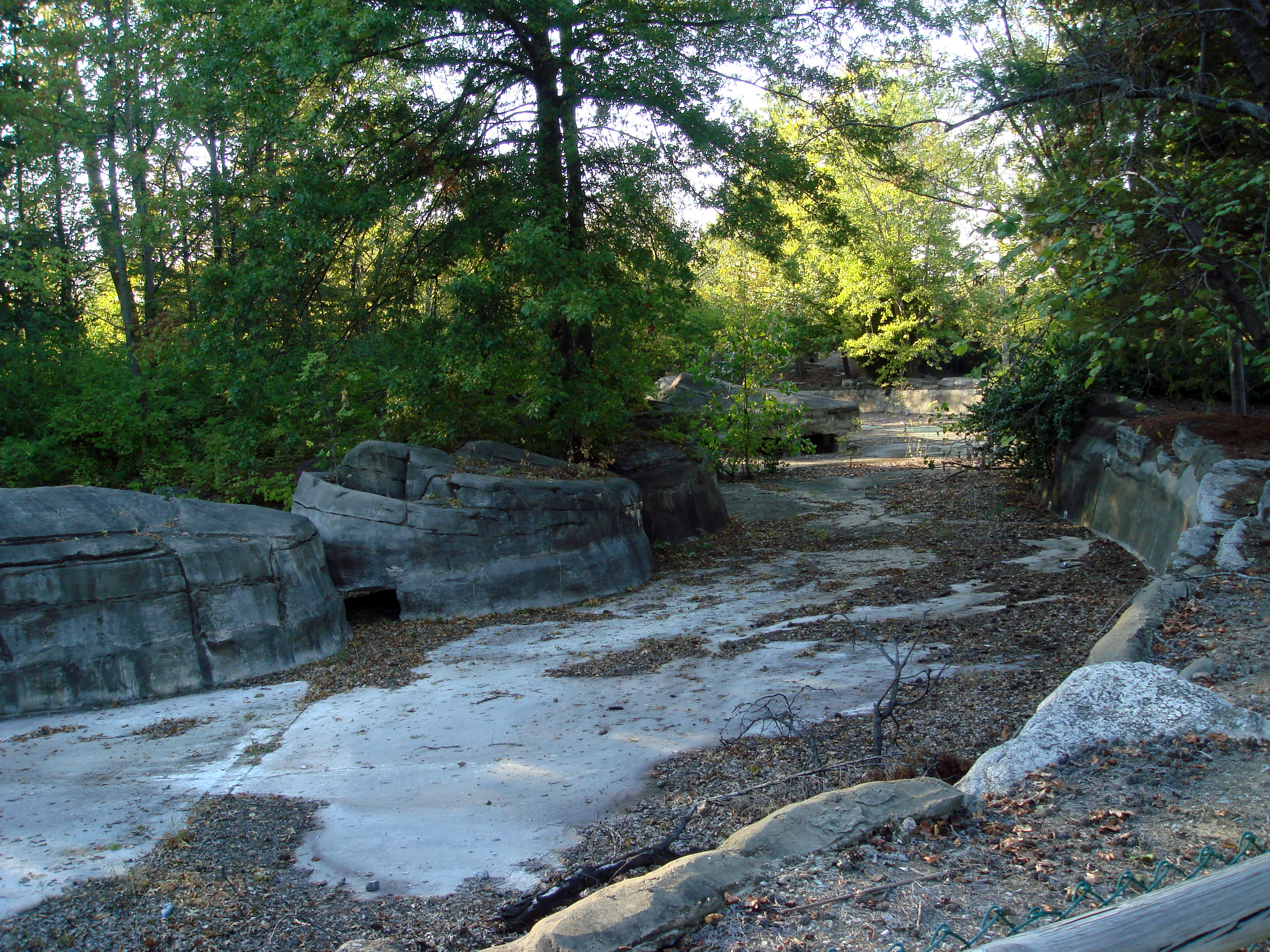
Nashville tourism dropped 40 percent in the summer of 1998. The city's Convention and Visitors Corporation had to reinvent its entire marketing strategy, shifting focus to the downtown renaissance that was already underway with the new arena, the football stadium, and the relocated Country Music Hall of Fame. The five roller coasters were auctioned for $7.034 million to Premier Parks; most sat rusting in an Indiana field until 2002. The Rock n' Roller Coaster resurfaced in 2003 as Canyon Blaster at Six Flags Great Escape in New York. The Grizzly River Rampage's concrete channel remained visible for 14 years until it was finally cleared in 2011. As of 2025, only three original structures remain on the property: the Grand Ole Opry House, the Roy Acuff House (now the WSM Radio studio), and the former Grand Ole Opry Museum (now a training center). In 2012, Gaylord CEO Colin Reed called the park's closure "a bad idea" and announced plans for a new theme park with Dolly Parton and Herschend Family Entertainment. Those plans collapsed within months. The Opry Mills parking lot sits where the Wabash Cannonball once climbed its first hill.
From the Air
The former Opryland USA site is at 36.2083N, 86.6953W in Nashville's Pennington Bend along the Cumberland River. The distinctive river bend and the massive Gaylord Opryland Resort complex are unmistakable from the air. Opry Mills mall now occupies the former park footprint. The Grand Ole Opry House is still visible adjacent to the mall. Best viewed from 3,000-6,000 feet AGL. Nashville International Airport (KBNA) is approximately 7 nautical miles south. Look for the sharp meander of the Cumberland River and Briley Parkway as visual references.