Oracabessa Bay Fish Sanctuary
Sixteen thousand hawksbill hatchlings scramble across sand toward the Caribbean each year at Oracabessa Bay, their flippers tracing tiny furrows in the dark. A sanctuary warden crouches nearby, shielding them from frigatebirds and ghost crabs, counting each one that reaches the surf. A decade ago, those nests went unprotected and these beaches were losing their turtles. The turnaround at Oracabessa Bay Fish Sanctuary, established in 2010 on Jamaica's north coast, is one of the Caribbean's quieter conservation victories, built not by outside experts but by the fishing community that depends on the bay for its livelihood.
Where the Reef Meets the Abyss
Oracabessa Bay sits in Saint Mary Parish on Jamaica's northeastern shore, a crescent of turquoise water backed by mangroves and estuarine channels that serve as nursery habitat for dozens of marine species. The bay's northern boundary drops away at the edge of the Cayman Trough, one of the Caribbean's deepest submarine trenches, plunging more than 25,000 feet into blackness. Along that edge, reef walls begin at around 60 feet and cascade to over 150, draped in elephant-ear sponges, basket sponges, and enormous fans of black coral and gorgonia in shades of red, pink, yellow, and orange. Lobsters wedge into overhangs. King crabs and spotted moray eels patrol the ledges. The Golden Clouds reef, one of the bay's largest, draws divers for its structural complexity and the sheer density of life clinging to its surfaces. Beyond the sanctuary's boundaries, the deep water is renowned for marlin and tuna, but inside the protected zone the emphasis is on what grows rather than what is caught.
Fishermen Who Became Gardeners
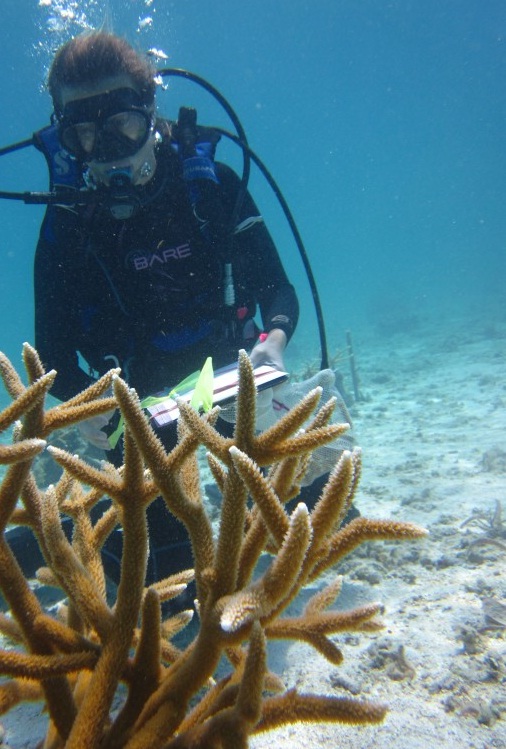
The Oracabessa Foundation, a local group alarmed by declining fish stocks, pushed for the bay's official protection. When it came in 2010, the sanctuary faced a practical problem: fishermen who had worked these waters for generations needed alternative livelihoods. The answer arrived in 2012 through a Global Environment Facility grant that funded the Coral Propagation Project. The concept is called coral gardening. Workers collect fragments of staghorn coral, grow them in underwater nurseries until they are robust, then transplant them onto degraded reef sections. The project aimed to propagate 2,000 individual pieces of staghorn coral and out-plant them across the bay's reefs. Former fishermen were retrained as coral gardeners, their intimate knowledge of the bay's currents and bottom topography making them ideal candidates. What had been an extractive relationship with the reef became a restorative one, and the steady employment gave families economic stability that seasonal fishing never had.
The Turtle Beach Ritual
The same year the sanctuary launched, it began the Oracabessa Bay Sea Turtle Project, focused on the critically endangered hawksbill sea turtle. Wardens monitor nesting beaches throughout the season, tracking nests and timing releases to maximize hatchling survival. The process is precise: when a nest is ready, a warden carefully opens it and the hatchlings pour out, scrambling instinctively toward the ocean. Visitors gather to watch, but the real audience is the wardens keeping predatory birds and crabs at bay. Over 100 nests are now recorded each year, producing those 16,000 hatchlings, a number that would have seemed improbable when the project started. The nesting beach sits adjacent to the locally famous James Bond Beach, named for its connection to Ian Fleming's nearby estate, GoldenEye, where Fleming wrote the Bond novels. Tourism and conservation share this coastline, each reinforcing the other.
A Community's Stake in the Water
Oracabessa has been a fishing village for as long as anyone remembers. The bay's ecosystem, its mangroves filtering runoff, its reefs sheltering juvenile fish, its estuaries providing nutrient-rich nursery habitat, underpins the local economy whether residents fish, dive, or host visitors. The sanctuary model works here because it was never imposed from outside. The Oracabessa Foundation is a local organization, and its partnerships with international groups like Seacology and the Global Environment Facility provided funding without displacing local decision-making. The result is a sanctuary where the people who enforce the rules are the same people who used to fish those waters, and who understand better than any outsider what is at stake if the reef fails. Investments by these partners funded not just coral propagation and turtle monitoring but the infrastructure of ongoing stewardship, turning a one-time declaration into a living program.
From the Air
Located at 18.40N, 76.95W on Jamaica's north coast in Saint Mary Parish. The bay is visible as a turquoise crescent against the darker Caribbean waters, with mangrove-fringed shoreline. The Cayman Trough lies just offshore to the north. Nearest major airport is Ian Fleming International Airport (MKNG/OCJ) at Boscobel, roughly 5 nautical miles to the east. Norman Manley International (MKJP/KIN) in Kingston is about 55 nm to the south. Best viewed at 2,000-5,000 feet AGL for reef and shoreline detail.