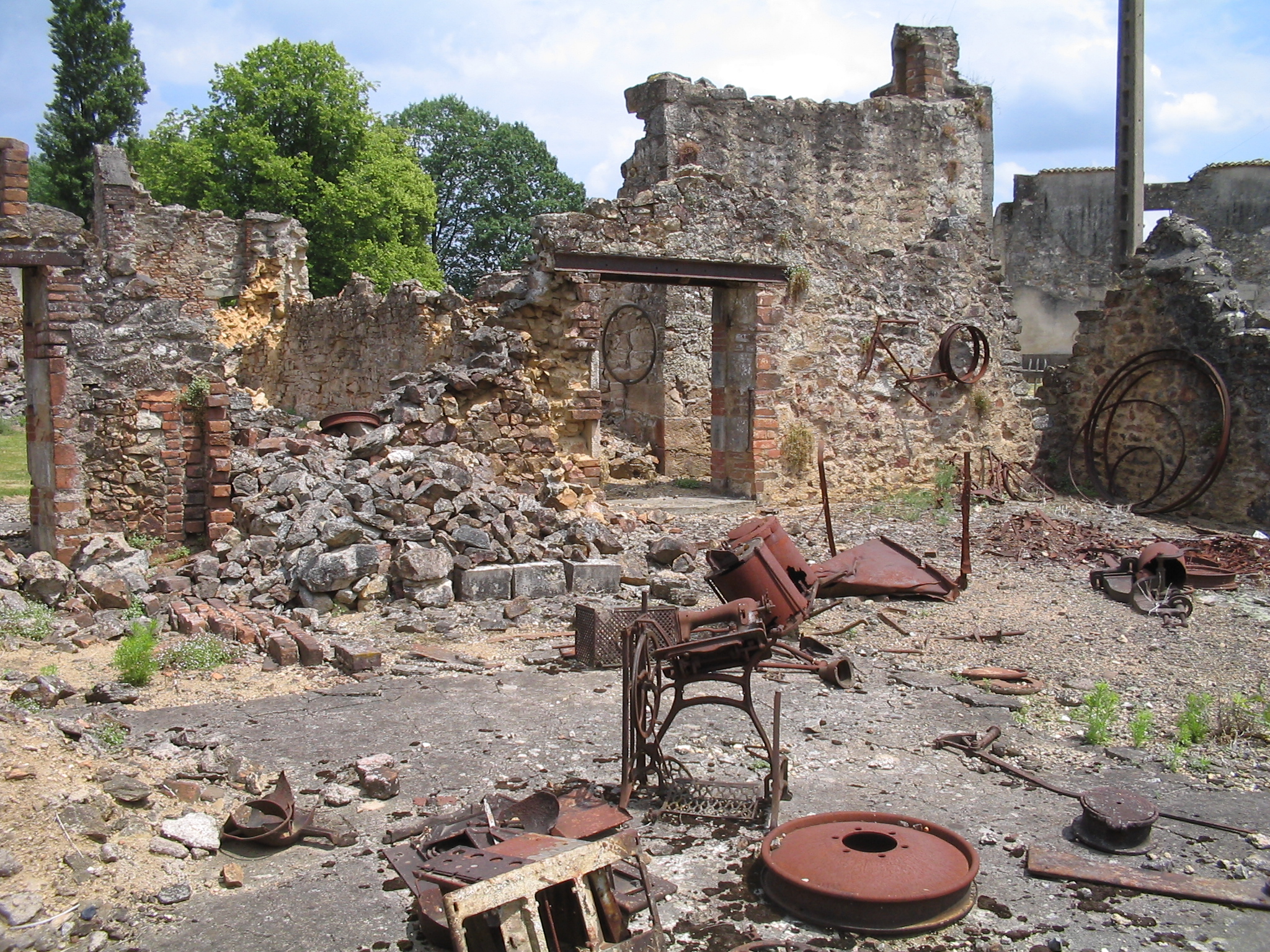
Oradour-sur-Glane Massacre
The watches recovered from the ruins of Oradour-sur-Glane all stopped between four and five in the afternoon. Their owners had been burned alive. Today those watches sit in a museum display case near the entrance to what the French call the Village Martyr -- the martyred village -- their frozen hands marking the hour when an ordinary Saturday in a quiet commune in Haute-Vienne became one of the worst massacres of civilians on French soil during World War II. On 10 June 1944, four days after D-Day, soldiers of the 2nd SS Panzer Division Das Reich killed 642 people here: 190 men, 247 women, and 205 children.
A Village Sealed Off
Oradour-sur-Glane was not a center of Resistance activity. The SS unit that arrived on the afternoon of June 10 was acting on faulty intelligence and a thirst for retaliation. Their battalion commander, Sturmbanführer Adolf Diekmann, believed the French Resistance was holding a captured SS officer, Helmut Kämpfe, in the area. Kämpfe had in fact been captured the day before near Saint-Léonard-de-Noblat and was already dead, executed by Maquis fighters. But two members of the Milice, the Vichy paramilitary, pointed Diekmann toward Oradour-sur-Glane -- possibly confusing it with the nearby Oradour-sur-Vayres. The soldiers sealed off the village and ordered everyone to assemble in the main square, ostensibly for an identity check. Among those gathered were six people who had simply been cycling through when the SS arrived.
The Hours of Destruction
The men were separated from the women and children and led to six barns and sheds where machine guns had already been positioned. The SS aimed for their legs first, immobilizing them before dousing the buildings with fuel and setting them alight. Five men survived by crawling beneath the bodies of the dead. The women and children -- 247 women, 205 children -- were locked inside the village church. An incendiary device was ignited inside. When people tried to escape through doors and windows, they were met with machine gun fire. Only one woman survived: 47-year-old Marguerite Rouffanche, who climbed through a sacristy window, was shot, and crawled to nearby pea bushes where she hid until morning. A young woman and child who followed her through the window were killed. Among the dead were three parish priests, 17 Spanish citizens, 8 Italians -- a mother and seven of her nine children -- and 3 Poles. The village was then systematically razed.
Justice Delayed and Denied
Protests followed even within the German command. Field Marshal Erwin Rommel objected to Diekmann's actions. Regimental commander Sylvester Stadler ordered a court martial. But Diekmann was killed in Normandy on June 29, and the charges died with him. Division commander Heinz Lammerding, who had authorized the reprisal policy, lived out his postwar years as a successful businessman in Düsseldorf, never extradited despite French requests. A 1953 military tribunal in Bordeaux charged 65 of the roughly 200 SS men involved, but only 21 appeared -- among them 14 Alsatians, French citizens conscripted into the Waffen-SS. These malgré-nous, meaning 'against our will,' were convicted but quickly amnestied by the French parliament, igniting bitter protests in the Limousin region. The last trial came in 1983, when former platoon leader Heinz Barth was sentenced to life imprisonment in East Berlin. He was released in 1997.
The Village That Stands as It Fell
Charles de Gaulle ordered that Oradour-sur-Glane never be rebuilt. A new village was constructed nearby, but the ruins of the original remain exactly as the SS left them -- roofless stone walls, a burned-out church, rusted cars on empty streets. In 1999, President Jacques Chirac dedicated the Centre de la mémoire d'Oradour, a memorial museum near the entrance to the ruins. Its displays include melted eyeglasses, scorched personal effects, and those stopped watches. In 2013, German president Joachim Gauck visited alongside French president François Hollande -- the first time a German head of state had come to the site. Robert Hébras, the last living survivor, who was 18 at the time of the massacre, spent decades working for reconciliation between France, Germany, and Austria. He died on 11 February 2023 at the age of 97. The village remains a place of silence, its ruins speaking for those who cannot.
From the Air
Located at 45.93°N, 1.04°E in Haute-Vienne, approximately 22 km northwest of Limoges. The preserved ruins of the original village are visible from moderate altitude as a distinct cluster of roofless structures separate from the new village built nearby. Nearest airport is Limoges-Bellegarde (LFBL). Best viewed at 2,000-3,000 ft AGL. This is a memorial site -- approach with appropriate respect.