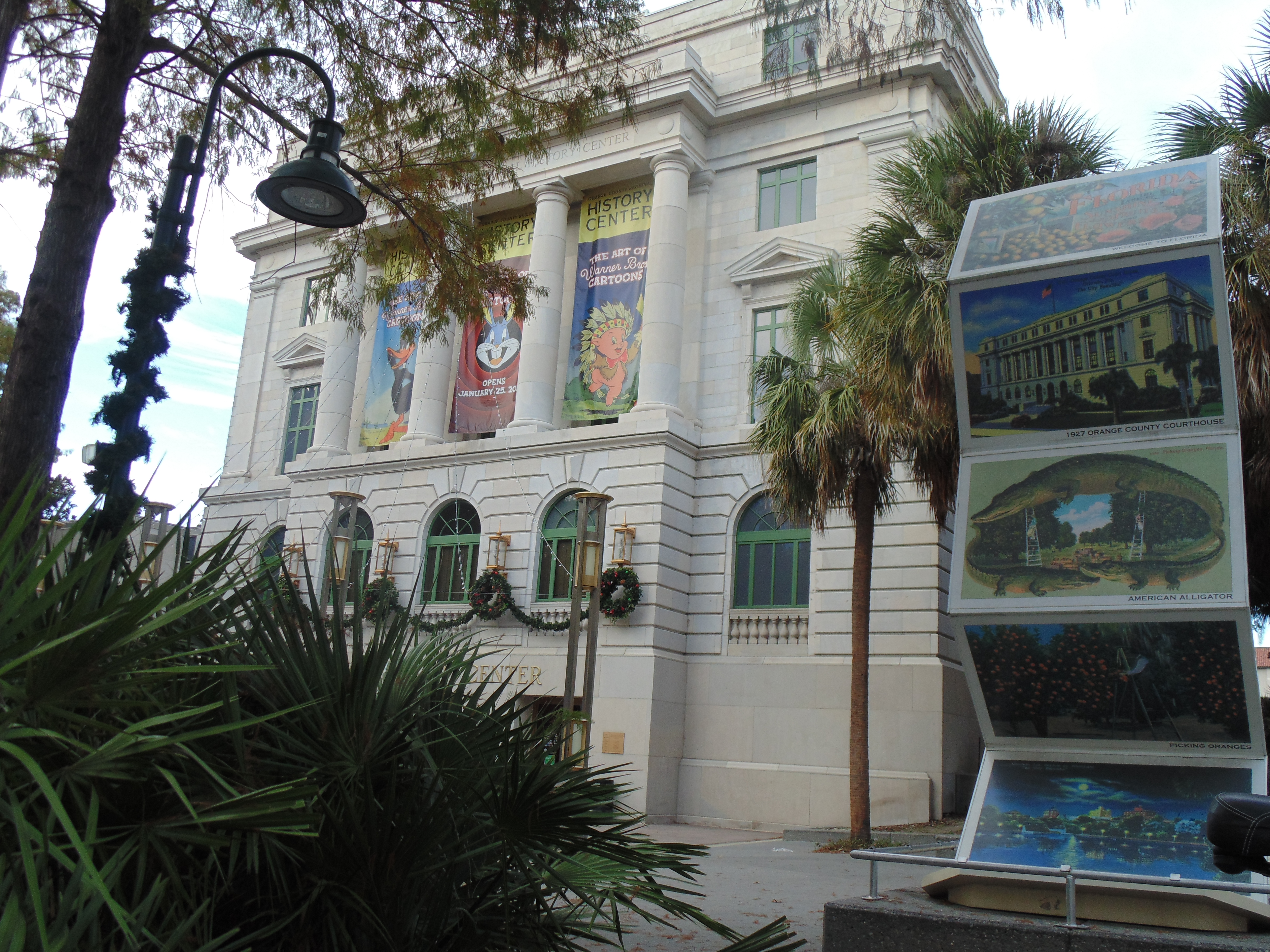
Orange County Regional History Center
The fifth floor of the Orange County Regional History Center once held prisoners. A jail sat at the top of the 1927 courthouse, complete with quarters for the jailer and his wife and a small infirmary for inmates too sick to be moved. Today, that same floor houses the Joseph L. Brechner Research Center, where visitors can browse more than 5,000 volumes of regional history by appointment, free of charge. The transformation is fitting. This building in downtown Orlando has spent nearly a century changing its purpose while keeping its walls -- from seat of justice to archive of memory, from the place where Orange County adjudicated its present to the place where it preserves its past.
A Courthouse That Outlived Its Courts
The building's story begins with Orlando's first registered architect. Murry S. King won the commission to design a new Orange County courthouse, a neoclassical structure that would replace the red-brick courthouse built in 1892 at the newly established city limits. Construction began in May 1926, funded at nearly $1 million -- a significant investment for a Central Florida community still years away from air conditioning and interstate highways. King died before the building was completed, and his son, James B. King, oversaw the final work. The courthouse was dedicated on October 12, 1927. It served as the seat of county government for decades, but as Orlando grew, the building could not keep pace. A courthouse annex was added in 1960. By 1989, that annex had been closed due to asbestos contamination. In 1995, Orange County opened a modern high-rise courthouse, and a task force of community leaders unanimously recommended that the 1927 building be repurposed as a regional history museum rather than demolished.
Twelve Thousand Years in Five Floors
The Orange County Regional History Center opened in September 2000, housing the collections of the Historical Society of Central Florida across three exhibit floors, with an atrium and gift shop on the ground level and the Brechner Research Center on the fifth. Its permanent exhibits reach far deeper than the theme park era that defines Orlando in the popular imagination. The timeline begins roughly 12,000 years ago, with the Paleo-Indian cultures that inhabited the region's lakes and springs. Exhibits trace the arc through Seminole history, the citrus industry boom that gave Orange County its name, the cattle ranching economy that preceded the groves, and the military presence that transformed the region during World War II. The museum does not flinch from difficult history, either. Central Florida's story includes segregation, displacement, and the environmental costs of explosive growth -- all of which find space within the courthouse walls.
The Brechner Legacy
The fifth-floor research center carries the name of Joseph L. Brechner, an award-winning journalist and freedom-of-information advocate whose widow, Marion Brody Brechner, funded its creation. The center houses the Historical Society's special collections, a research library, and archival materials spanning the full breadth of Central Florida's documented past. The collection includes more than 5,000 volumes -- local newspapers, land records, family papers, and photographs that offer granular detail unavailable in the exhibit halls below. Access is free by appointment, making it one of the most accessible regional archives in the state. For genealogists, local historians, and students, the Brechner Center is the place where Orlando's official narrative gives way to the particular: individual deeds, individual lives, individual stories that the museum's broader exhibits can only gesture toward.
Teaching the County Its Own Story
The History Center runs several educational programs that extend its reach beyond the courthouse walls. History on the Go sends presentations -- including plays and puppet shows -- directly into Orange County public schools, accompanied by curriculum materials aligned with Florida's Sunshine State Standards. Home School Days provides programming tailored for homeschooling families. School Break Camps offer structured programs during winter and summer vacations for children ages six through high school. The museum also sits at the center of a civic landscape that reinforces its purpose. Heritage Park, built in 1998 on the site of the demolished courthouse annex, flanks the building. Downtown Orlando's Lake Eola Park is a short walk east. The History Center occupies a position where the physical layers of the city -- 19th-century courthouse, 20th-century park, 21st-century skyline -- are all visible at once, a geography lesson that requires no exhibit labels.
From the Air
Located at 28.543N, 81.378W in downtown Orlando, Florida, on the corner of Central Boulevard and Magnolia Avenue. The neoclassical 1927 courthouse is identifiable from the air by its symmetrical form and Heritage Park to its west. Lake Eola is approximately 0.3nm to the east. Recommended viewing altitude 1,500-2,500 feet AGL. Nearby airports: Orlando Executive Airport (KORL) approximately 3nm southeast, Orlando International Airport (KMCO) approximately 10nm south-southeast. The building sits within the downtown Orlando core, surrounded by modern high-rise development.