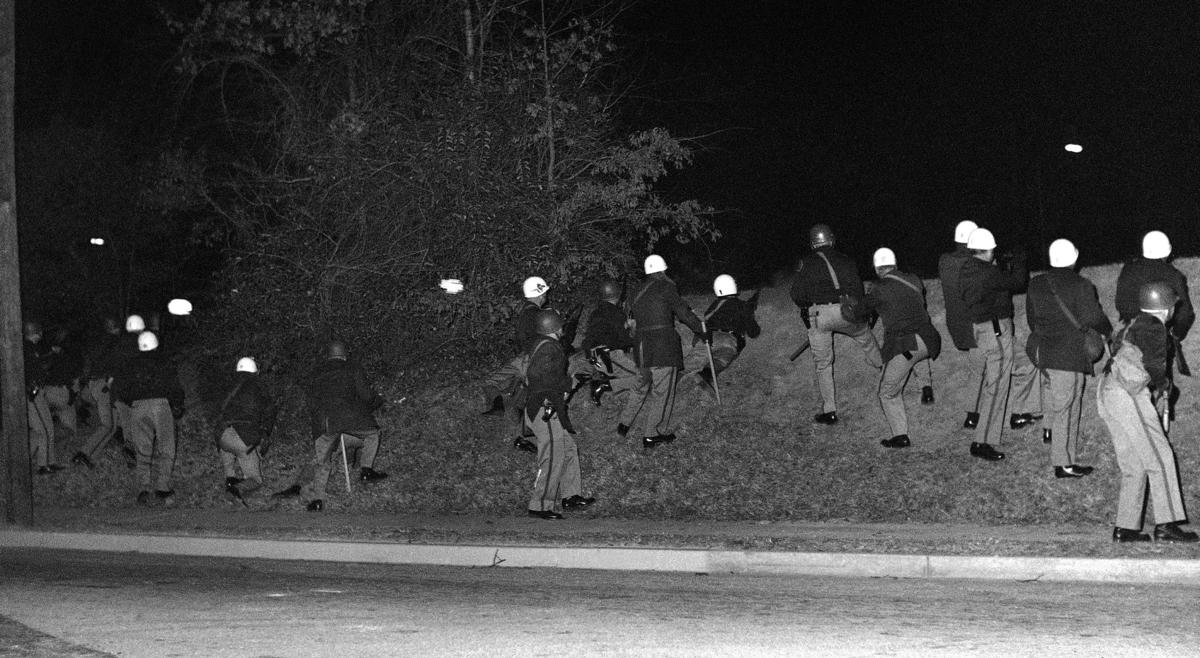
Orangeburg Massacre
It started with a bowling alley. In February 1968, while the nation's attention was fixed on Vietnam and the presidential primaries, Black students at South Carolina State College in Orangeburg wanted to knock down pins at the All-Star Bowling Lane a few blocks from campus. The owner refused to serve them. A student named John Stroman devised a clever legal strategy: send a white student first, with no club membership, and watch him bowl without question. When Stroman and his classmates arrived moments later, the staff refused them entry and threw away anything they touched. That act of defiance over ten-pin bowling set off three days of escalating confrontation that ended with highway patrolmen firing shotguns into a crowd of fleeing students. Three young men died. Twenty-eight more were wounded. It was the first time American police shot and killed students on a university campus - two full years before Kent State made the practice infamous.
A City Primed to Burn
Orangeburg had been a flashpoint long before 1968. In 1960, a thousand students from South Carolina State and neighboring Claflin College marched downtown to protest segregation. Police and firefighters met them with fire hoses and tear gas, arrested nearly 400 students, and confined them in an outdoor cattle stockade. The college president promised to expel any student who protested again. By 1967, a student walkout forced that president's resignation. A new administration allowed political organizations on campus for the first time, including a chapter of the NAACP and the smaller, more militant Black Awareness Coordinating Committee. Meanwhile, the city remained stubbornly segregated. Doctors' offices, entertainment venues, and even the Orangeburg Regional Hospital maintained separate facilities. The city boundaries were gerrymandered to exclude Black voters. Governor Robert McNair had just rejected the college's request for a budget increase despite a stark funding gap between Black and white institutions. The bowling alley was simply the match that found the kindling.
Three Days in February
Stroman's planned sit-in on February 5 went exactly as designed. Fifteen students were arrested for trespassing, intending to challenge the policy in court. But the situation spiraled when a fire truck arrived at the bowling alley that night. In Orangeburg, fire hoses had been used as weapons against protesters. Students saw the truck as a provocation. Windows broke. Police waded in with billy clubs. Witnesses described officers beating female students who had fallen while trying to flee. Eight students went to the hospital. By Wednesday, Governor McNair had activated the National Guard, convinced by unfounded rumors that Black activists planned to burn the city. Two hundred fifty guardsmen took up positions protecting utilities. Highway patrol officers flooded in. The local newspaper did not even publish the students' list of demands. Negotiations, which had been slow, collapsed entirely once state officials arrived. The city was an armed camp, and the students had no one left to talk to.
Eight Seconds
On the night of February 8, about 200 students gathered around a bonfire at the front of the State College campus. More than 130 police from at least five agencies surrounded them. When officers moved in to extinguish the fire, someone threw a wooden banister post that struck patrolman David Shealy in the mouth. His fellow officers mistakenly believed he had been shot. Minutes later, students walked back toward the embankment, unaware that sixty-six patrolmen had taken positions in the darkness behind it. Lieutenant Jesse Spell shouted a single word: "now." At least nine patrolmen and one city police officer opened fire. The shooting lasted eight seconds. Most fired Remington Model 870 shotguns. Samuel Hammond, Henry Smith, and Delano Middleton - two State College students and a high school senior - were killed. Most of the thirty-one victims were struck from behind while running or on the soles of their feet while lying on the ground. At the hospital, reporters overheard a patrolman gloating on police radio: "You should have been here, ol' buddy; got a couple of 'em tonight."
The Silence That Followed
The Associated Press reported a "heavy exchange of gunfire" and never corrected the record. Newspapers ran headlines like "Three Die in Riot" and "Trio Slain after Opening Fire on Police." Governor McNair blamed "black power advocates," and his spokesman identified organizer Cleveland Sellers as "the main man" using a racial slur. Most white reporters never left the Holiday Inn to investigate. Time magazine did not mention the event. Federal prosecutors charged nine patrolmen with civil rights violations; all were acquitted. The state charged Sellers - one of the victims - with rioting, convicted him, and sent him to prison. He was not pardoned until 1993. Martin Luther King Jr. demanded an investigation, but the assassinations of King himself and Robert Kennedy soon consumed the news cycle. When Kent State happened two years later, the Orangeburg Massacre had already been forgotten. Historians note that Kent State involved white students protesting a popular cause, Vietnam, while Orangeburg involved Black students fighting segregation - a cause white America had grown tired of supporting.
What Remains
The bowling alley desegregated within weeks of the shooting, as did most of Orangeburg's remaining whites-only establishments. South Carolina State University - the college's current name - maintains a granite monument at the center of campus inscribed with the names of the thirty-one victims. The gymnasium that opened in 1968 was named the Smith-Hammond-Middleton Memorial Center. Bronze busts of the three slain men were installed in 2022. In 2001, Governor Jim Hodges became the first governor to attend the annual memorial service and issued a formal apology. In 2019, photographer Cecil J. Williams, a Claflin graduate who had documented the events, opened South Carolina's first civil rights museum with his collection of images from those February days. The deaths of Hammond, Middleton, and Smith remain on the Department of Justice's list of unsolved civil rights cases. The legislature has never established the official day of remembrance that has been proposed in every session since 2003.
From the Air
Located at 33.50°N, 80.85°W on the campus of South Carolina State University in Orangeburg, South Carolina. The campus and surrounding city are visible southeast of the intersection of US Route 601 and Interstate 26. Orangeburg County Airport (OGB) is approximately 3 miles south. Charleston International Airport (KCHS) is 75 miles southeast. The campus sits in the flat Coastal Plain of central South Carolina, easily identifiable from altitude by its rectangular layout along US 601.