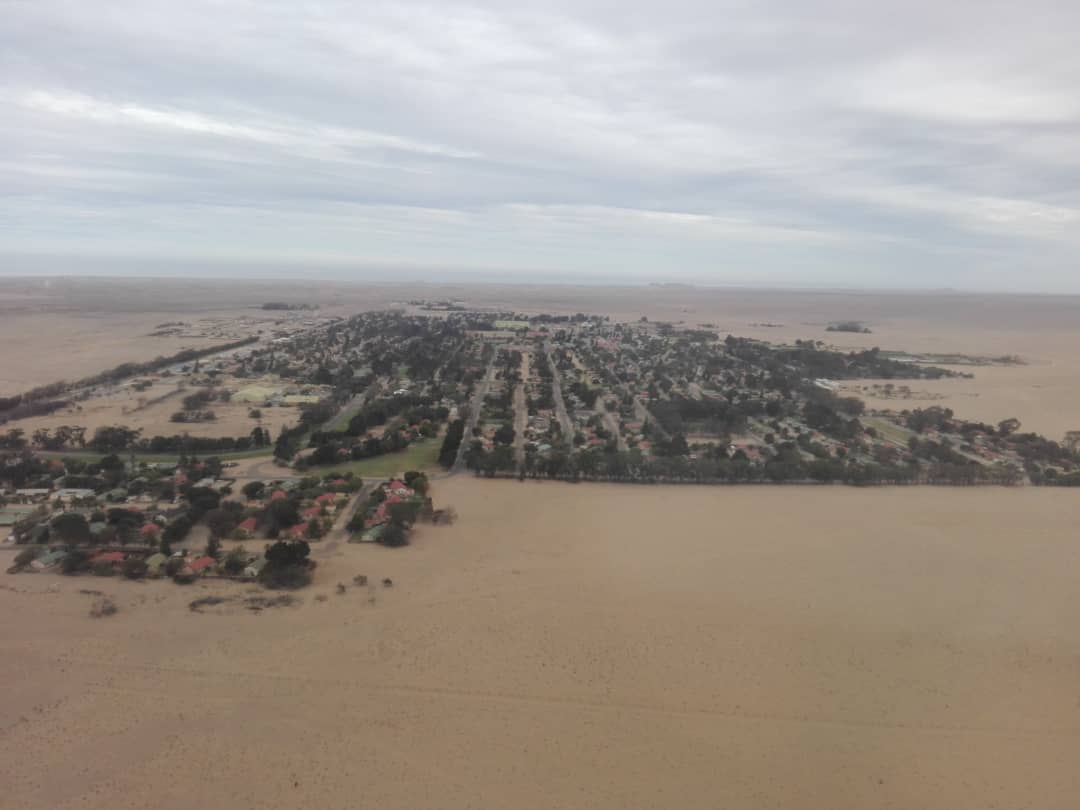
Oranjemund
Drive too fast through Oranjemund and you will anger the residents, though perhaps not the ones you expect. Oryx antelopes roam the streets freely here, claiming parking spots and crosswalks with the serene entitlement of animals that have never been challenged. Honk at one and the human neighbors will let you know you have violated an unwritten code. In a town built by a diamond company and governed by its rules for eighty years, the oryx may be the only inhabitants who never needed a permit to enter.
De Beers' Private City
Oranjemund was established in 1936 by De Beers with a singular purpose: to house the workers who extracted diamonds from the alluvial deposits along the Orange River and the Namibian coast. For decades, the town was operated privately by Namdeb, a joint venture between De Beers and the Namibian government. No one entered or left without passing through security gates and submitting to screening for stolen diamonds. Cars could not cross the checkpoints and had to be parked on either side. Non-residents needed a permit, obtainable only through a sponsor inside the town, whether a tour operator or a mining executive. The road from Rosh Pinah required a security checkpoint 20 kilometers outside town. Until 2017, the only vehicular access ran through Alexander Bay in South Africa, across the Harry Oppenheimer Bridge over the Orange River. The diamond industry's deep history in southern Africa, with its complex legacies of wealth extraction and controlled labor, shaped every aspect of Oranjemund's design.
An Unlikely Utopia
What emerged from this controlled environment is genuinely unusual. Because De Beers managed everything, from housing to landscaping to law enforcement, Oranjemund developed none of the social problems that afflict most Namibian towns. Homelessness is virtually nonexistent. Crime is rare. The streets are lined with old, shady trees watered by recycled grey water from the mines. Parks and playgrounds are well maintained. People in bars talk about their work, because almost everyone's work is the same thing: mining. The town feels like a suburb that somehow materialized in the desert, complete and self-contained, lacking only the surrounding city. Opened to the general public in October 2017, Oranjemund remains a settlement in search of a post-mining identity, a place where the infrastructure of corporate paternalism lingers even as the company's direct control recedes.
The Desert Oasis
Despite sitting near the Atlantic in one of the driest corners of Namibia, Oranjemund is surprisingly green. The vegetation that surrounds the town is maintained by its residents using grey water from mining operations, creating an artificial oasis in the coastal desert. The wind here is calmer than in other Namibian coastal towns, sheltered by the geography of the Orange River mouth. Walking through Oranjemund feels nothing like walking through Swakopmund or Walvis Bay, where Atlantic gales can sandblast exposed skin. The quiet is notable too, enforced by local custom near dormitories where shift workers sleep during the day and near the old age home. It is the only place in Namibia where silence is essentially mandated by social contract.
The Coast You Cannot Drive
The road south from Oranjemund toward Luderitz exists on maps but not in practice. The entire coastal strip between the two towns is restricted territory, a Sperrgebiet whose diamond deposits make it off-limits to anyone without mining authorization. This prohibition has had an unintended conservation benefit: the restricted zone is one of the least disturbed stretches of coastline in southern Africa, its ecology shaped more by wind and tide than by human activity. For travelers, the practical consequence is that Oranjemund remains a destination you arrive at deliberately rather than pass through. The 90-kilometer tarred road from Rosh Pinah is in excellent condition, threading through desert landscape to the now-unused screening gate six kilometers outside town at the Harry Oppenheimer Bridge. You may drive straight through unless you want to cross into South Africa, a crossing that once required elaborate documentation and now requires only a passport.
From the Air
Located at 28.55S, 16.43E on the Namibian coast at the mouth of the Orange River, directly across from Alexander Bay, South Africa. The border crossing at the Harry Oppenheimer Bridge is visible from altitude. The coastline north and south is restricted Sperrgebiet diamond territory. Nearest major airport is Alexander Bay (FAAB) across the border. The green oasis of the town contrasts sharply with surrounding desert terrain. Best viewed at 2,000-4,000 ft AGL.