Oranjewoud
In 1676, Countess Albertine Agnes of Nassau — a Princess of Orange in her own right — bought a country seat in the Frisian woods. Her husband the Stadtholder Willem Frederik of Nassau-Dietz had died twelve years earlier, killed when his own pistol misfired. The wooded estate she chose acquired its name from the family who came to summer there: Oranjewoud, the Orange Forest. The palace she founded is long gone, demolished during the French Revolution. But the woods are still here, and the line of royals who kept coming back to walk in them runs from her in 1676 to Queen Beatrix in 2004.
The Architect Who Never Finished
After Albertine Agnes died, her daughter Princess Henriëtte Amalia of Anhalt-Dessau inherited the estate and hired the architect Daniel Marot — the same Marot who built Het Loo, the great royal palace of the Netherlands — to design a far grander Oranjewoud. He drew a tripartite palace: a central main building flanked by two wings. Only the wings were ever constructed. The central pavilion that would have tied them together remained on paper, leaving Oranjewoud as a kind of architectural fragment, two graceful arms reaching toward each other across an absence. For decades it served anyway. John William Friso, Prince of Orange, lived there until his early death. His widow Marie Louise of Hesse-Kassel stayed on. William IV grew up there. William V visited one last time in 1777. Then the French Revolution arrived, the estate was confiscated and sold, and the palace was pulled down.
A House Built on a Royal Footprint
The Frisian nobleman Hans Willem de Blocq van Scheltinga bought a piece of the broken royal estate, and in 1834 he built a new country house on it. He called it Oranjewoud, after the palace that no longer existed — a self-conscious echo of what had stood there. The royals kept coming. King William I, King William III, and Queen Juliana all stayed at the new Oranjewoud. Prince Henry, Prince Bernhard, Queen Beatrix, and Prince Claus all visited. The house passed through the Friesland Bank and now belongs to the Bopper Fryslan Foundation. Around it a constellation of smaller buitenplaatsen — Oranjestein, Klein Jagtlust, Oranjehoeve, Princenhof, Klemburg — survive from the era when this corner of Heerenveen was lined with country seats. Others — Ontwijk, Brouwershave, Veenzigt, Paauwenburg — exist only as names on old maps.
The French Garden in Frisian Woods
The most visited piece of Oranjewoud today is the Overtuin — literally, the garden in front of — a French Baroque park laid out on the old royal grounds. In 1953 the de Blocq van Scheltinga family sold the estate in two parts; the government bought the Overtuin and opened it to the public, free of charge. Symmetrical avenues cut through the trees. Geometry imposes itself on the Frisian woodland, which keeps trying to impose itself back. The result is a curious hybrid: a seventeenth-century French idea of nature, executed in oak and beech under the broad northern sky, surviving three centuries of revolution, demolition, sale, and replanting.
Belvédère
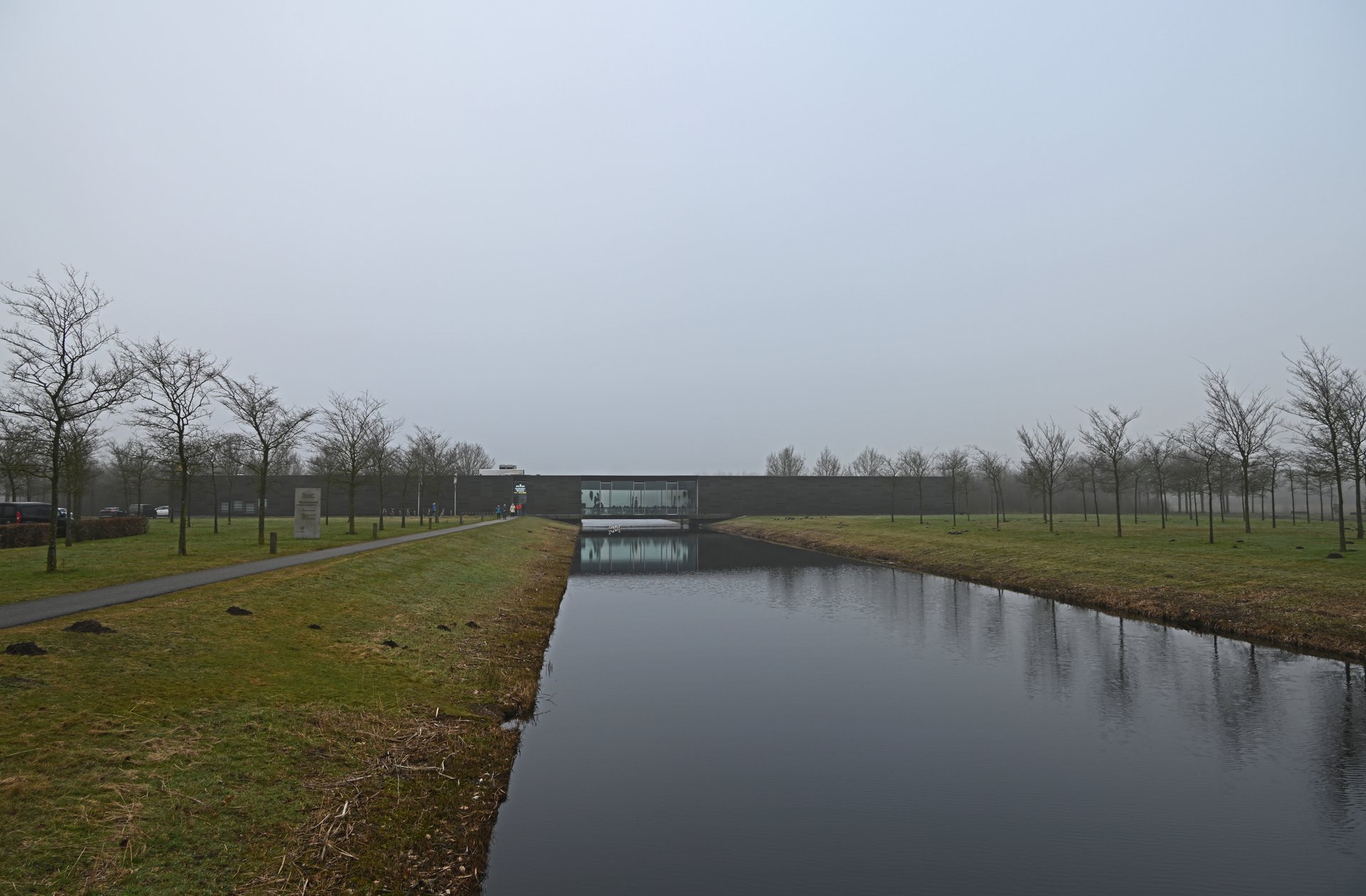
On 24 November 2004, Queen Beatrix opened a new building at Oranjewoud — Museum Belvédère, a long, narrow gallery designed by Eerde Schippers, 104 meters of glass and pale concrete cutting through the trees. It won the BNA Building of the Year award in 2006. The collection is dedicated to Frisian artists: Jan Mankes, who painted muted woodland animals with unsettling stillness; Thijs Rinsema, Tames Oud, Gerrit Benner, Boele Bregman, William Althuis, Sjoerd de Vries. Beatrix, opening the museum, was the latest in a line of royal visitors that began with her ancestor Albertine Agnes 328 years earlier. The palace she had come to inaugurate was no palace at all but a contemporary art museum — though both, in their way, were monuments to the same impulse: to make the Orange Forest a place where culture and royalty could quietly meet.
From the Air
Coordinates 52.9458°N, 5.9511°E, on the southeastern edge of Heerenveen. From altitude the village reads as a dark patch of mature woodland surrounded by the geometric green of Frisian farmland — the forest itself is the landmark. Recommended viewing altitude 2,000-3,000 feet to pick out the avenues of the Overtuin cutting through the trees. Drachten (EHDR) is about 13 nautical miles north; Lelystad (EHLE) lies 40 nautical miles southwest.