Oregon Shakespeare Festival
Ashland city leaders thought the drama professor had lost his mind. In 1935, Angus L. Bowmer looked at the crumbling walls of an abandoned Chautauqua building and saw not decay, but the skeleton of an Elizabethan playhouse. He asked for a loan "not to exceed $400" to stage Shakespeare plays on the Fourth of July. The city agreed, but with one condition: boxing matches would share the bill to cover the inevitable losses. Bowmer accepted the terms without hesitation. After all, bawdy entertainment was perfectly in keeping with Shakespeare's own era. The Works Progress Administration helped build a makeshift stage, and on July 2, 1935, Bowmer himself directed and starred in Twelfth Night. The boxing matches turned a profit. So did Shakespeare. Ninety years later, the Oregon Shakespeare Festival welcomes nearly 400,000 visitors annually, having hosted over 20 million theatergoers since that unlikely beginning.
From Ruins to Renaissance
The site's theatrical destiny was shaped by earlier dreamers. In the early 1900s, the Chautauqua movement brought cultural programming to small-town America, and Ashland built a domed structure that once accommodated 1,500 people for appearances by John Philip Sousa and William Jennings Bryan. When the movement faded in the 1920s, the dome fell to ruin. What remained was a circular wall that Bowmer recognized as eerily similar to London's Elizabethan theaters. The improvisation of those early years became legendary: stage lighting housed in coffee cans, string beans planted along the walls to improve acoustics, actors doubling as stagehands. General admission cost fifty cents; reserved folding chairs cost a dollar. The festival paused during World War II while Bowmer served, but resumed in 1947 with a purpose-built theater designed after London's 1599 Fortune Theatre.
A Stage That Signals the Show
The Allen Elizabethan Theatre, rebuilt and refined over decades, preserves traditions that span centuries. Just before each performance, an actor opens a gable window, runs a flag up the pole to the sound of a trumpet, and doffs his cap to the audience - the same signal Elizabethan playhouses used to announce that a play was in progress. The three-story facade creates multiple acting areas: forestage, middle stage, inner below, inner above, and a musicians' gallery. Twelve hundred seats ascend the original hillside in slightly offset arcs. The ivy-covered walls of the old Chautauqua theater remain as the outer perimeter, silent witnesses to more than a century of performance. The $7.6 million Paul Allen Pavilion, added in 1992, houses modern conveniences while traditional vomitoria allow actors to enter from beneath the seats.
Repertory in Action
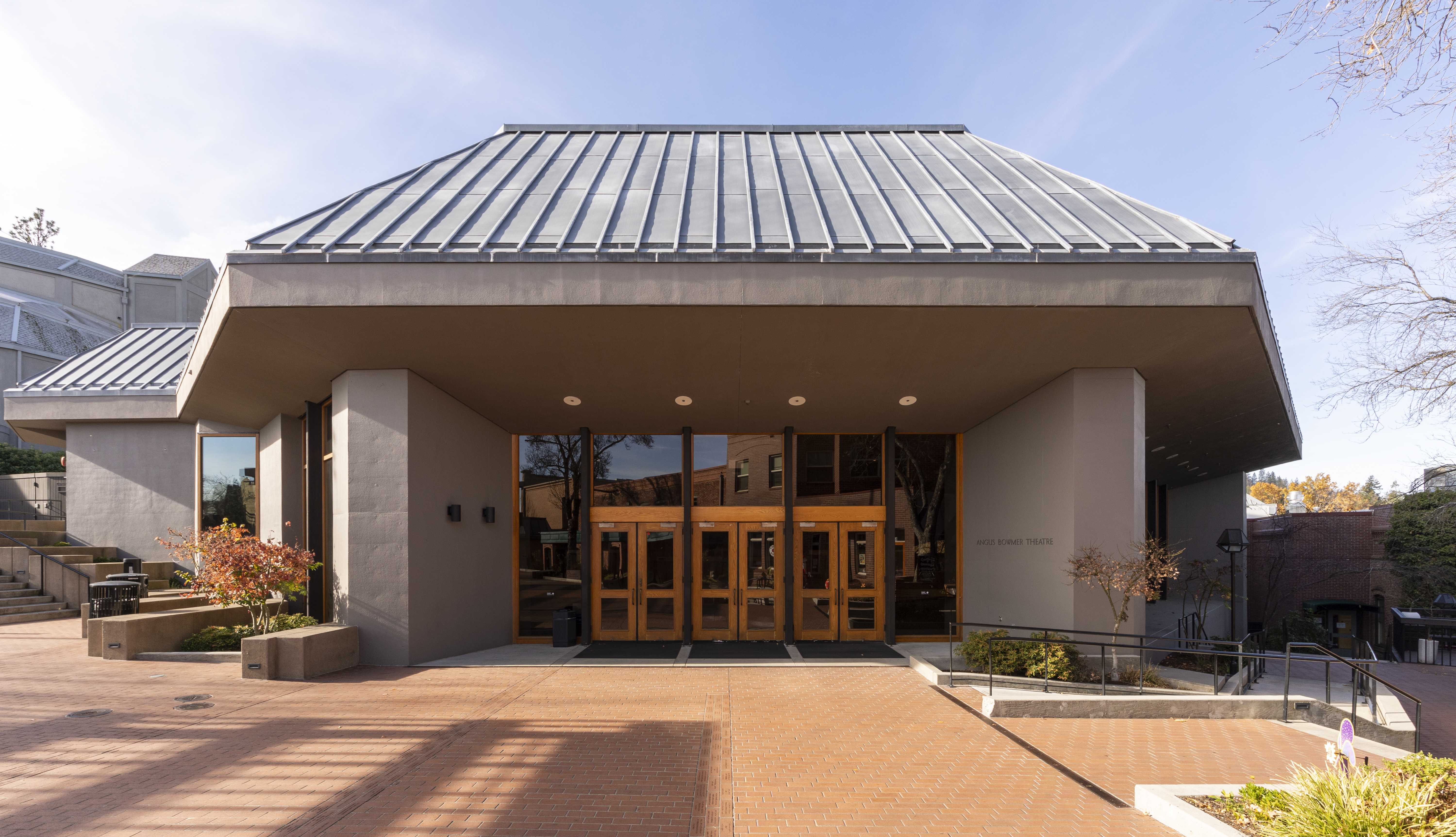
True repertory theater demands an almost athletic commitment from everyone involved. On any given day, audiences might see different plays on the same stage, which means stage crews must complete full set changes six days a week between matinee and evening performances. The Angus Bowmer Theatre, opened in 1970, demonstrated this capability dramatically when photographs taken two hours apart showed the set for August Wilson's Fences transformed into the set for the ancient Hindu classic The Clay Cart. This requires sets designed to withstand constant assembly and disassembly, and actors capable of inhabiting vastly different roles simultaneously. The repertory model allows visitors to experience the full range of the festival's offerings in a concentrated visit, seeing comedy, tragedy, classic, and contemporary works within the span of days.
The Town That Theater Built
The economic impact of the Oregon Shakespeare Festival on Ashland, a town of only 20,000 people, defies easy calculation. The festival supports approximately 125 restaurants - a variety and density per resident comparable to New York or Paris. Economists estimate a multiplier effect of 2.9, meaning each dollar spent at the festival generates nearly three dollars in local economic activity through hotels, restaurants, and shops. Beyond economics, the festival weaves itself into community life through Martin Luther King Day celebrations, Juneteenth commemorations, and the Fourth of July parade. The free Green Show, running since 1951, draws hundreds of audience members to pre-performance entertainment that has evolved from Renaissance music and dancers to an eclectic mix of Afro-Cuban bands, hip-hop artists, fire performers, and classical quartets.
Crisis and Continuity
The festival has weathered storms both literal and figurative. In June 2011, a crack was discovered in the seventy-foot main ceiling beam of the Bowmer Theatre just two hours before a matinee. Within weeks, a 598-seat tent dubbed "Bowmer in the Park" rose in adjacent Lithia Park, and four different shows were restaged to fit a single versatile set. The COVID-19 pandemic forced closures in 2020 and most of 2021, while wildfire smoke has occasionally cancelled outdoor performances. In April 2023, financial crisis struck, and the festival launched an emergency $2.5 million fundraising campaign. By June, donors had exceeded the goal. Through it all, the festival's commitment to artistic risk has remained constant - from Bill Rauch's American Revolutions project commissioning 37 new plays exploring American history, to the Black Swan Lab where actors develop new works for the stage.
From the Air
Located at 42.20N, 122.72W in Ashland, Oregon, at approximately 1,900 feet elevation in the Rogue Valley. The festival campus lies adjacent to Lithia Park near downtown Ashland. Nearest airport is Rogue Valley International-Medford (KMFR), 15 nautical miles north. Best viewed in summer months when the outdoor Elizabethan Theatre is in use. The Cascade foothills provide scenic approach terrain.