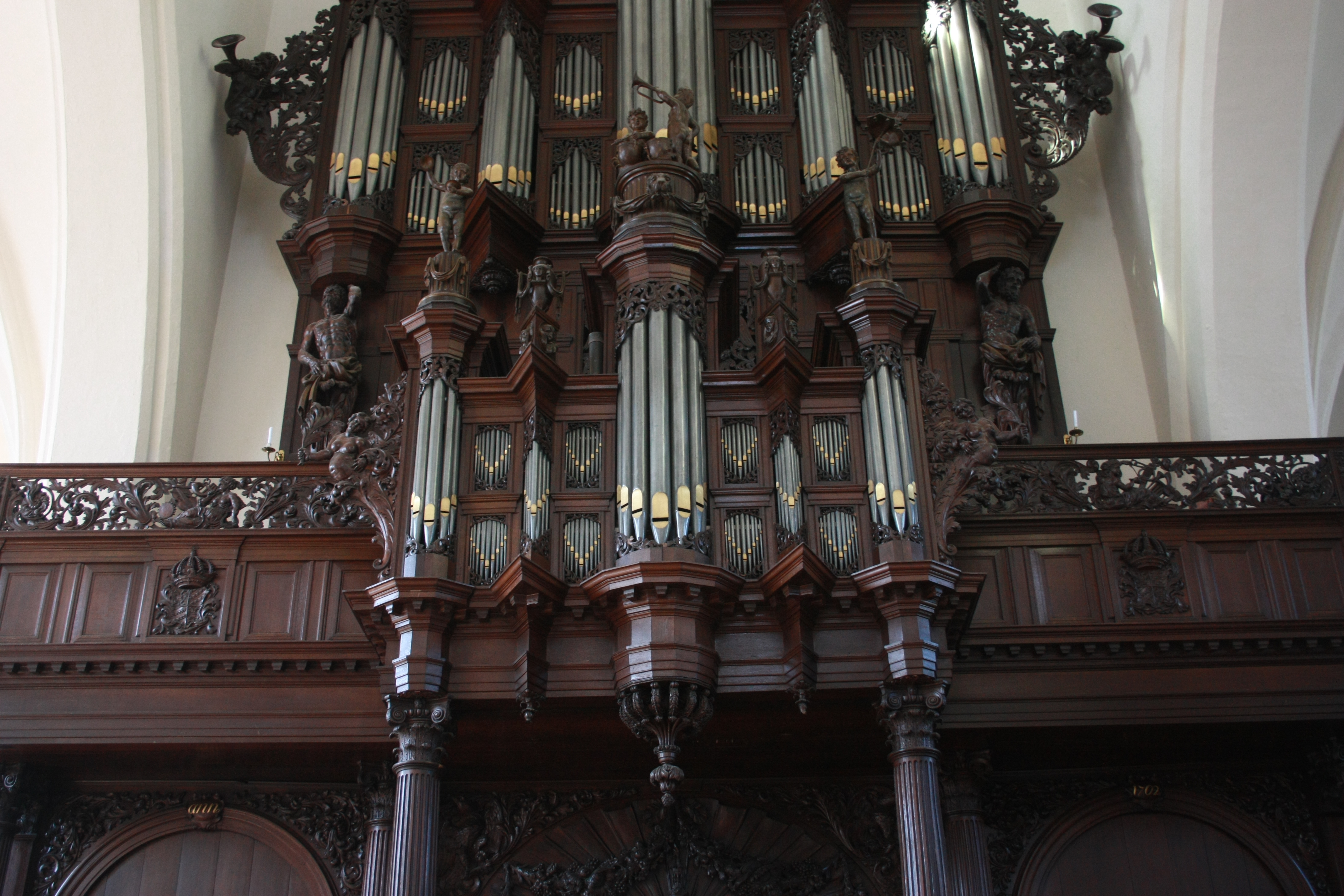
Organ in the Aa-kerk in Groningen
On 23 April 1710 the tower of the Aa-kerk in Groningen came down, and it landed on the largest pipe organ Arp Schnitger had ever built in the Netherlands - a 1694 instrument with over forty stops on four manuals, facade pipes of pure East Indian tin, and a builder who had bragged in writing that he 'did not spare anything and made everything wonderful.' The instrument was destroyed. The church sat in silence for a hundred years. The organ that fills the west gallery today is not that organ. It is its slightly older sibling, built by Schnitger for a different Groningen church across town, donated to the Aa-kerk in 1815 by King William I, and dragged across the city to fill the long-silent gallery. It has been there ever since.
Three Organs Before This One
The first organ in the Der Aa-kerk arrived in 1475 and stood on the eastern wall of the south transept. Andreas de Mare I rebuilt it in 1558. By 1654, the parish wanted something bigger, and Theodorus Faber was commissioned with Andreas de Mare II to build a large new organ on the west wall - but Faber died in 1659 before finishing it. Jacobus Galtus Hagerbeer completed the instrument in 1667 with forty stops on three manuals and pedal. In 1671, just four years later, it burned. The replacement, by Arp Schnitger between 1694 and 1697, was on a different scale entirely: four manuals, more than forty stops, and the kind of materials a master builds when he is showing off. Only Schnitger's preparatory sketch survived the 1710 tower collapse. The rest is debris and contracts.
Built for the Academiekerk
The organ now in the Aa-kerk was built by Schnitger between 1699 and 1702 for the Academiekerk - the University Church - elsewhere in Groningen. Allert Meijer constructed the case, Jan de Rijk did the carving. Schnitger reused several stops from an earlier 1679 organ in that church by Hendrick Harmens van Loon and Andreas de Mare II, which had itself reused material from a still older instrument. Layers of reuse went back perhaps two centuries by the time the new organ stood complete. The Rugpositief case in front mirrors the main case behind in miniature - nine-part facades with elevated polygonal central towers, double-headed eagles from the Groningen coat of arms in the carved Borstwerk doors, angels with palm branches on the Rug-Positief, angels playing musical instruments on the main case. The 103 case-pipes of the Rug-Positief and 91 of the main case are about 90 percent pure tin with semicircular gilded lips. It is the largest stock of original tin case-pipes in any surviving Schnitger organ.
A Royal Donation, A Crosstown Move
In 1814, the Academiekerk was handed over to Groningen's Roman Catholic community in one of the many religious reshufflings that followed the Napoleonic wars. King William I donated the organ to the Aa-kerk, which had spent a century without one. The organ builder Johannes Wilhelmus Timpe, a Groninger, dismantled the instrument and moved it across town between 1815 and 1816, adapting it to the new gallery. The original gallery from the Academiekerk had to be redesigned to fit. The wide entrance portal below, with its three double-winged doors under round arches by Allert Meijer - the same carpenter who had made the case - had been used by university professors going to the Academiekerk. After the move, the doors lost that purpose entirely. They serve now only as access to the organ above.
The Decision to Preserve
Every organ that survives for three centuries accumulates layers of repair: a coupler added by Albertus Hinsz in 1754, transposition work by Petrus van Oeckelen in 1856 to 1858, new bellows from Jan and Klaas Doornbos in 1920, modern adjustments in the 1930s and 1950s. By 1977 the instrument needed serious work, and a debate broke out among Dutch organ experts that lasted more than two decades. Should the organ be restored to its 1858 state, as the expert Rudi van Straeten proposed in 1993? Or should the 'grown state' - the accumulated layers of all those builders - be preserved? The Reil firm of Heerde carried out partial restoration in 1990. The dispute was officially settled in 2002 in favour of preservation. Reil then spent the next decade on technical maintenance without altering the instrument's substance. Only the pedal Posaune was reconstructed, replacing an unsatisfactory 1935 substitute. The re-inauguration took place on 14 October 2011, marked by concerts, a symposium, and a Festschrift.
What You Hear Today
Forty stops. Fifty-four ranks of pipes. Three manuals and pedal, with wind pressure of 82.5 millimetres of water column. The keyboards are by van Oeckelen, the temperament is equal, the pitch sits at A1 = 478 Hz - higher than modern concert pitch, closer to the historical north German organ tradition. Under its organist Johan van Meurs in the 1960s and 1970s, the Aa-kerk instrument helped train a new generation of Dutch organists and became a centerpiece of the Schnitger renaissance in the Netherlands. The 1969 Groningen Arp Schnitger Congress, the radio and television broadcasts since the 1950s, the LPs and CDs - they have made the instrument internationally known. Walk into the late Gothic cruciform church on a quiet afternoon and look up at the west gallery. The case is enormous. The tin pipes catch the light. You are looking at the largest stock of original case-pipes any Schnitger organ still possesses - and one of the few intact survivors of an instrument-making tradition that did not have a second act.
From the Air
The Aa-kerk stands in the historic centre of Groningen at 53.22 N, 6.56 E, on the Akerkhof square. Groningen Airport Eelde (EHGG) is about 12 km south. From low altitude, the Aa-kerk is identifiable by its tall west tower, distinct from the larger Martinikerk tower a few hundred metres to the east. The two towers together define the skyline of the medieval city core. The church is in the Akerk neighbourhood, just west of the Vismarkt.