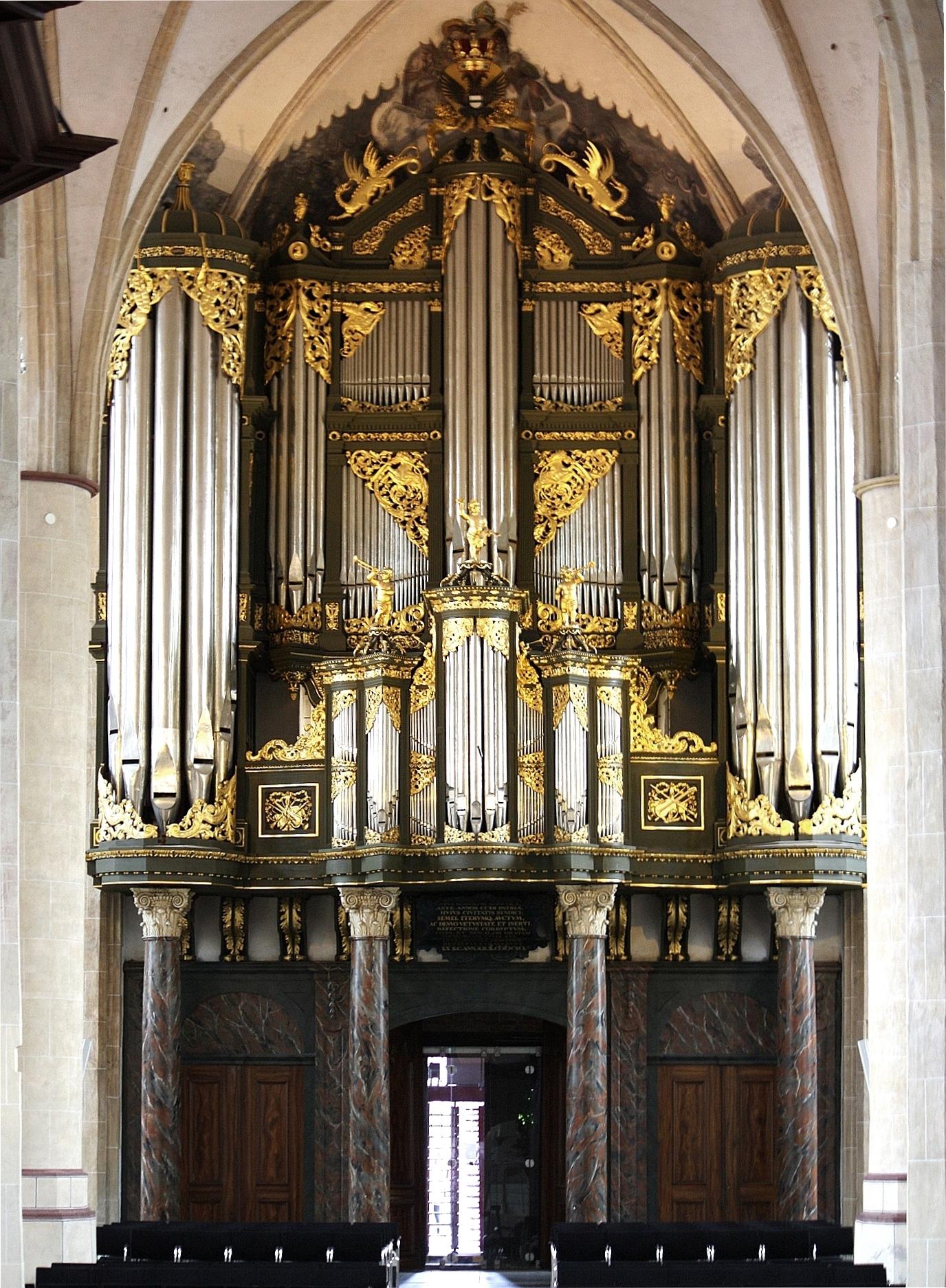
Organ in the Martinikerk at Groningen
Some of the pipes in the west gallery organ of the Martinikerk in Groningen were already old when Bach was born. They were cast in the late fifteenth century, possibly around 1479, when the church's Gothic tower was newly finished and a humanist named Rodolphus Agricola was working as the city's syndic. Those pipes — high-lead Gothic, lancet-mouthed, lined up across the Hoofdwerk facade — have been speaking, with interruptions, for roughly five and a half centuries. They are the oldest functioning organ pipes in the Netherlands, and around them stretches one of the largest and most famous baroque organs in northern Europe: 52 stops, 81 ranks, three manuals, a pedal division, and a case that grew like a tree.
Layers in the Facade
Look closely at the front of the Martinikerk organ and you can read its centuries the way a geologist reads rock. The main case dates from 1542, an unknown builder — possibly the young Andreas de Mare — refitting the medieval instrument in Renaissance style with pilasters, mouldings, and a gabled frontispiece. Inside that 1542 case sit Gothic pipes from the 1470s in the Hoofdwerk and Renaissance pipes from 1542 in the Bovenwerk. The Groningen coat of arms, a crowned double-headed eagle, has perched on the gable since 1628. Then in 1691 Arp Schnitger — the most celebrated north German organ builder of his era — arrived under contract with the church, lowered the pitch by moving pipes along three semitones, and within eight months had a new Bovenwerk windchest in place. The mighty pedal towers he added the next year carry the date Anno 1692 in small panels on their cornice.
Schnitger's Pedal and Hinsz's Gilding
Schnitger's pedal towers transformed the organ from large to monumental. Polygonal, stylistically matched to the older Renaissance casework, they rise on either side and end in curved spires capped with pommels — a coronation found on no other Schnitger organ anywhere. Two trumpeting angels hang from each pedal tower's pipe-shade. The 32-foot Principal in the pedal is the only Schnitger Principal 32 anywhere that has survived intact. In 1729 and 1730, Schnitger's son Franz Caspar and his successor Albertus Antonius Hinsz added the Rugwerk — the chair organ that hangs at the front of the gallery — with carvings by the sculptor Caspar Struiwigh, more gilded trumpeting angels, and a seven-axis case crowned by a circular tower. By 1740 Hinsz had given the whole instrument its decorative coloring and gold leaf. That was the state the twentieth-century restorers later chose as their target.
A Long Career at One Console
From 1728 until his death in 1796, Jacob Wilhelm Lustig was the organist of the Martinikerk. Almost seven decades on the same bench. It was Lustig who pushed for the Hinsz extensions, who would have known the instrument's voice better than anyone before or since, and who watched the organ grow under his hands to 47 stops over his lifetime. Generations of Groningen worshippers heard their psalms accompanied by Lustig's playing on pipes that had already been ancient when he sat down. After Lustig, repairs and small alterations continued — Hinsz again in 1781 and 1782, then Frans Casper Schnitger Jr. and Heinrich Hermann Freytag in 1793, then Lohman, then van Oeckelen in 1855. Each generation left a few pipes behind. The disposition lists today read like a family tree.
Undoing the Romantic Refit
Not every chapter went well. Between 1937 and 1939, the firm J. de Koff & Zoon modernized the organ in ways the twentieth century would come to regret: a new detached electrical console, electro-pneumatic key and stop action, lowered wind pressure, new stops cut, the existing pipe work revoiced in romantic style. The historical substance took serious damage. Fortunately the original wind-chests and the eighteenth-century Hinsz console were stored away rather than scrapped. When restoration tenders went out in 1971, organ expert Cor Edskes drew up a plan to return the instrument to its 1740 condition, keeping a few later registers that fit the mature voice. The master restorer Jürgen Ahrend did the work in two phases — casework, Rugwerk, and Bovenwerk in 1976 and 1977, then Hoofdwerk and Pedal in 1983 and 1984. The 32-foot Principal was repaired on site, too large to move. The organ that speaks today in the Martinikerk is, as much as restoration can manage, the organ Hinsz left in 1740, with Schnitger's pedal beneath it and Agricola's late-Gothic pipes still on the facade.
From the Air
The Martinikerk sits at the center of Groningen at 53.219 north, 6.568 east, with its tower the dominant landmark of the old city. Groningen Airport Eelde (EHGG) is about 6 nautical miles south. The Martinitoren — the church's free-standing tower — rises 97 meters and is visible from far across the flat Groningen countryside; the organ is inside the church beneath it. Recommended viewing altitude 1,500 to 3,000 feet AGL when overflying the city center.