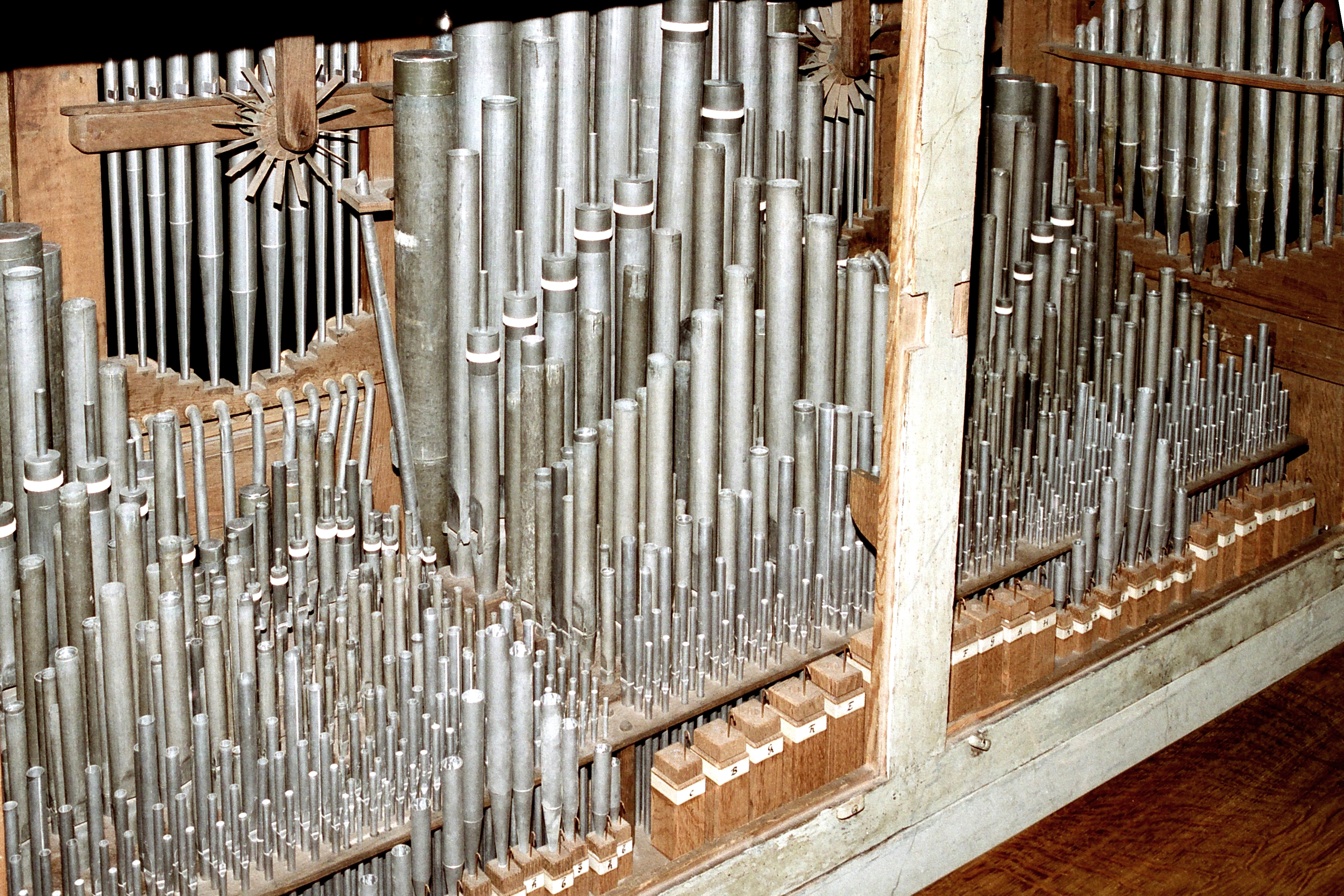
Organ of St. Ludgeri in Norden
Arp Schnitger signed the contract on February 26, 1686, and almost immediately did something unusual. Instead of placing his new organ in a single tidy case at the west end of the Ludgerikirche, as custom dictated, he split it. The manual divisions would stand in the choir. The pedal pipes would occupy their own tower on the crossing pier, separated by an open expanse of nave. The sound would arrive at the congregation from two directions at once - a stereo image two and a half centuries before anyone coined the word. Three hundred forty years later, organists still travel to Norden specifically to hear what that decision sounds like.
The Builder's Most Personal Project
Schnitger built somewhere between 150 and 170 organs across northern Europe over his career, and many of them are masterworks. But the Norden instrument is unique even within his catalog. The architectural arrangement is found nowhere else: four manual divisions stacked above and behind one another - Rückpositiv, Brustpositiv, Hauptwerk, and Oberpositiv - while the pedal stands in a single dramatic tower rather than the customary pair of flanking towers. Each division speaks toward a different part of the building. From the western nave you hear the pedal tower most clearly. From the choir, the manuals dominate. Walk the length of the church during a recital and the registration seems to follow you, swelling and receding as your ears find different lines of sight to the pipework.
What Survived From Before
The Ludgerikirche already had an organ when Schnitger arrived. Edo Evers had built it in 1618, using older pipes from an instrument that Andreas de Mare had constructed in 1567. By the 1680s the Evers organ was past repair, but its bones were still worth saving. Schnitger preserved eight stops from the older builders and integrated them into his new work. Listen carefully to the right registrations today and you can hear pipes that were already over a century old when Schnitger laid hands on them - pipes whose sound predates Bach's grandfather. Schnitger also exceeded his contract: a six-stop Brustpositiv came in the first construction phase, then he returned in 1691-92 to add an eight-stop Oberpositiv. The final count: 46 stops, 76 ranks, 3,110 pipes.
Saved by Carpenters in Wartime
Like much of Germany's pre-modern heritage, the Norden organ might easily have been lost. In 1943, with the Reich at war and bombs falling on cathedral cities, the entire instrument was dismantled and crated for safekeeping. It came back in pieces between 1945 and 1948. The reassembly was rushed, the wind pressures wrong, and well-intentioned restorations through the 1950s pushed it further from Schnitger's original voicing. By the late 1960s the organ was technically still playing but musically diminished. The serious recovery work began in 1981 under the builder Jürgen Ahrend, who returned the action, the wind, and crucially the temperament to historically informed practice. The result, completed in 1985, is now considered one of the great restorations of the twentieth century.
The Mathematics of Sound
The organ is tuned in a modified meantone temperament developed by Reinhard Ruge, the church's former organist and cantor, born in 1934. The system narrows seven fifths slightly, widens two, and leaves three perfectly pure - an arrangement that gives sweet, ringing major chords in the central keys of F, C, G, and D while still allowing the more remote keys to be played in passing. In C major the fifth and the third beat at almost exactly the same speed, around 2.3 hertz, producing what musicians describe as an almost shimmering effect. Bach's predecessors composed within these constraints, and hearing their music in Norden is to hear it for the first time in the acoustic environment that produced it.
Angels and Acanthus
Three gilded trumpeting angels stand atop the central towers - two on the manual cases and one crowning the polygonal pedal tower in the crossing. They are attributed to Christian Precht of Hamburg, a carver whose work shows up across the late Baroque churches of the lower Elbe. Gilded acanthus leaves border every pipe field. The Brustpositiv doors carry openwork carvings of acanthus and volutes, opening like book covers to reveal the wooden Plockfloit and Gedact pipes inside. Even the dummy pipes are decorated - in the Oberpositiv front, foliated wooden pipes shaped like tobacco leaves. The whole instrument is a piece of Baroque sculpture you can listen to.
From the Air
The Ludgerikirche stands in central Norden at 53.60°N, 7.20°E. From the air the church's distinctive shape - long nave with prominent transept and freestanding bell tower - is visible against the surrounding old town from 2,000-4,000 feet. Best viewed in clear weather; the seaside marshland often produces low stratus and mist. Nearest airfield: Norden-Norddeich (EDWS) immediately north. Emden (EDWE) lies about 20 nm south for general aviation.