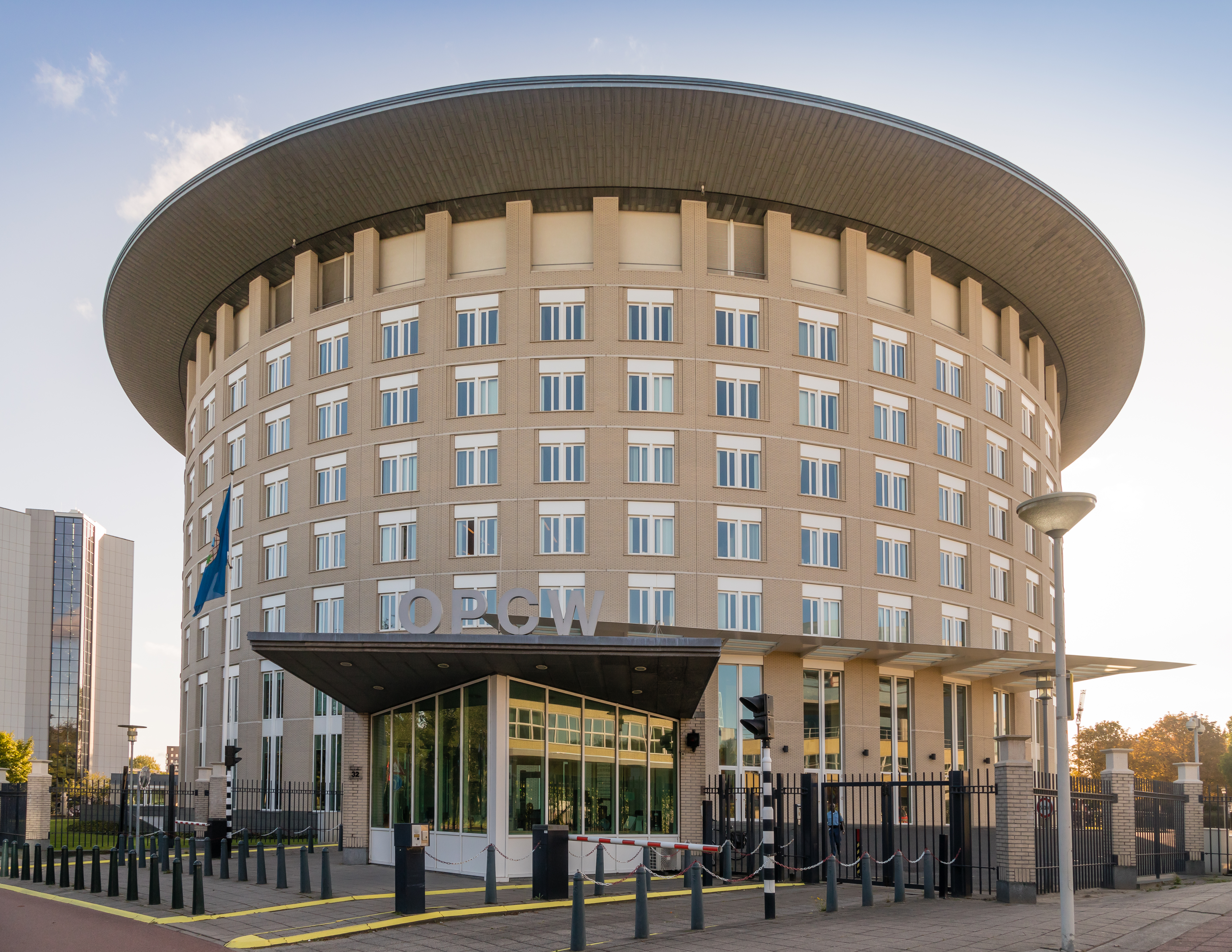
Organisation for the Prohibition of Chemical Weapons
On 13 April 2018, Dutch military intelligence officers arrested four Russian GRU agents in a hotel car park in The Hague. The car park happened to be a few hundred metres from the semicircular eight-storey building that serves as headquarters for the Organisation for the Prohibition of Chemical Weapons. In the trunk of the Russians' rental car was hacking equipment aimed at the OPCW's Wi-Fi network. The agency they were trying to break into is the implementing body of the 1997 Chemical Weapons Convention, the treaty that defined the use of chemical weapons as, in the words of Nobel chairman Thorbjorn Jagland, 'a taboo under international law.' The Dutch quietly expelled the operatives the same day. The OPCW kept working.
How a Treaty Became an Institution
The Chemical Weapons Convention entered into force on 29 April 1997 with what is, by international-law standards, an exceptionally specific mandate: the permanent and verifiable elimination of an entire category of weapon. Member states declare their stockpiles and their industrial production. The OPCW verifies. Today the organisation has 193 member states - all but four UN members. Israel signed but has not ratified. Egypt, North Korea, and South Sudan have neither signed nor acceded. Palestine joined most recently. To house the work, the Dutch government outlobbied Vienna and Geneva, and the OPCW set up next to the World Forum Convention Centre in The Hague. The semicircular eight-storey headquarters, designed by American architect Gerhard Kallmann of Kallmann McKinnell and Wood, was opened by Queen Beatrix on 20 May 1998. Behind the building is a permanent memorial to all victims of chemical warfare, open to the public.
The Bustani Affair
In April 2002 the United States convened an extraordinary session of OPCW member states and engineered the dismissal of the first Director-General, the Brazilian diplomat Jose Bustani. The vote was 48 to 7 with 43 abstentions. Bustani's offence, as he and the Guardian columnist George Monbiot saw it, was that he had been working to bring Iraq into the Chemical Weapons Convention, which would have placed Saddam Hussein's chemical programs under OPCW inspection at exactly the moment Washington was building its case for invasion. The US gave its own reasons: polarising conduct, mismanagement, advocacy of inappropriate roles. The Convention itself prohibits the OPCW from receiving instructions from any government. The Administrative Tribunal of the International Labour Organization later ruled the dismissal improper, ordered Bustani's pay for the remainder of his second term, and awarded him fifty thousand euros in moral damages. He chose not to seek reinstatement. The affair sits uneasily in the institution's history.
Syria, Novichok, and the Nobel
On 11 October 2013 the Norwegian Nobel Committee awarded the OPCW the Nobel Peace Prize. Syria had already become the most visible test of the convention. After the Ghouta sarin attacks the previous August, the OPCW joined a United Nations mission and by September 2014 had overseen the destruction of about ninety-seven percent of Syria's declared chemical weapons. On 21 April 2021 a two-thirds majority of OPCW members stripped Syria of its voting rights, citing repeated use of poison gas during the civil war. In response to the 2018 nerve agent poisoning in Salisbury, the UK persuaded the membership to expand the OPCW's powers to assign blame for attacks, by a vote of 82 to 24. The following year, by unanimous agreement, the Novichok agents were added to the controlled-substances list in one of the most significant amendments to the convention since the 1990s.
What an Inspection Looks Like
OPCW inspectors do not look like soldiers, although they sometimes wear hazmat suits. They travel on the United Nations Laissez-Passer, with a small sticker explaining their privileges and immunities. They carry out routine industry inspections to verify that member states are correctly declaring scheduled chemicals - Schedule 1, 2, 3, or 'other discrete organic chemicals' - and they prepare mass balances to confirm that what was made matches what was reported. When chemical weapons are alleged to have been used, the convention allows for a challenge inspection, although none has yet been formally invoked. In dangerous environments inspections are often carried out remotely by CCTV. The Executive Council of 41 member states oversees the budget and the General Secretariat. In 2020 the budget came to roughly seventy-one million euros, modest for a body whose mandate is the elimination of an entire weapons category.
The Hague Award and the Wider Hague
The OPCW is one of more than a hundred international institutions clustered in The Hague, the city that has built much of its modern identity on hosting international law. The roughly nine hundred thousand euros that came with the Nobel Peace Prize was used to create the OPCW-The Hague Award, established in 2014 with additional support from the city itself, to recognise individuals and institutions advancing the goal of a world free of chemical weapons. The current Director-General, Ambassador Fernando Arias of Spain, was elected by the Conference of the States Parties in December 2017 and assumed office in July 2018. The day-to-day work continues: inspections, declarations, mass balances, laboratory analysis. The 2018 GRU operation was a vivid reminder that the institution still has enemies. The taboo, as Jagland called it, holds because someone insists on enforcing it.
From the Air
The OPCW headquarters is at Johan de Wittlaan in The Hague, at roughly 52.09N, 4.28E, immediately adjacent to the World Forum Convention Centre. The Hague sits on the North Sea coast about 50 km southwest of Amsterdam. Rotterdam The Hague (EHRD) is about 12 km southeast; Schiphol (EHAM) about 40 km northeast. The OPCW also operates a laboratory and equipment store in nearby Rijswijk.