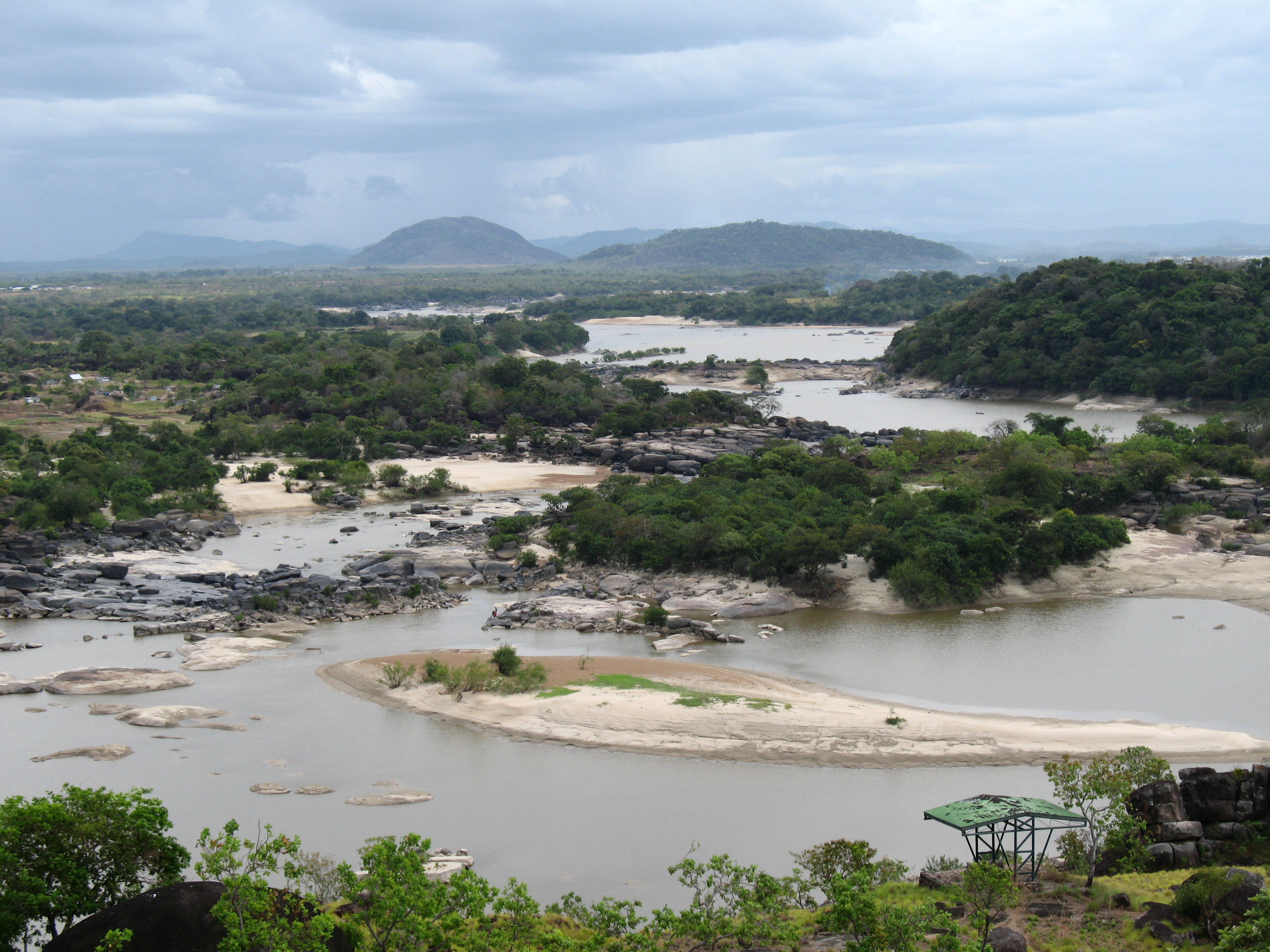
Orinoco
In 1988, the Irish singer Enya released "Orinoco Flow" and the river's name became a melody most people could hum but few could locate on a map. The real Orinoco is no lullaby. It is one of the great rivers of the world -- South America's third largest by discharge, draining a basin of more than 880,000 square kilometers across Venezuela and Colombia. Its waters run in three colors: the black of tannin-stained tributaries, the white of sediment-heavy Andean runoff, and the clear green of streams filtering through ancient sandstone. Where these waters converge, they create one of the most biologically rich river systems on Earth.
Three Colors of Water
More than 1,000 fish species have been recorded in the Orinoco basin, with roughly 15 percent found nowhere else. The dominant orders -- Characiformes and Siluriformes -- account for over 80 percent of freshwater species. Among the more famous residents are the black spot piranha and the cardinal tetra, the tiny neon-bright fish that populates aquariums worldwide. The Orinoco connects to the Amazon basin through the Casiquiare canal, a natural waterway that splits from the upper Orinoco and flows south into the Rio Negro. Because the canal passes through blackwater, clearwater, and whitewater sections, only the hardiest species can make the crossing between the two great river systems -- the cardinal tetra being one of the few that manages it.
Iron Mountains and Black Gold
In 1926, a Venezuelan mining inspector exploring near the Orinoco Delta stumbled onto one of the richest iron ore deposits in the world, on a mountain south of San Felix called El Florero. Full-scale mining began after World War II, driven by a partnership between Venezuelan firms and American steel companies. By the early 1950s, workers were extracting roughly 10,000 tons of ore-bearing soil per day. But iron was only the beginning. Beneath the Orinoco basin lies the Orinoco oil belt, one of the largest deposits of heavy crude and tar sands on the planet. The petroleum reserves have shaped Venezuela's economy and politics for decades, making the river not just a waterway but a geological inheritance -- and a source of both wealth and geopolitical turmoil.
The Rarest Reptile in the World
The Orinoco crocodile is one of the rarest reptiles alive. Its entire wild range is restricted to the middle and lower Orinoco basin, where it inhabits the river's main channels and tributaries. Hunting in the 20th century nearly exterminated the species -- crocodile leather was profitable, and the Orinoco crocodile, which can grow to over five meters, offered a lot of leather. Conservation programs have brought the species back from the immediate edge of extinction, but its population in the wild remains critically small. The crocodile shares these waters with Amazon river dolphins, giant otters, and a fish fauna so diverse that scientists are still describing new species. The river is navigable for most of its length; ocean-going ships can reach Ciudad Bolivar, hundreds of kilometers inland, thanks to dredging at the confluence with the Caroni River.
The River as Arena
Since 1973, the Internacional Rally Nuestros Rios son Navegables has sent powerboats on a 1,200-kilometer circuit through the Orinoco, Meta, and Apure rivers -- the longest fluvial rally in the world, with boats averaging 120 miles per hour across waters that are also home to piranhas and crocodiles. Since 1988, the government of Ciudad Guayana has organized an annual swim race where up to 1,000 competitors plunge into the Orinoco and Caroni rivers. The race, the Paso a Nado Internacional de los Rios Orinoco-Caroni, has been held every April since 1991 and draws competitors from around the world. Jules Verne set his 1898 novel "Superbe Orenoque" on the river. Enya turned it into a pop song. But the Orinoco needs no literary or musical embellishment. It is its own spectacle -- a river system vast enough to be visible from space, carrying the sediment of the Andes to the Atlantic across a landscape that has barely changed in ten thousand years.
From the Air
The Orinoco River's delta empties into the Atlantic near 8.56N, 60.50W, but the river system extends across much of Venezuela and eastern Colombia. From altitude, the Orinoco is unmistakable -- a massive brown waterway winding through green lowlands, with its delta fan clearly visible where it meets the Atlantic. Ciudad Bolivar (SVBL) sits on the river's south bank. Ciudad Guayana, at the Caroni confluence, has the Puerto Ordaz airport (SVPR). The Orinoco oil belt runs roughly parallel to the river's southern course. At cruise altitude, the river's channel braiding, oxbow lakes, and sediment plumes at the delta are distinctive navigational features.