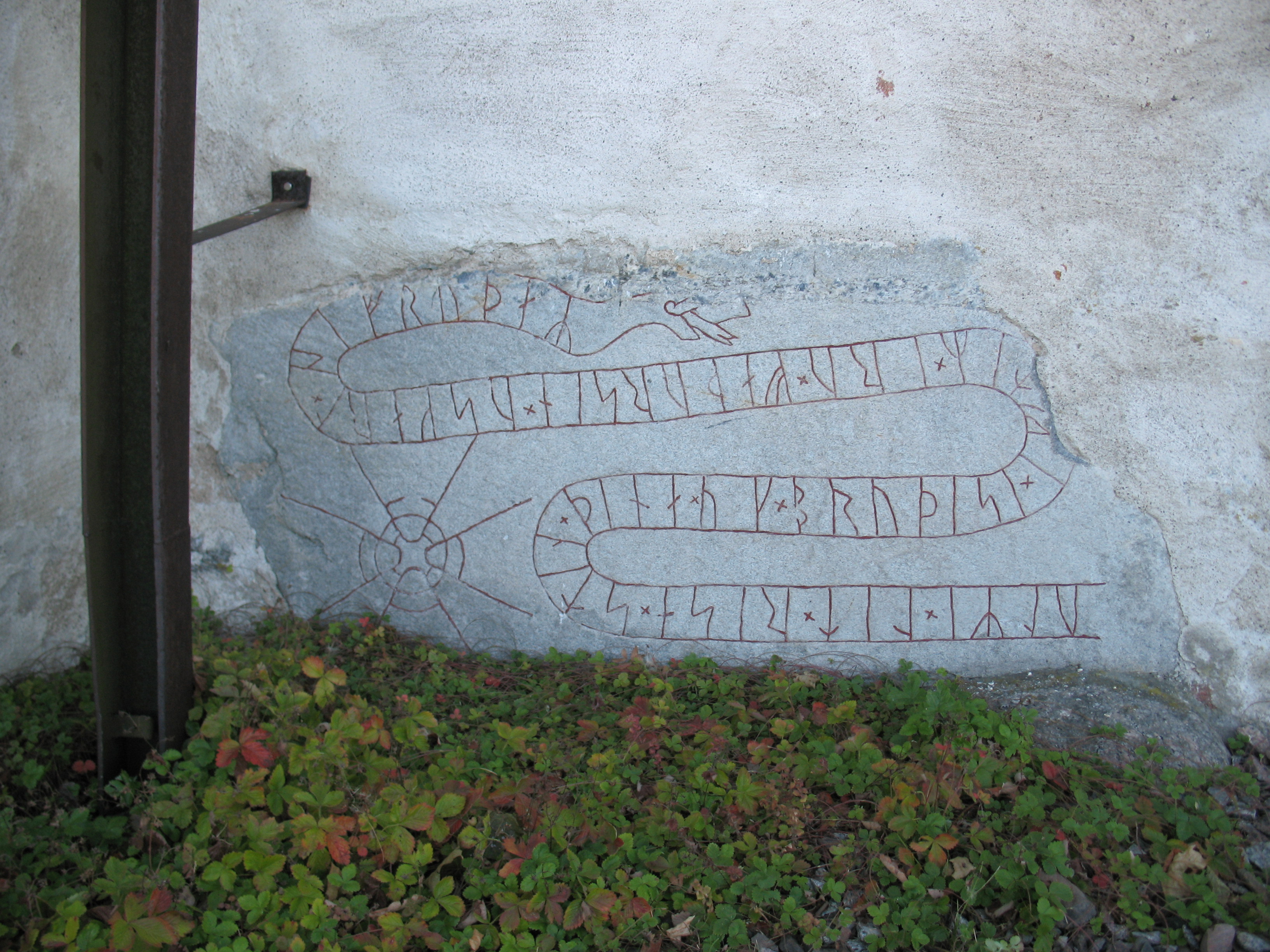
Orkesta Runestones
Ulf of Borresta knew how to survive. While countless Vikings sailed to England and never returned, Ulf crossed the North Sea three times and lived to tell the tale. His story is carved into granite at the church of Orkesta, northeast of Stockholm, where a cluster of 11th-century runestones records the remarkable career of a man who served under three of the most powerful Viking leaders of his age: Skagul Toste, Thorkell the Tall, and Canute the Great. Each expedition brought him home laden with Danegeld, the tribute money that English kings paid to buy peace from Scandinavian raiders. Few Vikings accumulated such wealth. Fewer still commemorated it in stone.
Three Kings' Ransoms
The inscription on runestone U 344 wastes no words on sentiment. It states simply that Ulf took three payments in England. The first was under Tosti, likely the chieftain Skagul Toste. Then came Thorkell the Tall, the legendary warrior who commanded the great Viking army that besieged Canterbury in 1011. Finally, Ulf served under Canute himself, who would become king of England, Denmark, and Norway. The stone records these expeditions like entries in an account book, the unsentimental summary of a professional soldier's career. Danegeld payments were enormous. In 1018 alone, Canute extracted 82,500 pounds of silver from England. Ulf's share of three such tributes would have made him wealthy beyond most Scandinavians' dreams.
Warriors in Stone
The Orkesta runestones are not alone in commemorating England expeditions. Two nearby stones, U 241 and U 194, also mention the Danegeld, making this region of Uppland a center for veterans of the English campaigns. The clustering suggests these men may have sailed together, neighbors who formed the core of a ship's crew and returned to raise monuments in each other's memory. Ulf also erected the Risbyle Runestones in the same region, weaving a geographic tapestry of commemoration across the landscape. His lost runestone U 343, recorded in 18th-century surveys before it disappeared, formed a monument pair with U 344 at Yttergarde.
Serpents and Saints
The artistry of the Orkesta stones reflects the sophisticated visual culture of late Viking Age Scandinavia. Runestone U 333 displays the Urnes style, named for the famous Norwegian stave church where this art form reached its peak. Slim, stylized animals weave through tight patterns, their bodies forming elegant ribbons that frame the runic text. Heads appear in profile with almond-shaped eyes and curling appendages on noses and necks. Yet alongside these pagan-rooted serpent designs, Christian crosses appear prominently on several stones. The Vikings of Orkesta lived in a transitional world where old and new beliefs intertwined on the same monuments.
Building Bridges to Heaven
Runestone U 335 commemorates a different kind of achievement. Holmi raised this stone to honor his father Haera, a housecarl in the service of a lord named Sigrodr, and to mark the construction of a new bridge. Bridge-building carried spiritual significance in 11th-century Scandinavia. The Catholic Church promoted infrastructure projects as acts of piety, offering indulgences to those who built roads and bridges for fellow travelers. The runic text thus served dual purposes: honoring the dead and securing merit for the living builder's soul. Similar bridge stones appear throughout Uppland, silent testimonies to a society transforming under Christian influence.
Decoding the Past
The runemaster Asmund carved several Orkesta inscriptions, leaving distinctive stylistic fingerprints that scholars use to attribute unsigned stones. His work appears on U 343 and U 344, identified by characteristic spelling variations. On the word for mother, Asmund consistently omits the final letter. Such idiosyncrasies help researchers trace the movement of these medieval craftsmen across the landscape. The stones preserve not just the names of the dead but the hands of the living, anonymous artisans whose technical choices and aesthetic preferences can still be recognized a thousand years later. At Orkesta, their work continues to speak in the Younger Futhark alphabet they mastered.
From the Air
Located at 59.60N, 18.12E at the church of Orkesta in Vallentuna Municipality, approximately 25 kilometers northeast of Stockholm. The runestones cluster around the medieval church, visible as a small white building with surrounding gravestones. Stockholm Arlanda Airport (ESSA) lies approximately 10 km to the northwest. Approach from the south at 1500-2000 feet for best viewing angle in clear weather. The site sits in typical Uppland terrain of forests and agricultural fields.