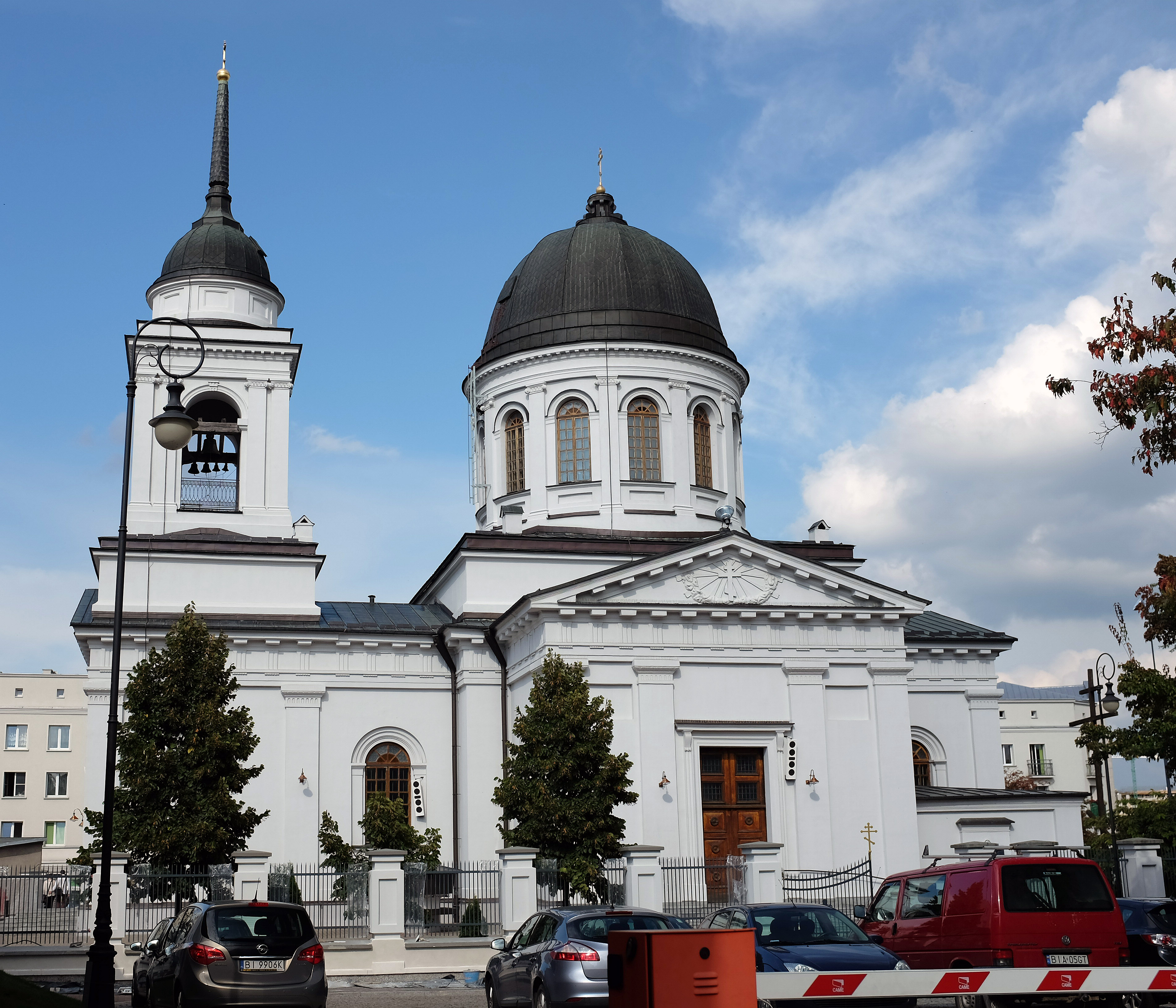
Orthodox Cathedral of St. Nicholas, Białystok
The procession was so large that one observer counted seventy thousand people. On 21 September 1992, the relics of Gabriel of Białystok, a six-year-old boy whose murder in 1690 had become a foundational story of the local Orthodox community, were carried through the streets of this small Polish city to a final resting place on Lipowa Street. Nine Orthodox bishops walked in the procession. The Roman Catholic archbishop of Białystok walked alongside them, an unusual gesture in a country where the religious wars had not entirely faded. The cathedral that received Gabriel that day was the same building that had received Tsar Nicholas II in 1897, and Pope John Paul II in 1991, and the patriarchs of Constantinople, Moscow, Antioch, Jerusalem, and Alexandria across the decades since. St. Nicholas of Białystok has had a stranger life than its modest classical exterior suggests.
An Old Church and Its Replacement
There has been a Saint Nicholas church in Białystok since the seventeenth century, possibly earlier. The first one stood near today's cathedral, on what was then Choroska Street, and it was a small wooden Uniate church painted yellow and gray with red domes. It served the Orthodox parish that had taken over the chapel in the Branicki Palace, the great residence of the magnates who effectively founded modern Białystok. By the early nineteenth century the wooden church was inadequate to a growing congregation. Between 1843 and 1846, under Russian Imperial rule following the partitions of Poland, the present masonry cathedral was built on the same site. It rose in classical style, with elements borrowed from antiquity and from Byzantine cross-dome temples, and it was consecrated by Józef, the Vilnius and Lithuanian metropolitan.
Tsars and Frescoes
On 25 August 1897, Tsar Nicholas II and his wife Alexandra Fyodorovna visited the cathedral, and donors purchased a silver Gospel to commemorate the imperial visit. The interior at that time was already decorated with frescoes, but the original 1840s composition was destroyed before 1910. That same year, a team of Russian painters led by Mikhail Avivov repainted the cathedral, modeling their work on the Vasnetsov frescoes from the Cathedral of St. Vladimir in Kyiv, the most celebrated example of Russian church painting from that era. The roof was renovated in 1910 as well. When Saint Nicholas was reconsecrated that October, it had been transferred to the Grodno eparchy following an administrative reorganization. Four years later, the Russian Empire would collapse, and Białystok would become part of an independent Poland that viewed Orthodox cathedrals as artifacts of foreign rule.
From Parish Church to Cathedral
After 1918, when Polish independence was restored, the new government regarded Białystok's Orthodox buildings with suspicion as symbols of Russification policy, and many were transferred to Catholic use across the country. Saint Nicholas survived. During the interwar years it remained one of two Orthodox churches in Białystok and continued to serve a substantial local Orthodox community, descended in part from the Belarusian and Ukrainian populations of the eastern borderlands. In July 1936, when the Pochaiv Icon of the Mother of God was brought to Białystok for veneration, fifteen hundred people attended the service. After the Second World War and the establishment of communist Poland, the Polish Autocephalous Orthodox Church reorganized; on 7 September 1951, Saint Nicholas was elevated to cathedral status as the seat of the new Białystok-Gdańsk diocese.
A Saint Returns Home
Throughout the postwar decades, the building was renovated repeatedly. Most of Avivov's frescoes proved impossible to preserve and were replaced in the 1970s with new paintings by Józef Łotowski; only one Avivov work, a Risen Christ in the presbytery, survived. Between 1988 and 1990 the iconostasis was regilded, and the domes were re-covered in copper sheet. Then in September 1992 came the procession that brought Gabriel's relics to Białystok from Grodno, where they had been kept across the Belarusian border. The boy's veneration had survived three centuries and three empires. The cathedral that received him in 1992 has since hosted a remarkable parade of religious leaders: Constantinople's Patriarch Demetrios in 1987, Pope John Paul II in 1991, Russian Patriarch Cyril in 2012, and the patriarchs of Antioch, Jerusalem, and Alexandria. The interior plasters are pristine. The bells still hang on a belfry equipped with five since the nineteenth century.
From the Air
Located at 53.1327°N, 23.1546°E in central Białystok, northeastern Poland, on Lipowa Street in the city center. Białystok Krywlany Airport (EPBK) lies 4 km south. From the air, the cathedral's classical facade and dome are recognizable among the dense rooflines of Białystok's center. The city sits roughly 50 km west of the Belarusian border and 180 km northeast of Warsaw.