Osaka Castle: The Fortress That Refused to Stay Dead
Toyotomi Hideyoshi did not build Osaka Castle to be equal to anything. When he began construction in 1583 on the ruins of the Ishiyama Hongan-ji temple, he modeled the basic plan on Oda Nobunaga's Azuchi Castle -- then set out to surpass it in every dimension. The main tower rose five stories on the outside with three additional stories underground. Gold leaf covered the exterior walls. The message was unmistakable: the man unifying Japan intended his headquarters to look the part. Construction finished in 1597. Hideyoshi died the following year, and the castle passed to his young son, Toyotomi Hideyori. What followed was not a peaceful succession but a cascade of sieges, fires, lightning strikes, and rebuildings that would stretch across four centuries and make Osaka Castle one of the most repeatedly destroyed and reconstructed landmarks in Japan.
The Siege That Ended a Dynasty
In the winter of 1614, Tokugawa Ieyasu marched on Osaka Castle with 200,000 soldiers -- roughly twice the defending Toyotomi force. The defenders held. Osaka Castle's concentric moats, massive stone walls, and fortified gates did exactly what Hideyoshi had designed them to do. Unable to take the castle by force, Ieyasu negotiated a truce and promptly had the outer moat filled in, neutralizing the fortress's strongest defense. When Hideyori began restoring the moat the following summer, Ieyasu attacked again. On June 4, 1615, his forces breached the outer walls. Toyotomi Hideyori and his mother Yodo-dono committed seppuku. The castle burned to the ground. The Toyotomi clan, which had unified Japan, ceased to exist. The Tokugawa shogunate would rule for the next 250 years.
Stones from the Inland Sea
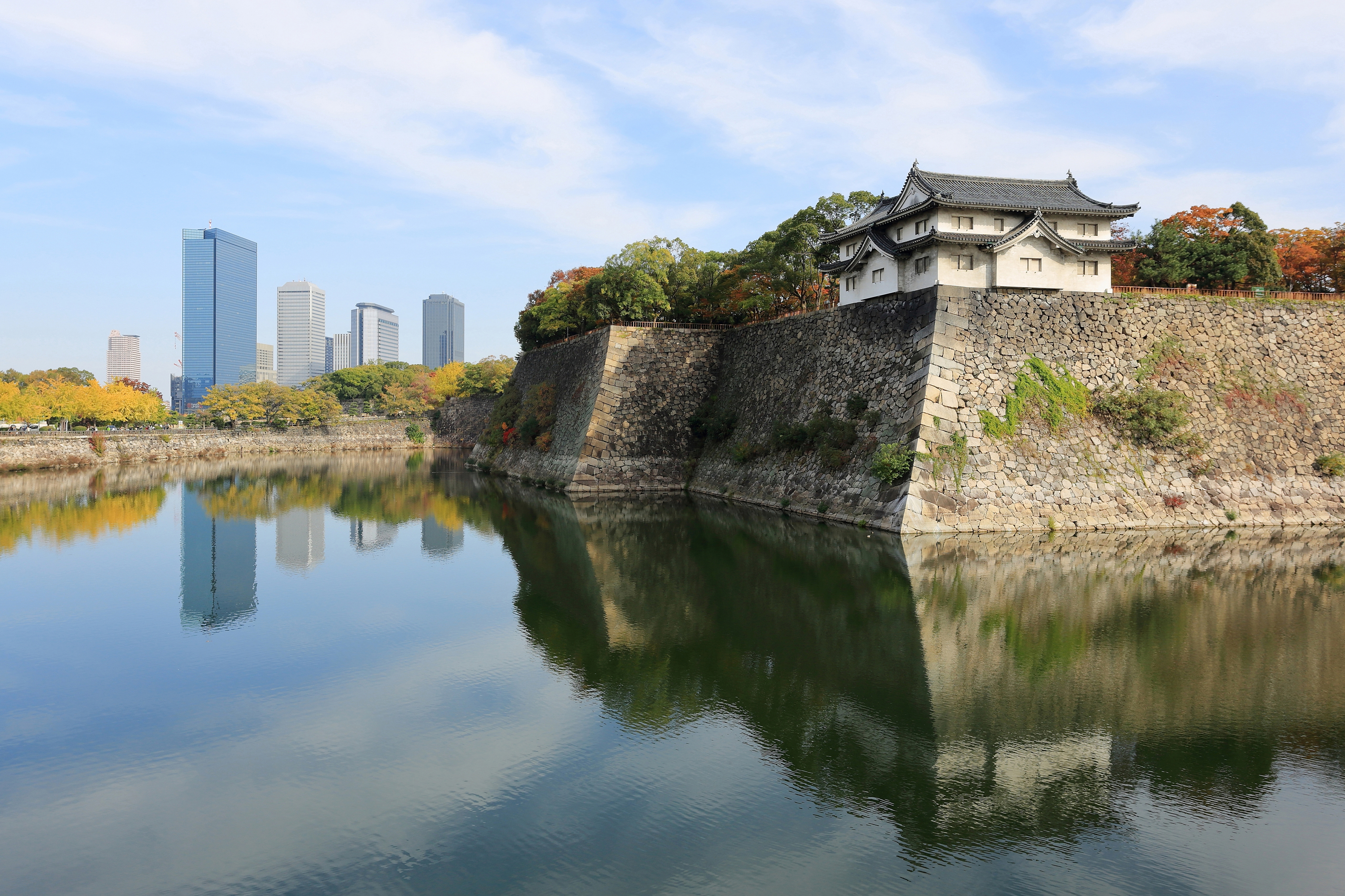
The Tokugawa did not simply rebuild -- they erased and replaced. Individual samurai clans were assigned sections of wall to construct, and they quarried interlocking granite boulders from sites near the Seto Inland Sea. The stones were fitted without mortar using a technique that allowed them to lock together under their own weight. Many bear carved crests identifying the families that contributed them -- a kind of feudal autograph wall that still stands today. A new tower rose five stories on the outside and eight on the inside, following the general layout of Hideyoshi's original but built on Tokugawa authority. Construction of the tenshu began in 1628 and finished around 1630. The castle grounds cover approximately 61,000 square meters and contain thirteen structures designated as Important Cultural Properties by the Japanese government.
Lightning, Neglect, and Revolution
Nature proved as destructive as any army. In 1660, lightning ignited the castle's gunpowder warehouse, and the resulting explosion set the complex on fire. Five years later, in 1665, lightning struck the tenshu directly, burning it to the ground. The tower would not be rebuilt for over 260 years. The castle fell into neglect until 1843, when the bakufu collected money from the surrounding region to repair several turrets. Then came the Meiji Restoration in 1868: Osaka Castle was surrendered to imperial loyalists, and a number of buildings burned in the civil upheaval that followed. The Meiji government repurposed the grounds for the Osaka Army Arsenal, which manufactured guns, ammunition, and explosives for Japan's rapidly modernizing military. The fortress of warlords became a factory of the industrial age.
Concrete and Iron
In 1931, the people of Osaka funded the construction of a new tenshu -- this time in ferroconcrete rather than wood. The modern tower replicated the exterior appearance of a traditional castle keep while housing a museum inside. It was a conscious choice: Osaka wanted its castle back, but it wanted one that would not burn down again. The castle grounds, which cover roughly one square kilometer, sit on two raised platforms of landfill supported by sheer walls of cut rock, a construction technique called burdock piling. The inner and outer moats still define the defensive geometry. Within the inner bailey, visitors find the Takoishi -- the Octopus Stone, one of several megaliths embedded in the walls -- along with the Kinzo treasure house and a time capsule from Expo '70 that will not be opened until the year 6970.
The Castle That Keeps Standing
Today, Osaka Castle is one of Japan's most visited landmarks, receiving millions of visitors annually. The observation deck atop the reconstructed tower offers views from Osaka Bay to Mount Ikoma, spanning the entire Osaka Plain. Below, the grounds contain gardens, shrines, sports facilities, and concert venues within the park that replaced the wartime arsenal. The Hokoku Shrine, dedicated to Hideyoshi's memory, sits between the inner and outer moats. Monuments mark where Hideyori and Yodo-dono took their lives. Cherry blossoms line the moats each April, drawing crowds for hanami beneath the walls that samurai clans built four hundred years ago. The castle has been a temple site, a warlord's stronghold, a shogunate fortress, a weapons factory, and a public park. It has been besieged, burned, struck by lightning, blown up, neglected, and bombed. The ferroconcrete tower is, in its own way, the most honest version: a structure built by people who understood that Osaka Castle's purpose is not to be original, but to be there.
From the Air
Located at 34.687N, 135.526E in the heart of Osaka. The castle's white tower and green-roofed roofline are visible from considerable altitude, sitting atop massive stone walls surrounded by the distinctive rectangular moat system. The park grounds form a large green rectangle in central Osaka, with the Osaka Business Park high-rises immediately to the east. From 2,000-5,000 feet AGL, the concentric moat pattern is clearly visible. Osaka International Airport (RJOO/Itami) lies approximately 8 nautical miles northwest; Kansai International Airport (RJBB) is about 26 nautical miles southwest. The Yodo River is visible to the north.