Osaka Castle Park: Where Temples, Arsenals, and Cherry Blossoms Took Turns
Somewhere beneath the plum groves and baseball diamonds of Osaka Castle Park, there are layers. A militant Buddhist temple occupied this ground in the 15th century. Toyotomi Hideyoshi razed it in 1583 and built one of Japan's grandest castles in its place. For 75 years starting in 1870, the Imperial Japanese Army ran a massive weapons factory across the eastern half of the site. American bombers leveled that factory on August 14, 1945 -- the day before Japan surrendered. Today, buskers perform in the open air, children ride a road train through the grounds, and visitors climb the reconstructed castle tower for panoramic views stretching from Osaka Bay to Mount Ikoma. Every layer erased the one before it, but not completely. Monuments, ruins, and the occasional chemical laboratory building survive as reminders that this park's tranquility was hard-won.
Five Centuries of Demolition and Rebuilding
The timeline reads like a catalog of destruction. The Ishiyama Hongan-ji, a fortified temple of the Jodo Shinshu Buddhist sect, stood here until Hideyoshi's forces obliterated it. Osaka Castle rose on the same ground, only to be besieged, burned, rebuilt by the Tokugawa shogunate, struck by lightning, and burned again. The Meiji government converted the grounds into a military arsenal. The arsenal was destroyed by air raids. After the war, the military infrastructure was stripped away and replaced with public parkland. The park opened to the public in 1931, but most of its area remained under army control until after 1945. Only then did the full transformation begin -- barracks and munitions warehouses giving way to gardens, sports fields, and concert venues.
Thirteen Gates, Two Moats, and a Time Capsule
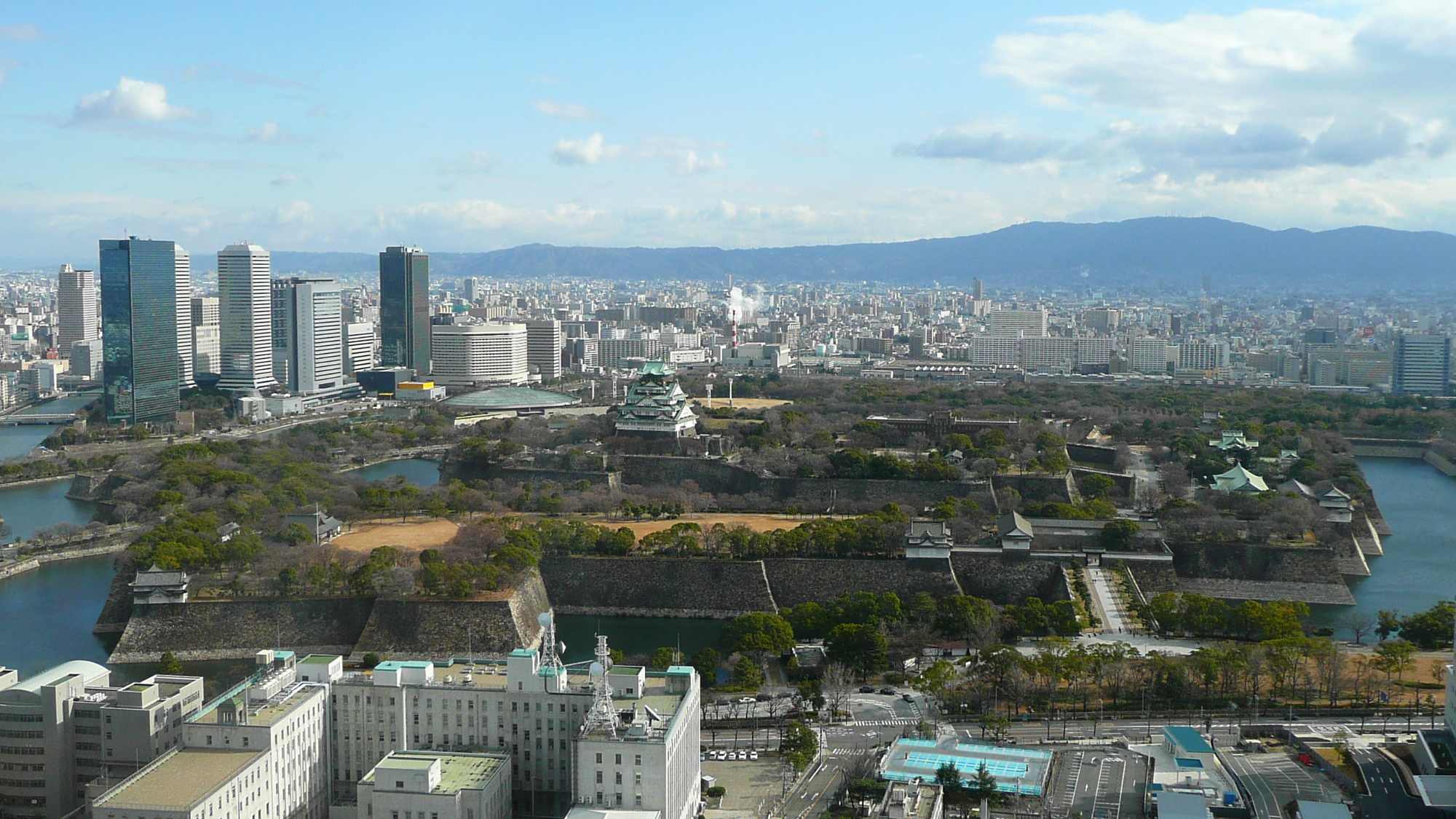
The park sprawls across the castle's historic footprint, and the military architecture that survives is remarkable. Thirteen structures within the grounds hold official designation as Important Cultural Properties: the Ote Gate, the Sakura Gate, turrets numbered first through sixth, the Sengan and Tamon turrets, the Kinzo gold storehouse, and the Inui turret among them. The inner and outer moats still define the castle's concentric defenses -- the inner moat split between wet sections to the northeast and dry sections to the southwest, the outer moat fully water-filled. Tucked within the inner bailey, a time capsule buried during Expo '70 is not scheduled for opening until the year 6970 -- nearly five thousand years from now. It sits quietly among the ancient stones, a bet that someone will still be here to dig it up.
The Sounds of the Park
Osaka Castle Park has earned a reputation as a place where music happens without formal invitation. Bands, buskers, and solo musicians stake out spots throughout the grounds, their sound drifting across the moats and through the tree lines. The park contains a dedicated open-air concert hall and the 16,000-seat Osaka Castle Hall, which hosts major concerts and events. A martial arts training center, the Shudokan, operates within the grounds, as does a kyudo archery range. The Osaka International Peace Center once stood here as well, offering exhibits on wartime history -- a pointed reminder given the park's own military past. Athletic fields, a baseball diamond, and the broad Taiyo-no-Hiroba plaza give the park a lived-in quality that distinguishes it from manicured tourist destinations.
Seasons Written in Blossoms
The park's calendar is structured around flowering trees. Plum blossoms open the season from January through March, their pale petals appearing against bare branches in the park's dedicated Bairin plum grove. Peach blossoms follow briefly in March. Then come the cherry blossoms in April, when Osaka Castle Park becomes one of the city's premier hanami destinations. Thousands spread tarps beneath the sakura, eating and drinking as pink petals drift over the moats. The Nishi-no-Maru Garden, on the western side of the inner compound, offers a particularly celebrated vantage point -- cherry blossoms in the foreground, the reconstructed castle tower rising behind them. It is a scene so thoroughly Japanese that it can feel almost choreographed, yet the trees bloom on their own schedule, indifferent to the centuries of human drama that unfolded beneath them.
Ghosts and Monuments
Scattered through the park are markers that refuse to let visitors forget what happened here. A monument marks the spot where Toyotomi Hideyori and his mother Yodo-dono took their own lives after the castle fell in 1615. A stone commemorates the site of the original Ishiyama Hongan-ji temple. A pine tree is associated with the priest Rennyo, who reportedly hung his surplice from its branches. The former headquarters of the Imperial Japanese Army's 4th Division still stands, repurposed as a commercial complex. And in the park's eastern sections, the former chemical laboratory of the Osaka Arsenal survives -- a concrete relic of the decades when this green space manufactured weapons instead of leisure. The Hokoku Shrine, dedicated to the memory of Toyotomi Hideyoshi himself, sits between the inner and outer moats, ensuring that the warlord who built the castle remains a presence in the park that replaced his fortress.
From the Air
Located at 34.687N, 135.526E in central Osaka, the park is clearly visible from altitude as a large green rectangle bounded by moats, with the white castle tower at its center. The park covers approximately 105 hectares and is Osaka's second-largest. The Osaka Business Park cluster of high-rises sits immediately to the east. Osaka International Airport (RJOO/Itami) is approximately 8 nautical miles northwest; Kansai International Airport (RJBB) is about 26 nautical miles southwest. Best viewed at 2,000-4,000 feet AGL, where the moat system and park layout are clearly distinguishable.