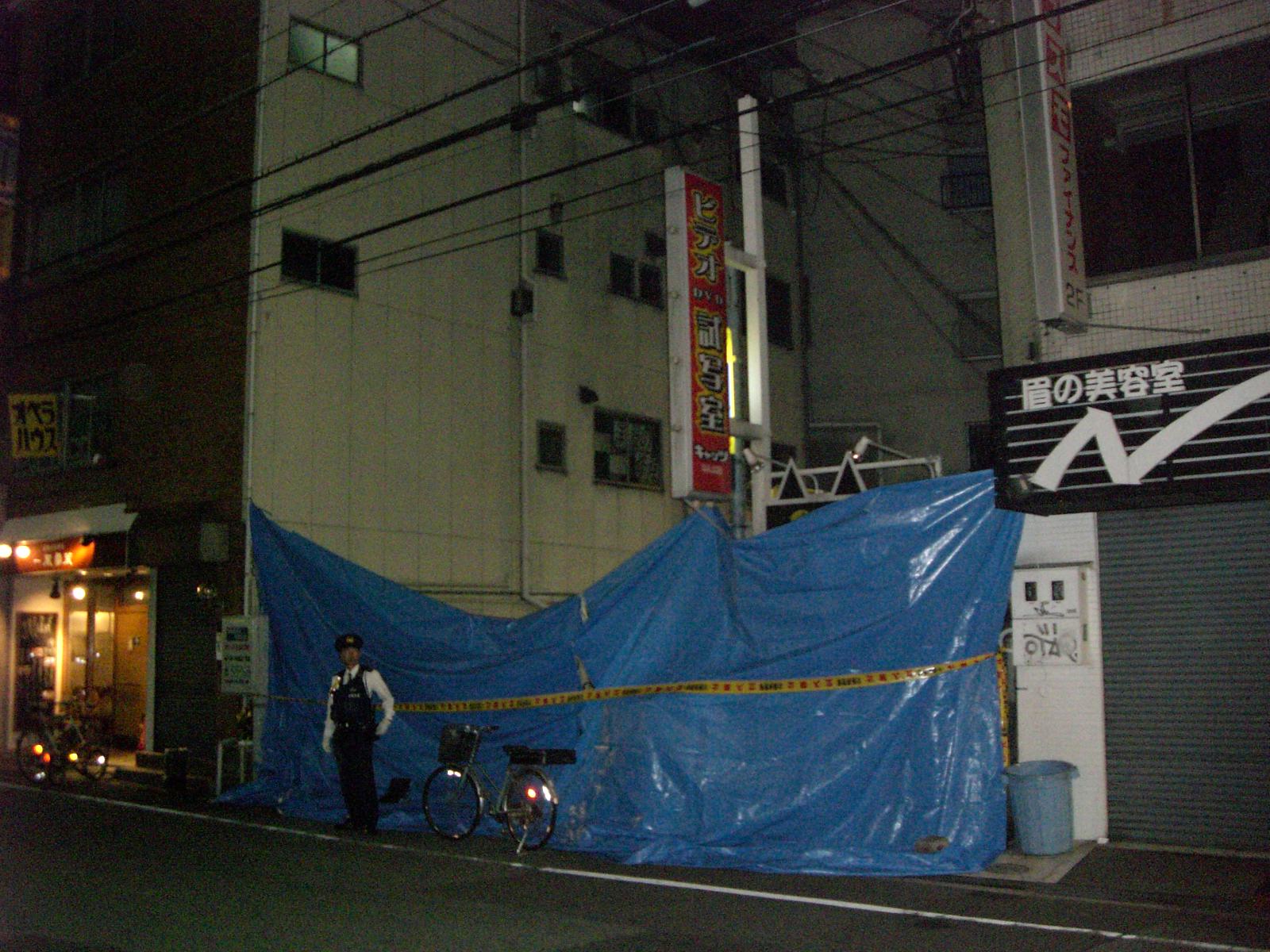
The Osaka Video Arcade Fire: A Night in Namba That Changed Japan's Safety Laws
The fire alarm went off at 3:13 a.m. on October 1, 2008, inside a narrow building in Osaka's Namba entertainment district. The manager of Cats, an adult video arcade occupying a cramped floor of a multi-tenant building, heard the alarm and shut it off. He assumed it was a false alarm. It was not. Smoke was already filling the single hallway that connected thirty-two tiny rental rooms -- each barely large enough for a person to lie down -- to the only exit. Twenty-six customers and three employees were inside. Within minutes, carbon monoxide would claim fifteen lives. A sixteenth victim, Hirokatsu Igawa, would die in hospital two weeks later.
Thirty-Two Rooms, One Way Out
Cats was a type of establishment common in Japanese cities: a private video booth rental business where customers paid roughly 1,500 yen -- about fifteen dollars -- for a small room with a screen and a door that locked from the inside. Many customers used the rooms as an inexpensive place to sleep overnight. The rooms lined both sides of a single narrow corridor, and the only way in or out of the business passed through the reception area. There were no windows. No sprinklers. No smoke ventilation system. The building met minimum fire code at the time of its opening, but those codes had never anticipated what would happen when fire erupted in a sealed corridor full of sleeping people with nowhere to go. Some 120 firefighters responded and brought the blaze under control in ninety minutes, but for the sixteen who died, the lethal agent was not flame but invisible carbon monoxide filling those sealed rooms like gas chambers.
A Desperate Act
Police arrested forty-six-year-old Kazuhiro Ogawa, an Osaka resident who had been living on welfare, within hours of the fire. He told investigators he had set the blaze after deciding to end his own life. He was depressed, unemployed, and told police he believed his life was meaningless. But when smoke began filling his rented room, Ogawa panicked. He fled through the corridor and escaped the building -- the very exit that dozens of other people in those locked, windowless rooms could not reach in time. Ogawa's confession was straightforward, but when his trial began in September 2009, he reversed course, pleading not guilty. He claimed he had only confessed because he assumed his own cigarette had started the fire. The court did not believe him.
Justice and Its Limits
On November 21, 2009, an Osaka district court found Ogawa guilty of arson resulting in death. On December 17, the court sentenced him to death. The severity reflected both the scale of the tragedy and the deliberate nature of the crime. Ogawa appealed the sentence through every level of the Japanese judicial system. In 2014, the Supreme Court of Japan rejected his final appeal. Justice Tomoyuki Yokota stated that the fire had caused 'an extremely large number of casualties,' that 'the impact and anxiety on society is great,' and that there was 'no reason to consider the motives and circumstances behind the decision to commit suicide' as mitigating factors. Ogawa remains on death row, where Japanese inmates receive no advance notice of their execution date -- a practice that has drawn criticism from international human rights organizations.
The Alarm That Never Sounded
Investigations after the fire revealed a cascade of safety failures that turned a manageable situation into a mass casualty event. The building's fire alarm had been triggered correctly, but the manager silenced it, treating it as a nuisance rather than a warning. The emergency lighting and exit guidance systems were either nonfunctional or inadequate. The rooms had no secondary means of escape. The tragedy prompted a national reassessment of fire safety regulations for small commercial spaces in Japan, particularly businesses that allowed overnight stays in enclosed rooms. Internet cafes, manga cafes, and video booth operations across the country faced new inspections and tighter requirements for emergency exits, sprinkler systems, and alarm protocols. The Cats fire became a cautionary reference point in Japanese fire safety policy -- a reminder that building codes written for one type of use can become death traps when the actual use diverges from what regulators imagined.
From the Air
Located at 34.66°N, 135.50°E in the Namba district of central Osaka, one of Japan's densest urban entertainment zones. The building where the fire occurred was part of the multi-tenant commercial strip near Nanba Station. From the air, Namba is identifiable by the convergence of major rail lines and the dense grid of narrow streets south of the Dotonbori canal. Osaka International Airport (Itami, RJOO) lies approximately 10 nautical miles to the north-northwest. Kansai International Airport (RJBB) is approximately 26 nautical miles to the south-southwest on its artificial island in Osaka Bay.
Sources
- Osaka movie theatre fire - Wikipedia
- Suspected arson in Osaka kills 15 - The Japan Times
- Death lifts Osaka arson toll to 16 - The Japan Times
- Suicide was motive in Osaka arson - The Japan Times
- Ogawa Kazuhiro - Japan Innocence & Death Penalty Information Center
- Man to hang for fatal arson at Osaka video parlor - The Japan Times