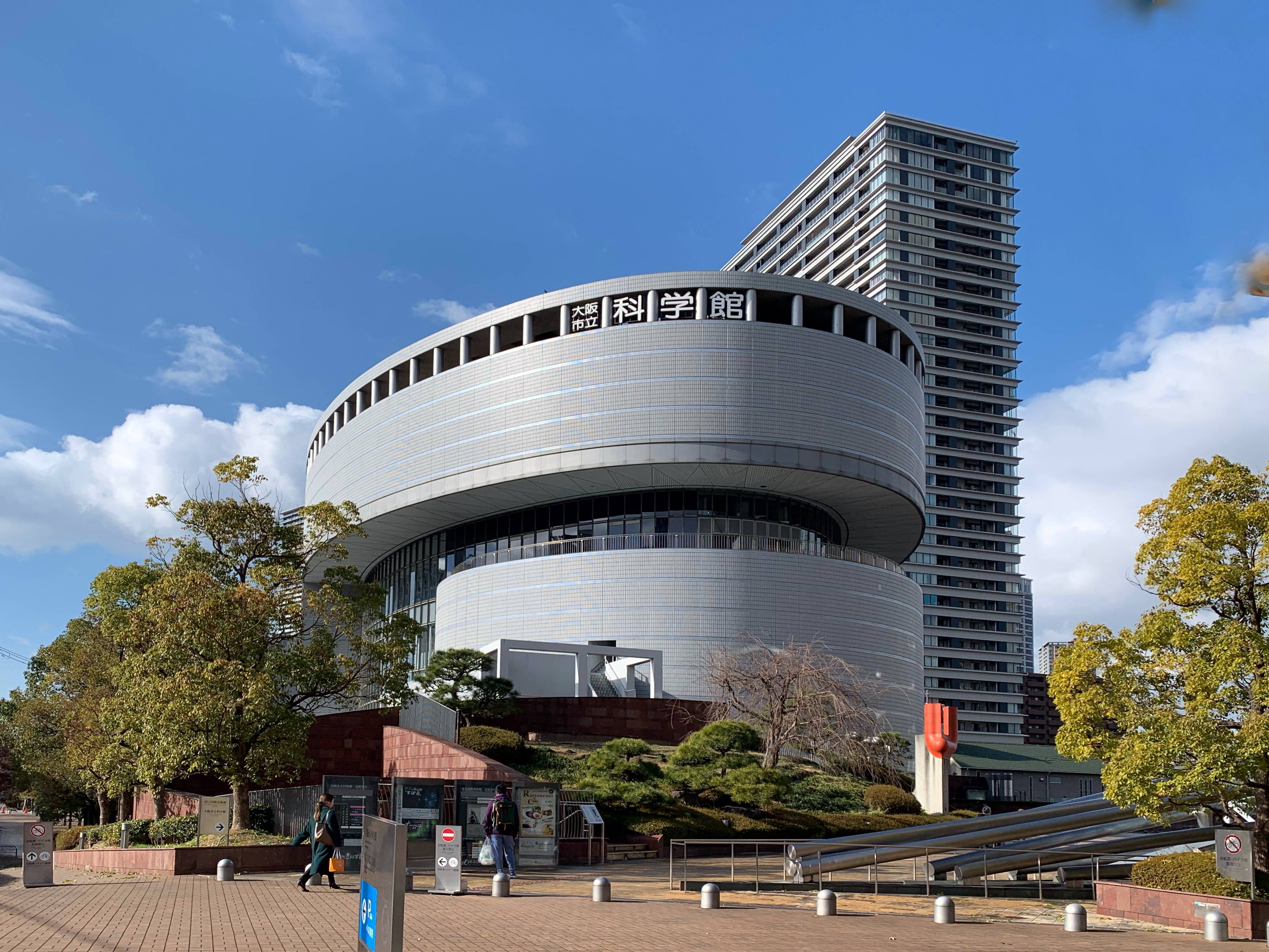
Osaka Science Museum: Where Japan's First Planetarium Met Its First Nobel Prize
In 1935, a physicist named Hideki Yukawa sat in a university building on a narrow island between two rivers in central Osaka and proposed the existence of a particle no one had ever seen. His meson theory -- predicting that nuclear forces were carried by particles heavier than electrons but lighter than protons -- would earn him the Nobel Prize in Physics in 1949, making him the first Japanese laureate. That university building stood on Nakanoshima, a slender island wedged between the Dojima and Tosabori rivers in the heart of Osaka. Today the same ground holds the Osaka Science Museum, a place that traces its lineage back to 1937, when Japan's first science museum and first planetarium opened here under the name Osaka City Electricity Science Museum. The current building, opened in 1989 to mark the hundredth anniversary of Osaka City, carries the theme 'The Universe and Energy' -- a fitting label for a site where a Nobel Prize was born.
The Island Between Two Rivers
Nakanoshima is one of Osaka's most distinctive landmarks from the air: a long, narrow sandbar-shaped island stretching east to west through the city center, flanked by the Dojima River to the north and the Tosabori River to the south. For centuries it served as a center of commerce and governance. Today it holds a concentration of cultural institutions that would be remarkable in any city, with the Science Museum sitting directly above the subterranean National Museum of Art. The two museums share the western end of the island, surrounded by the Osaka International Convention Center, the Museum of Oriental Ceramics, and the Osaka city government buildings. It is a pocket of public institutions in a city more famous for its street food and nightlife -- a quiet counterweight to the neon chaos of Dotonbori just a few kilometers south.
Japan's First Stars Projected Indoors
Before the current building existed, a predecessor museum opened on this same ground in 1937: the Osaka City Electricity Science Museum. It holds two distinctions in Japanese history -- it was the country's first science museum and the home of Japan's first planetarium. That original Carl Zeiss Model II projector, imported from Germany, cast artificial starlight onto a dome and opened a new kind of public experience in prewar Japan. The museum also became the first site in the country to detect radio waves from space, adding astronomical observation to its educational mission. The current museum preserves the original Zeiss projector in its scientific collection. The modern planetarium that replaced it features a dome with a 26.5-meter radius -- among the largest in the world -- and was renovated in 2004 with a next-generation digital projection system capable of rendering the entire night sky.
Yukawa's Ghost and a Robot's Second Life
The museum's connection to Hideki Yukawa is not merely commemorative. The building occupies the former site of the Osaka University School of Science, where Yukawa conducted the theoretical work that reshaped physics. His meson theory, published in 1935, predicted a then-unknown class of subatomic particles. When the muon and then the pion were discovered experimentally, Yukawa's prediction was confirmed, and his Nobel Prize followed. The museum also houses a Cockcroft-Walton particle accelerator and resources from the Seimikyoku, Japan's first modern chemistry laboratory. But its most charismatic artifact may be the replica of Gakutensoku, Japan's first robot. Built in 1928 by biologist Makoto Nishimura, the original Gakutensoku -- meaning 'learning from the laws of nature' -- stood 3.2 meters tall, could change its facial expressions, puff its cheeks, and move its head and hands using compressed air. The original was lost during a tour of Germany. The museum's replica, completed in 2008 at a cost of twenty million yen, faithfully reproduces the pneumatic movements of its ninety-year-old predecessor.
Four Floors of Touch and Discovery
The current building, designed by the Takenaka Corporation and funded through a 6.5 billion yen donation from Kansai Electric Power Company, covers nearly 9,000 square meters across four exhibition floors. Each floor focuses on a different theme, with roughly 200 interactive exhibits spread among them. Live science demonstrations run several times daily, though they are conducted entirely in Japanese. The museum's library holds the most comprehensive public collection of astronomy books and magazines in western Japan. From the outside, the Science Museum is a clean, functional box -- unremarkable by Osaka's architectural standards. But what happens inside connects visitors to a lineage that runs from Japan's first projected stars in 1937 through its first Nobel Prize to the digital planetarium overhead. The construction was funded by Kansai Electric, and the theme of energy runs throughout, but the museum's real power is in how it ties Osaka's identity as a practical, commercially minded city to the theoretical breakthroughs and technological firsts that happened quietly on this river island while the rest of the city was busy selling things.
From the Air
Located at 34.69°N, 135.49°E on Nakanoshima island in central Osaka. From the air, Nakanoshima is immediately recognizable as a long, narrow island running east-west between the Dojima and Tosabori rivers. The Science Museum sits on the western end of the island, adjacent to the National Museum of Art (which is largely underground) and the Osaka International Convention Center. Best viewed at 2,000-4,000 feet AGL for river and island detail. Osaka International Airport (Itami, RJOO) lies approximately 8 nautical miles north-northwest. Kansai International Airport (RJBB) is approximately 28 nautical miles south-southwest on its artificial island in Osaka Bay.