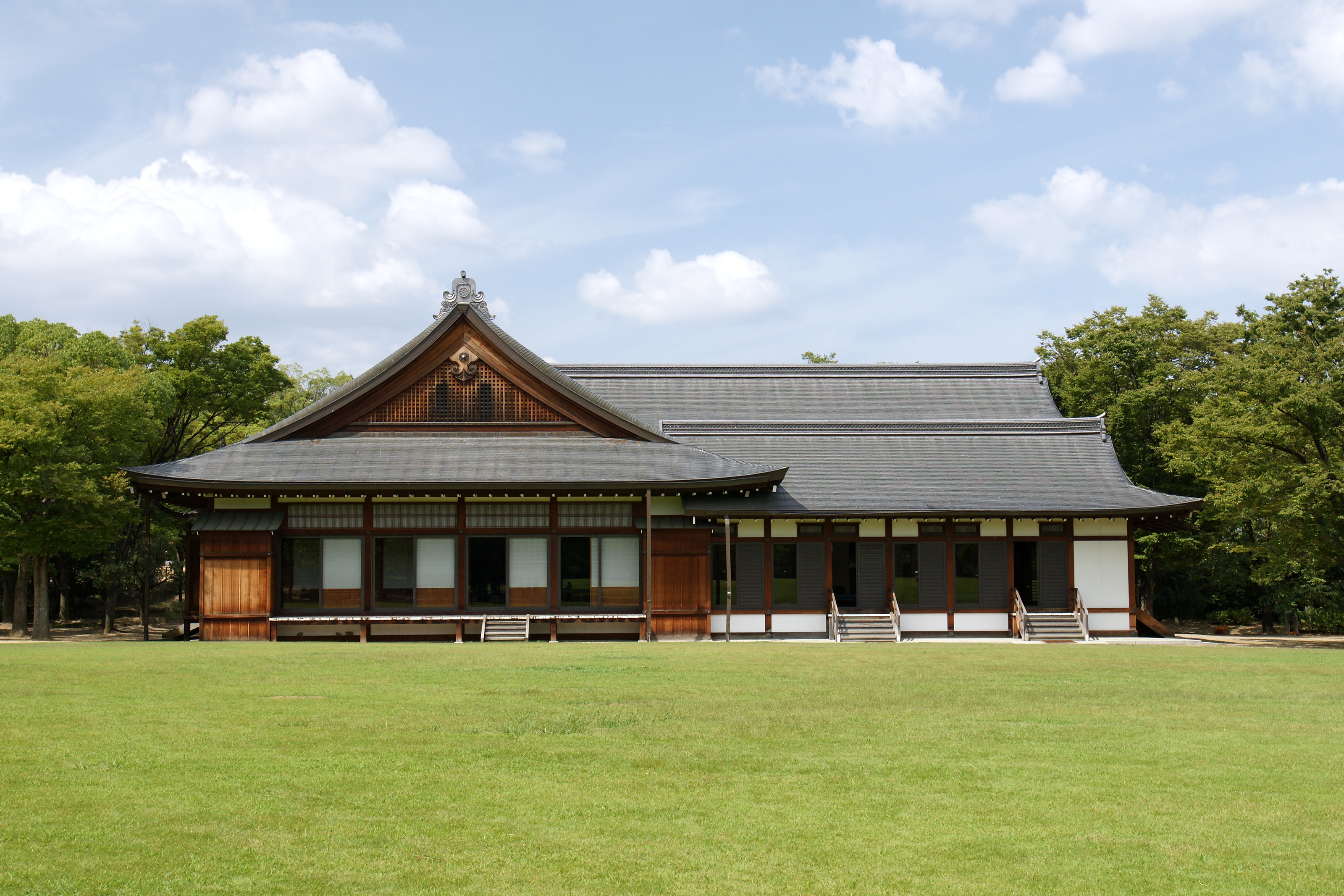
Osaka State Guest House
Only shoguns were permitted inside the Shiro Shoin, the White Drawing Room of Kyoto's Nijo Castle. The space was private, exclusive, reserved for the most powerful ruler in Japan and his closest attendants. In 1995, architects recreated that rarefied atmosphere inside the grounds of Osaka Castle, building a guest house where the world's most powerful leaders would gather not as conquerors but as dinner guests. The Osaka State Guest House, known in Japanese as Osaka Geihinkan, sits in the Nishinomaru Garden with castle stone walls on one side and 300 cherry trees on the other, a building where traditional Japanese formality meets high-stakes modern diplomacy.
Built for a Summit
The Geihinkan was constructed in 1995 on the site of an aging rest area in Osaka Castle Park, purpose-built for the Asia-Pacific Economic Cooperation summit held that year. The building was to serve as a meeting place for representatives from APEC's member economies. There was a diplomatic wrinkle, however: because representatives from China, Hong Kong, and Taiwan all attended, the gathering was officially classified as an unofficial meeting, despite being effectively an official summit. The architectural commission called for something that would project the gravity of its purpose. Designers modeled the structure after the Shiro Shoin of Nijo Castle, the shogun's private quarters within Kyoto's UNESCO World Heritage fortress. The result is a building of pure Japanese architectural tradition, all clean lines, tatami proportions, and a banquet room that frames views of the Nishinomaru Garden through wide openings.
A Castle Within a Castle
The Nishinomaru Garden, where the Geihinkan stands, occupies roughly 20,000 tsubo on the western side of Osaka Castle. This was historically significant ground: the residence of Kita no Mandokoro, the legal wife of Toyotomi Hideyoshi, once stood here during the castle's feudal heyday. Today the garden is famous across Japan as a cherry blossom viewing destination, with approximately 300 trees that erupt in pink each spring. The Geihinkan sits within this landscape as a kind of architectural echo, a building that channels the formality of the Tokugawa shoguns while overlooking the castle that their rivals, the Toyotomi, originally built. From inside the banquet hall, guests look out across the garden toward the castle tower, a view that compresses four centuries of Japanese history into a single frame.
The G20 Dinner
For nearly 25 years after APEC, the Geihinkan served various civic functions without attracting much international attention. That changed on June 28, 2019, when the building hosted the dinner for the G20 Osaka summit. World leaders including Japanese Prime Minister Abe Shinzo and his spouse Abe Akie welcomed heads of state in the traditional setting. Security preparations for the summit were unprecedented; The Japan Times reported that Osaka braced for extraordinary measures across the city. Inside the Geihinkan, the formality of the architecture matched the gravity of the occasion. The dinner brought the building full circle, fulfilling the diplomatic purpose it had been designed for, and briefly placing this quiet structure in the Nishinomaru Garden at the center of global attention.
Dining Where Diplomats Sat
Today the Osaka Geihinkan operates under a more accessible mission. The building is owned by the City of Osaka, managed by the Osaka Castle Management Consortium, and operated by Value Management. Part of the structure now functions as an exclusive restaurant available by reservation only, allowing ordinary visitors to dine in the same space where world leaders gathered. The venue also serves the MICE tourism industry, hosting meetings, incentive events, conferences, and exhibitions within its traditional rooms. A tea ceremony space, the Hosho-an hermitage on the grounds, offers guests a formal matcha experience. It is a rare opportunity: to sit inside a recreation of the shogun's private quarters, looking out at the same cherry trees and castle walls that APEC delegates and G20 leaders contemplated, while Osaka's modern skyline rises beyond the ancient stone ramparts.
From the Air
Located at 34.688N, 135.523E within the Nishinomaru Garden on the western side of Osaka Castle. From the air, Osaka Castle Park is one of the most recognizable landmarks in central Osaka, a large green rectangle surrounded by moats amid dense urban development. The Geihinkan is a low traditional structure within the park's western garden, difficult to distinguish individually but situated within the clearly visible castle grounds. Nearby airports include Osaka Itami (RJOO, 12 km north) and Kansai International (RJBB, 42 km south). Best viewed at 2,000-4,000 feet when overflying the Osaka Castle moat system.