Oseberg Ship
Two women were buried together in a single bed aboard a ship in the autumn of 834 CE. One was roughly eighty years old and crippled by arthritis. The other, perhaps fifty, had a healed collarbone fracture and teeth that showed she used a metal toothpick, a luxury almost unheard of in the 9th century. Both ate meat when most Vikings subsisted on fish. Whoever they were, someone thought them important enough to inter with fourteen horses, three dogs, an ox, four ornate sleighs, the only complete Viking-era cart ever found, and one of the most beautifully carved ships to survive a millennium underground.
Unearthed from the Mound
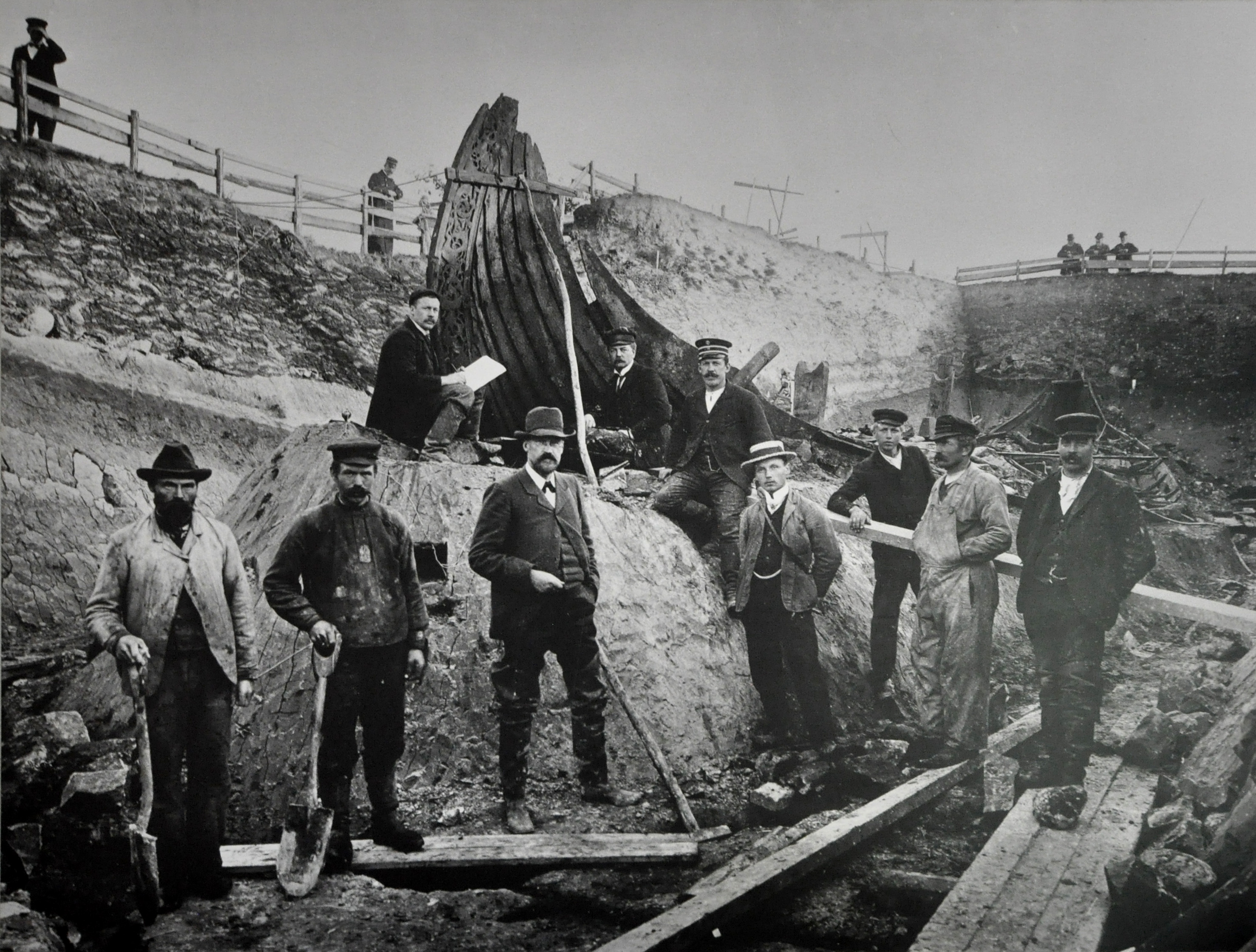
The Oseberg burial mound sat on a farm near Tonsberg in Vestfold county for over a thousand years before archaeologists Gabriel Gustafson and Haakon Shetelig excavated it in 1904 and 1905. What they found stunned the academic world. The ship itself, a karve of clinker-built oak measuring 21.58 meters long and 5.10 meters broad, had been sealed in blue clay that preserved both the vessel and its extraordinary cargo. The bow and stern curled upward in elaborate woodcarvings executed in the so-called gripping beast style, an interlocking tangle of animal forms so distinctive that art historians named it the Oseberg style. Dendrochronological analysis dated the burial chamber timbers to autumn 834, though parts of the ship itself were constructed as early as 800.
The Mystery of Two Queens
The identity of the two women has consumed scholars for more than a century. The older woman suffered from Morgagni's syndrome, a condition that would have given her a masculine appearance and facial hair, making her a striking figure even among Viking nobles. Some researchers have suggested she was Queen Asa of the Yngling clan, mother of Halfdan the Black and grandmother of Harald Fairhair, the king who would first unify Norway. Tests on the remains showed both women lived in Agder, as Queen Asa did, lending the theory some weight. Others believe she may have been a volva, a Norse shaman, given the ritual nature of the burial. One detail hints at the women's stratification: one wore a fine red wool dress with imported silk applique, while the other wore plainer blue wool. They were found lying together in one bed, their relationship as enigmatic as everything else about the grave.
Treasures from Two Worlds
Though the grave had been robbed of precious metals in antiquity, what remained was astonishing. The four elaborately carved sleighs, the wooden cart, bed-posts, chests, and agricultural tools painted a vivid picture of elite Viking life. The most puzzling object was the so-called Buddha bucket, a yew-wood pail with brass fittings and a handle attached to two seated figures resembling depictions of the Buddha in lotus posture. The connection to Buddhism is almost certainly coincidental; the enamelwork more closely resembles human figures in Irish Insular art manuscripts like the Book of Durrow, suggesting trade networks that linked Scandinavia to the Celtic world. The grave also yielded rare textiles, including woolen garments, imported silks, and narrow tapestries that remain among the few surviving examples of Viking-era fabric.
A Ship That Still Sails
For decades, scholars debated whether the Oseberg ship was purely ceremonial or actually seaworthy. A 2010 reconstruction project called Saga Oseberg set out to answer the question. Using timber from Denmark and Norway and employing traditional Viking building methods, craftspeople completed a faithful replica and launched it from Tonsberg on June 20, 2012. In March 2014, the replica sailed on open seas toward Faerder, achieving 10 knots under full sail. With 15 pairs of oar ports allowing up to 30 rowers, the ship proved itself a capable vessel, not merely a floating coffin. An earlier replica, the Dronningen, had sunk, but that failure was traced to errors in the original 1904 restoration that inadvertently altered the hull geometry. The Saga Oseberg's success vindicated the original Viking shipwrights across twelve centuries.
From the Air
The original Oseberg ship is displayed at the Viking Ship Museum at Bygdoy, western Oslo, at 59.90N, 10.68E. The burial site is near Tonsberg in Vestfold county, approximately 100 km south of Oslo. From the air, Bygdoy peninsula is clearly visible jutting into the Oslofjord. Nearest airport is Oslo Gardermoen (ENGM). Tonsberg Airfield (ENTO) serves the excavation area. Best viewed at 2,000-4,000 ft AGL.