Oshino Hakkai
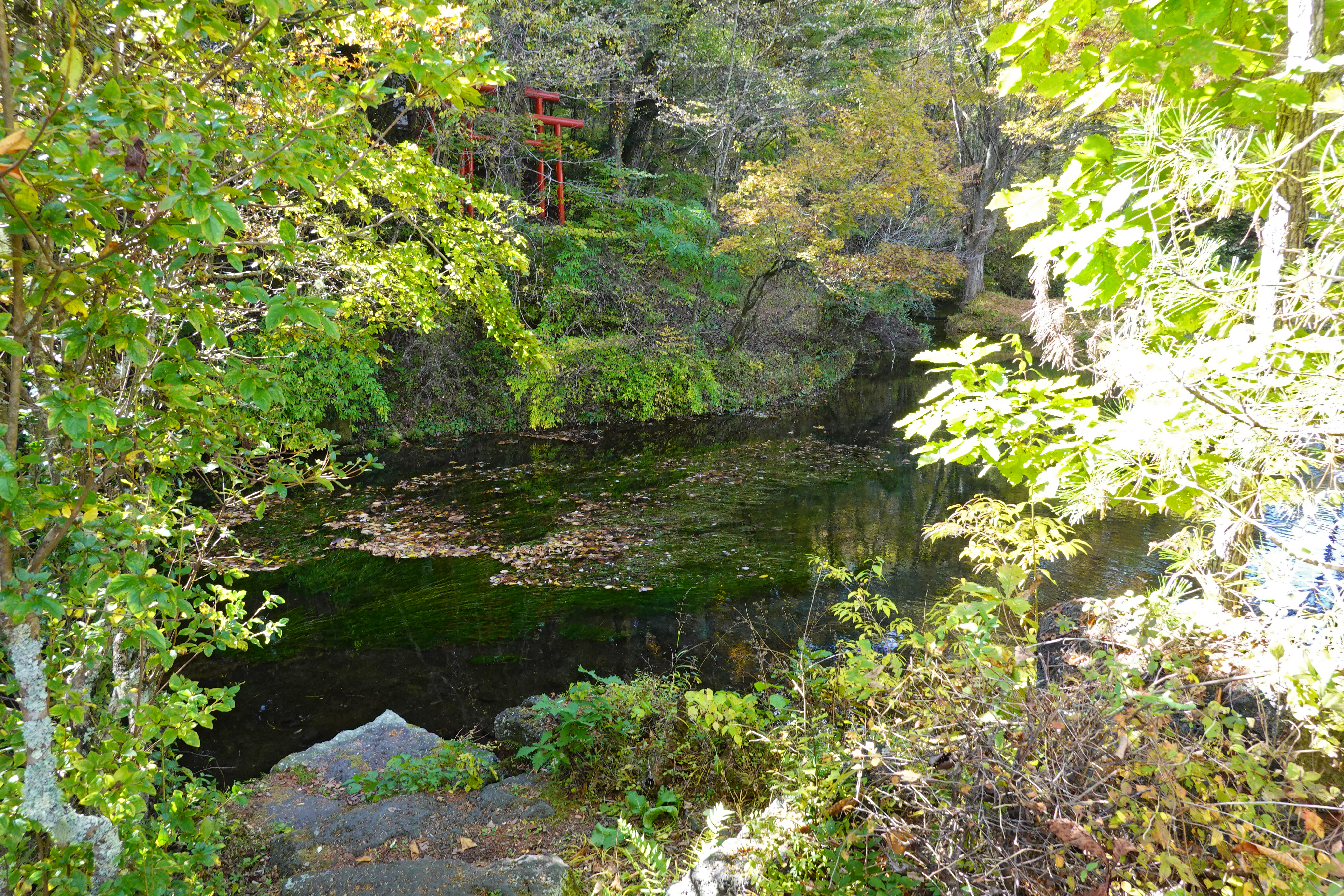
The water bubbling up in the village of Oshino fell as snow on Mount Fuji roughly 80 years ago. It seeped into the mountain's porous lava, descended through layer after layer of volcanic rock, and has been filtering ever since -- emerging at last as eight springs of astonishing clarity. The Japanese call them Oshino Hakkai, the "Eight Seas of Oshino," a name that captures both the grandeur locals see in these modest ponds and the deep reverence the water commands. Designated a Natural Monument of Japan and inscribed as part of the Mount Fuji UNESCO World Heritage Site, these springs produce roughly one million tons of water daily from Fuji's underground aquifer, each pond distinct in character, color, and legend.
Eighty Years Underground
The journey from snowflake to spring is extraordinarily slow. When snow melts on Mount Fuji's upper slopes, the water does not run off into rivers. Instead, it seeps into the mountain's porous volcanic substrate -- layers of basalt and scoria left by eruptions spanning 100,000 years. The water descends gradually, filtered through these mineral-rich layers, stripped of impurities, and cooled to a constant temperature. By the time it surfaces at Oshino, approximately 80 years have passed. The result is water of remarkable purity and mineral balance, so clear that the bottom of even the deepest ponds is sharply visible. Wakuike, the most famous of the eight springs, has a central pool where water visibly surges upward from the volcanic bedrock below, creating gentle ripples on the surface that seem to breathe. The village of Oshino itself sits at approximately 936 meters elevation in a basin between Mount Fuji and the peaks of the Misaka mountain range.
Eight Ponds, Eight Characters
Each of the eight springs has its own name, personality, and folklore. Deguchiike, the largest, sits slightly apart from the others and was traditionally the first stop on the pilgrimage circuit. Okamaike, the smallest, is named for its resemblance to a cooking pot, its waters an impossible shade of blue-green. Sokonashiike -- "bottomless pond" -- earned its name from the depth that seemed to defy measurement. Choshiike, shaped like a sake pourer, carries a legend about a nervous bridegroom whose wedding sake vessel fell into the water and was never recovered. Wakuike, where water visibly bubbles from the ground, is considered the centerpiece. Nigoriike, meaning "cloudy pond," appears slightly less transparent than its siblings. Kagamiike, the "mirror pond," reflects Mount Fuji on its surface when conditions are still. And Shobuike, the iris pond, is named for the iris flowers that bloom along its banks in early summer.
Pilgrims of the Fire Mountain
The springs took on spiritual significance during the Edo period (1603-1868), when Fuji-ko -- devotional associations dedicated to worshipping Mount Fuji -- grew into a widespread popular movement. Members of Fuji-ko believed that climbing the sacred mountain would bring purification and spiritual rebirth, but the ascent required preparation. Pilgrims traveling to Fuji's summit would stop at Oshino Hakkai to ritually cleanse themselves in the spring waters before beginning their climb. In 1843, the Daiga sect formalized this practice by dedicating each of the eight ponds to one of the Eight Great Dragon Kings of Buddhist tradition, creating an ordered pilgrimage route that began at Deguchiike and concluded at Shobuike. Visitors walked from spring to spring, performing purification rites at each, before proceeding to the mountain. That pilgrimage route has evolved into the modern tourist path that connects the ponds today, though the walking order and the placards at each site still echo the original spiritual geography.
A Village Framed by Fuji
Oshino remains a small village of traditional thatched-roof houses, many of which have been preserved or reconstructed as part of the cultural landscape. On clear days, the view from the ponds includes the full profile of Mount Fuji rising to the southwest, its snowcapped cone reflecting in the still surfaces of the springs. This combination of traditional architecture, crystal-clear water, and the ever-present volcano has made Oshino Hakkai one of Yamanashi Prefecture's most visited attractions. The ponds are located within the broader Fuji Five Lakes region and fall under the protection of Fuji-Hakone-Izu National Park. Despite the tourist traffic, the springs themselves remain remarkably undisturbed -- the water continues its 80-year journey from summit snow to village pond, indifferent to the visitors who gather along the banks to peer into depths that have been replenishing themselves since long before any human laid eyes on them.
From the Air
Oshino Hakkai (35.4601N, 138.8329E) is located in the village of Oshino, northeast of Mount Fuji in the Fuji Five Lakes region. The eight spring ponds are small and not individually visible from altitude, but the village itself is identifiable in the valley between Mount Fuji and the Misaka mountain range. The nearest airport is Mt. Fuji Shizuoka Airport (RJNS) to the southwest. Lake Yamanaka, the largest of the Fuji Five Lakes, lies just to the south and serves as an excellent visual reference. Recommended viewing altitude is 3,000-5,000 feet AGL for the village and surrounding landscape. The panoramic view of Fuji from this angle, with the lakes and village in the foreground, is one of the most iconic perspectives of the mountain.