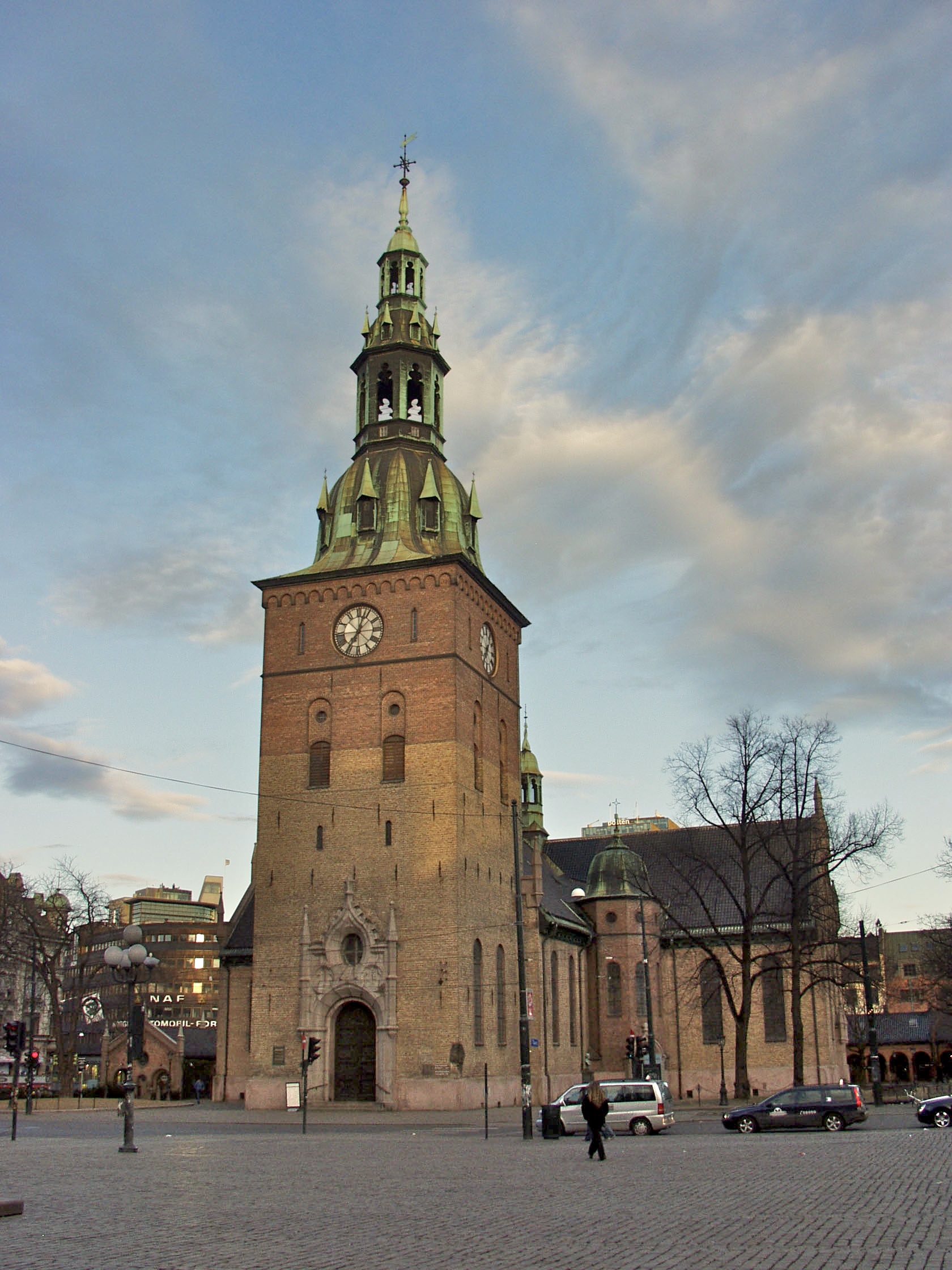
Oslo Cathedral
Every few minutes between seven in the morning and midnight, 48 bells inside the tower of Oslo Cathedral play one of 18 melodies that change with the calendar. The carillon, donated in 2003 by Ornulf Myklestad and programmed by carillonneur Brynjar Landmark, is the newest voice of a building that has been speaking to Oslo since 1697. But the cathedral on Stortorvet square is itself the third attempt to give this city a central church. The first two were claimed by fire and neglect. The third has endured through royal weddings, wartime occupations, and a four-year renovation that stripped it back to something close to its original self.
Three Cathedrals for One City
Oslo's first cathedral, Hallvards Cathedral, was built by King Sigurd I in the first half of the 12th century near the Old Bishop's Palace, about 1.5 kilometers east of today's site. For nearly 500 years it served as the city's most important church. Then came the great fire of 1624, and King Christian IV made a radical decision: rather than rebuild, he moved the entire city several kilometers west to shelter behind the walls of Akershus Fortress. The new city needed a new church, and construction began on a replacement in 1632. That second cathedral, Hellig Trefoldighet, lasted barely 50 years before it too burned. Councillor of state Jorgen Wiggers designed the replacement that still stands. Workers laid the foundation stone in 1694 on a small rocky outcrop at what would become Stortorvet, and the church was consecrated in November 1697.
Art Layered Upon Art
The cathedral's interior reads like a timeline of Norwegian artistic ambition. Emanuel Vigeland, brother of the more famous sculptor Gustav, created the stained-glass windows in the choir between 1910 and 1916. Dagfin Werenskiold cast the bronze doors of the west portal in 1938. Italian sculptor Arrigo Minerbi contributed a silver communion scene in 1930, and painter Hugo Lous Mohr decorated the ceilings. Behind the old Baroque organ facade sits an instrument built by Ryde and Berg of Fredrikstad in the 1990s for the cathedral's 300th anniversary. The Bazaar, a curved red-brick building with a green copper tower designed by city architect Christian H. Grosch, wraps around the cathedral's lower end. Integrated within it is the Brannvakten, which served as Oslo's main fire station from 1860 until 1939, an apt neighbor for a church born from its predecessor's ashes.
Where Crowns Meet Ceremony
Oslo Cathedral belongs as much to the Norwegian state as to its parish. The royal family and government use it for their most public occasions. On August 29, 1968, then-Crown Prince Harald married Sonja Haraldsen here, a union that drew attention because she was a commoner. Thirty-three years later, their son Crown Prince Haakon wed Mette-Marit Tjessem Hoiby in the same nave, a ceremony that again tested Norwegian conventions. Between these weddings, the cathedral has hosted state funerals, national commemorations, and the ordinary weekly rhythms of an active parish. Architect Arnstein Arneberg oversaw a comprehensive restoration completed for the city's 900th anniversary in 1950, stripping away neo-Gothic additions to reveal the original 17th-century furnishings beneath.
The Bells That Mark the Hours
Oslo Cathedral first received a donation for a carillon in 1924, but the plan was never realized. It took nearly 80 years and a second benefactor, Ornulf Myklestad, to bring bells to the tower. The resulting 48-bell concert carillon, installed in 2003, sits inside the tower rather than in the belfry, a placement that created acoustic challenges documented in a 2005 master's thesis by Laura Ruesltten. Since December 2016, carillonneur Vegar Sandholt and organist Kare Nordstoga have programmed the bells for regular use, marking hours and quarter-hours with ritornelles that shift with the liturgical and civic calendar. The cathedral closed for a major renovation in August 2006 and reopened on April 18, 2010, with a festive high mass attended by King Harald V and the royal family. Its red-brick walls, green copper tower, and now its 48 voices continue to anchor downtown Oslo.
From the Air
Located at 59.91N, 10.75E at Stortorvet square in downtown Oslo, northeast of Karl Johans gate. The cathedral's green copper tower and the curved Bazaar building are recognizable from the air at lower altitudes. Nearest major airport is Oslo Gardermoen (ENGM), approximately 40 km northeast. The church sits roughly 1 km east of Akershus Fortress on the waterfront. Best viewed at 2,000-3,000 ft AGL.