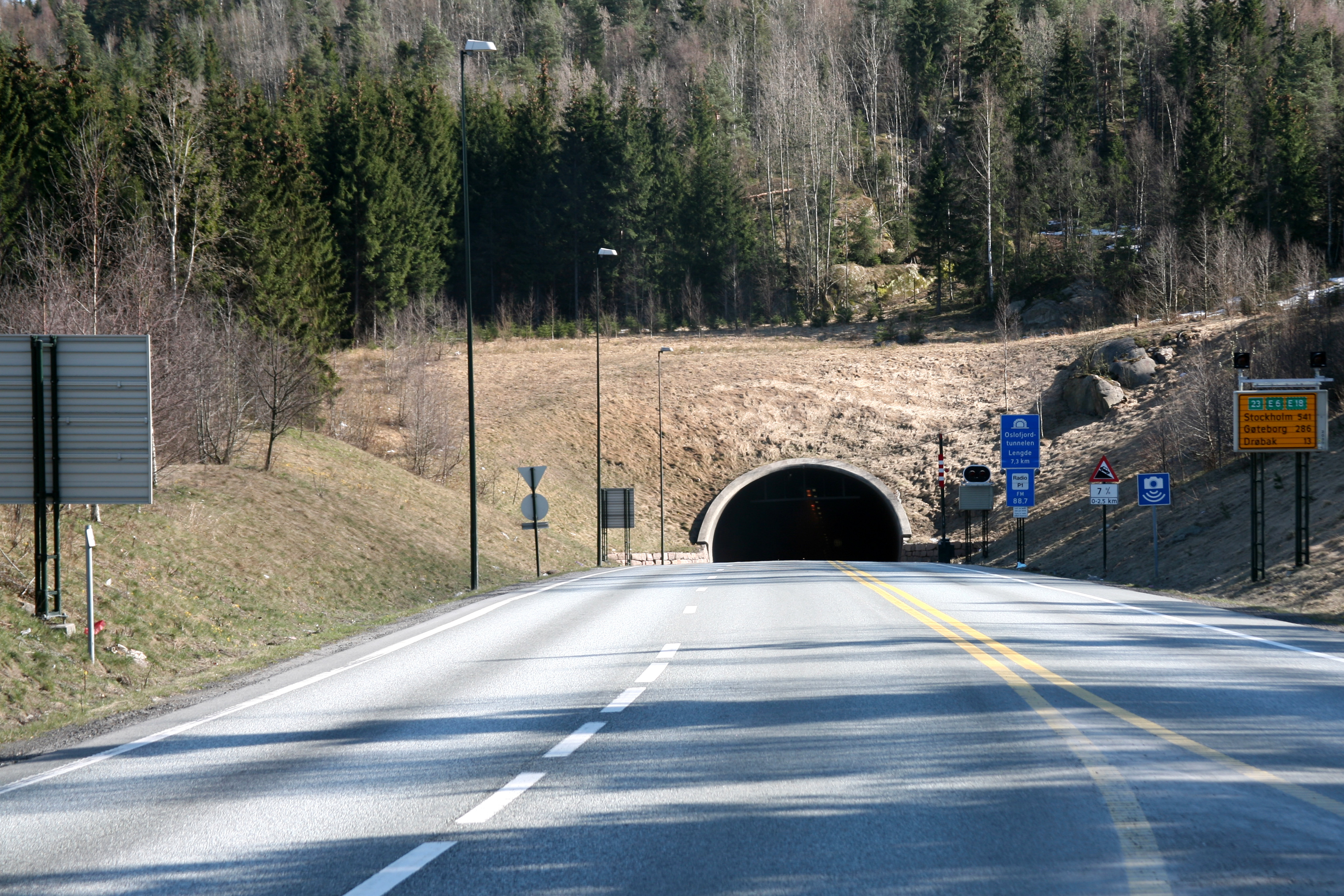
Oslofjord Tunnel
Every minute, 1,800 liters of seawater and groundwater seep into the Oslofjord Tunnel. Pumps work constantly to keep the passage dry. This detail captures something essential about the 7.3-kilometer tube that runs 134 meters beneath the surface of Norway's busiest fjord: it was built against the resistance of nature, against the resistance of local councils, and -- as its troubled history would prove -- against the limits of what a single-tube subsea tunnel can safely handle.
Four Decades of Maybe
The idea of a fixed crossing between the eastern and western shores of the Oslofjord first surfaced in 1958, proposed by a man named Anton Gronsand. A 1963 regional transport plan picked it up. Then it stalled -- the crossing required two counties to cooperate, and planning fell between jurisdictions. A small company called A/S Fjordbroene was founded in 1967 to keep the idea alive. Interest revived in the late 1970s when subsea tunneling technology proved viable at the Vardo Tunnel. Then came the Oslo Airport location controversy of the 1980s, which proposed sites in Hurum, As, and Hobol. A fixed fjord crossing would serve any of them. Parliament even voted in 1988 to build the airport at Hurum, with a four-lane motorway crossing included. When the airport went to Gardermoen instead, the tunnel survived as a consolation prize, backed by Transport Minister Kjell Opseth.
Blasting Through Ancient Rivers
Construction began on 14 April 1997 after Parliament approved the project in December 1996 -- over the objections of Frogn Municipal Council, which had tried to veto the development by demanding either two tubes or none. The contract for blasting went to Scandinavian Rock Group for 347 million Norwegian kroner. Most of the tunneling went smoothly through bedrock gneiss. In January 1998, tunnelers hit a wall of sediment deposited by an ancient river. It was twice as thick as projected -- over 10 meters instead of the expected 5 -- forcing a six-week delay and a 300-meter detour tunnel while engineers froze the sediment and blasted through it. The problem added 30 million kroner to the budget. The tunnel broke through on 4 February 1999 and opened on 29 June 2000.
Floods, Fires, and Closures
Almost immediately, the tunnel began demonstrating why a single tube beneath a fjord is a precarious proposition. It flooded in 2003 and again in 2008. A landslide in 2003 forced a week-long closure, and geological surveys afterward revealed that the rock quality had been overestimated during construction. Temporary ferry service had to be reinstated while 35 million kroner in repairs were carried out. Then came the fires. A truck carrying paper caught fire on 23 June 2011, trapping 34 people in smoke; twelve were hospitalized. After that incident, the tunnel was closed to vehicles exceeding 7.5 tonnes and eventually restricted to vehicles shorter than 12 meters. Twenty-five evacuation rooms were installed, each able to shelter 30 to 50 people in a pressurized space sealed from the main tube.
The Bridge That Never Was
Throughout its planning history, a bridge alternative competed with the tunnel. The most elaborate proposal called for two cable-stayed bridges connecting via Haoya island, with main spans exceeding 590 meters. The military vetoed three of four bridge options by 1988. Residents of Drobak organized Action Against a Bridge, enrolling 2,000 members within days. Environmental groups joined the opposition. The tunnel won -- but the bridge idea never fully died. In 2013, two new bridge proposals emerged: a Haoya crossing estimated at 7 billion kroner and a suspension bridge further south from Vestby at 10 billion. European Union regulations requiring twin tubes for tunnels on the Trans-European Network kept the pressure on for a permanent solution.
Under the Fjord, Unfinished
The Oslofjord Tunnel was designed from the start to eventually have two tubes, with the second planned 250 meters south of the first. Each tube would serve as an emergency exit for the other. But the compromise that got the first tube built -- one tube, limited highway, no western extension through Hurum -- left the project perpetually incomplete. Traffic peaked at 7,138 vehicles per day in 2010 before the fire closures drove numbers down. Tolls collected by the Bompengeselskapet amounted to 1.4 billion kroner -- twice the debt incurred -- with the surplus consumed by interest and the 14-million-kroner annual cost of operating the toll plaza. The toll was finally removed in August 2016. The tunnel remains open, its three lanes carrying traffic at 70 kilometers per hour through a passage that nature never stops trying to reclaim.
From the Air
Located at 59.66N, 10.61E beneath Drobaksundet in the Oslofjord. The tunnel itself is invisible from the air, but its portals on the Hurum (west) and Frogn (east) sides are visible, along with the toll plaza area on the Frogn end. The narrow strait of the fjord is clearly visible from altitude. Nearest major airport is Oslo Gardermoen (ENGM), approximately 75 km north. The Oslofjord's width at the crossing point is evident at 3,000-5,000 ft AGL.