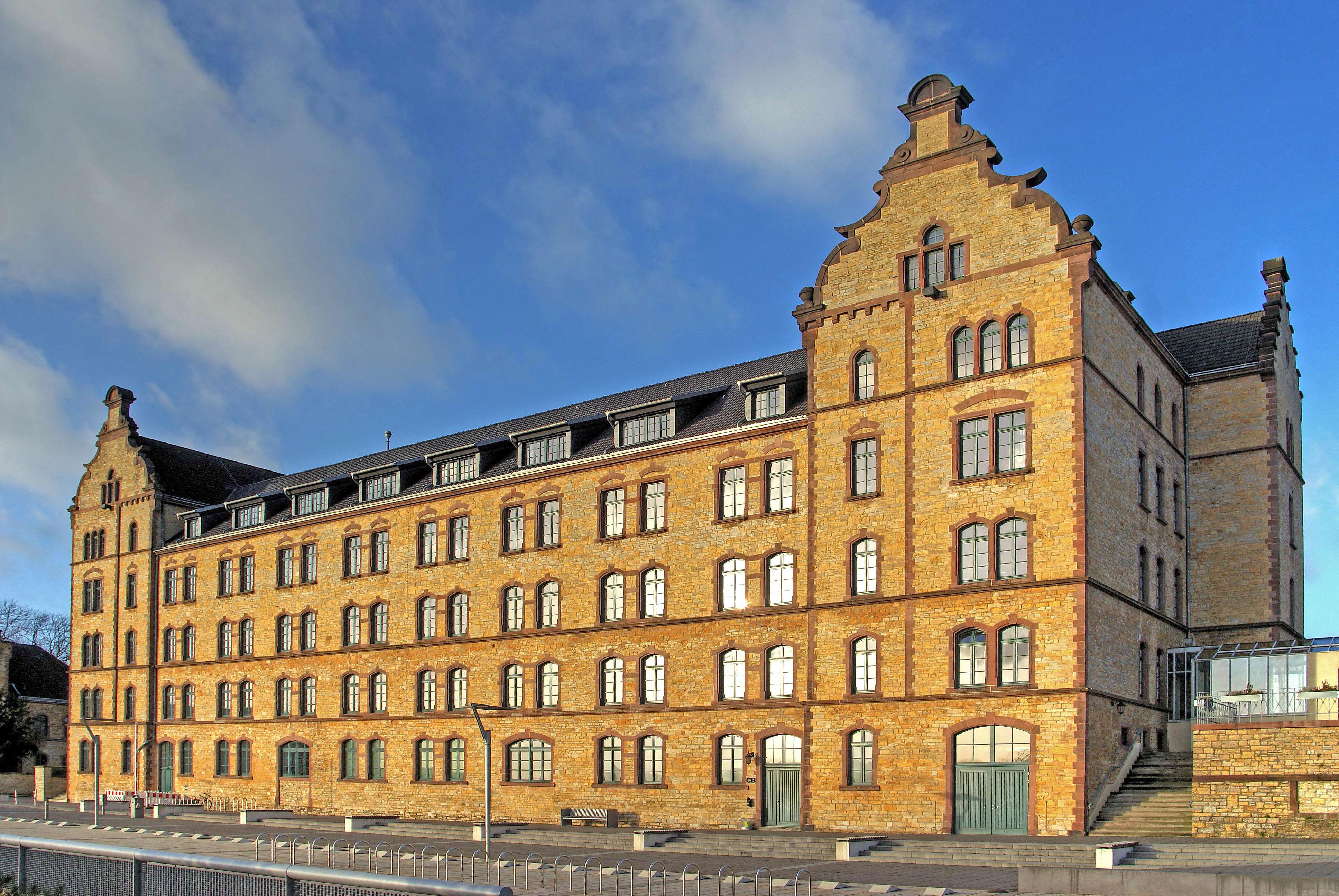
Osnabrück Garrison
On the night of 28 June 1996, three Mark 15 mortar bombs fired by the Provisional IRA were launched at Quebec Barracks in Osnabrück. One exploded inside the wire; the other two fell short of the perimeter fence and failed to detonate. The Provos called this kind of weapon a barrack-buster: a 200-litre gas cylinder packed with explosives and propelled by a separate launch tube. No one was killed, but the largest British military base outside the United Kingdom - sitting in a German city the RAF had bombed flat fifty-two years earlier - had just been attacked by the same campaign that was bombing English shopping centres. The garrison closed in 2009. The barracks are now apartments, university buildings, freight yards, and innovation centres. The names on the gates have been changed back to German.
Caprivi to Belfast
The oldest barracks in Osnabrück Station predated the British Army by half a century. Caprivi Kaserne was built in 1899 and named for General Leo von Caprivi, the man who replaced Bismarck as Chancellor of the German Empire. After 1945 it became Scarborough Barracks under the British and today serves as Osnabrück's University of Applied Sciences. Scharnhorst Kaserne, built in the 1930s and named for the Prussian military reformer Gerhard von Scharnhorst, became Belfast Barracks - home from 2006 to 2009 of the 1st Battalion the Duke of Lancaster's Regiment - and is now the Osnabrück Innovations Centre. Winkelhausen Kaserne, also 1930s, named for Colonel Willy Carl Winkelhausen, became Roberts Barracks after the war and home to the 4th Regiment Royal Artillery from 1984 to 2008. It is now a freight hub. A wartime Wehrmacht ammunition factory was expanded in the early 1950s into Imphal Barracks - named for the 1944 battle on the India-Burma border where the Japanese 15th Army was destroyed - and Mercer Barracks, named for the Royal Horse Artillery captain Cavalié Mercer, who left some of the most readable journals of any officer at Waterloo. Both are now being redeveloped as housing.
The Largest BAOR Base
British Forces Germany was always large, but Osnabrück was the high-water mark. Across the Osnabrück sites and the Loddenheide complex in Münster's Gremmendorf district, the garrison housed the 4th Armoured Brigade and most of its supporting units - tanks, artillery, signals, engineers, ordnance, infantry, medical. At peak strength in the Cold War decades it was the largest British military installation outside the UK, larger than Bergen-Hohne up the road, larger than the Westfalen Garrison. The Loddenheide site, built in the 1930s and originally named Hermann Göring Kaserne after the Reichsmarschall, was carved up by the British into Buller Barracks, Swinton Barracks, Waterloo Barracks and York Barracks. York Barracks alone hosted the 20th Armoured Brigade in the 1950s, the 6th Infantry Brigade in the 1960s, the 4th (Guards) Armoured Brigade in the 1970s, the 4th Armoured Brigade from 1981 to 1993, and then the Royal Dragoon Guards from 2001 until it closed in 2008. Children of soldiers were born in Osnabrück, attended British schools in Osnabrück, learned to ride bicycles on Osnabrück streets, and went home to a Britain they had never lived in.
Quebec Barracks, June 1996
The IRA's overseas campaign in the mid-1990s was aimed largely at British military targets in continental Europe. The Quebec Barracks attack came thirteen days after the Manchester city centre bombing and six weeks before the Lisburn bombings in Northern Ireland. Three Mark 15 mortars - the barrack-buster, an improvised weapon developed in South Armagh - were launched from a position outside the wire. Two fell short of the perimeter and failed to explode; one cleared the fence and detonated inside the base. Damage to buildings was significant; no soldier or civilian was killed. The attack confirmed for British commanders what the security services already suspected: that the Provisional IRA had active service units operating across the BAOR garrison towns of Lower Saxony and North Rhine-Westphalia, and that the long peace of the British Forces Germany community could no longer be assumed. Security around the wire tightened. Cars belonging to British personnel began to carry German plates. The convivial routines of garrison life, sustained for half a century, contracted into a more watchful version of themselves.
Sixty-Three Years Out
On 19 July 2008, the last large parade of British troops marched out of Osnabrück. The closure had been announced in the Defence Estate review of the mid-2000s, part of the long British military withdrawal from Germany that had begun with the end of the Cold War and was now accelerating as the army reorganised around expeditionary operations in Iraq and Afghanistan. The Yorkshire Regiment left Oxford Barracks in 2009; the Duke of Lancaster's left Belfast Barracks the same year. Quebec Barracks was already gone. The flag came down on a British presence that had begun in 1945 with Field Marshal Bernard Montgomery's occupation order, ran through every Cold War alert and exercise, and ended with handover ceremonies to German officials in business suits. Soldiers' families packed up sixty-three years of accumulated kit. Houses on the British married quarters estates went on the German civilian market. The military post office closed.
What Replaced Them
What is unusual about Osnabrück, compared to other shrinking British garrisons, is how thoroughly the city absorbed the empty space. Caprivi and Scarborough are a university campus. Scharnhorst and Belfast are an innovation centre. Roberts is a freight hub. Imphal and Mercer are housing. The Loddenheide barracks complex in Münster - Buller, Swinton, Waterloo, York - is the subject of an ongoing planning consultation, which in north-German urbanism normally means a careful conversion into mixed-use neighbourhoods rather than wholesale demolition. The street names mostly survive, the German originals back on the signs alongside small plaques explaining what the British called the place between 1945 and the year it closed. Walk down a residential road in the Eversburg district and you can still see the long low silhouettes of NAAFI buildings, repurposed but recognisable, where soldiers once queued for tea.
From the Air
Garrison locations cluster around 52.27°N, 8.02°E on the west and northwest sides of Osnabrück, with major sites in the Eversburg and Atter districts and the Loddenheide complex 50 km southwest in Münster's Gremmendorf district. EDDG (Münster/Osnabrück International) is 25-30 km north and lies between the two main garrison clusters. From 6,000-8,000 feet on approach, the rectangular grids of former barracks and parade grounds are still visible against the surrounding street pattern, even where the buildings have been replaced.