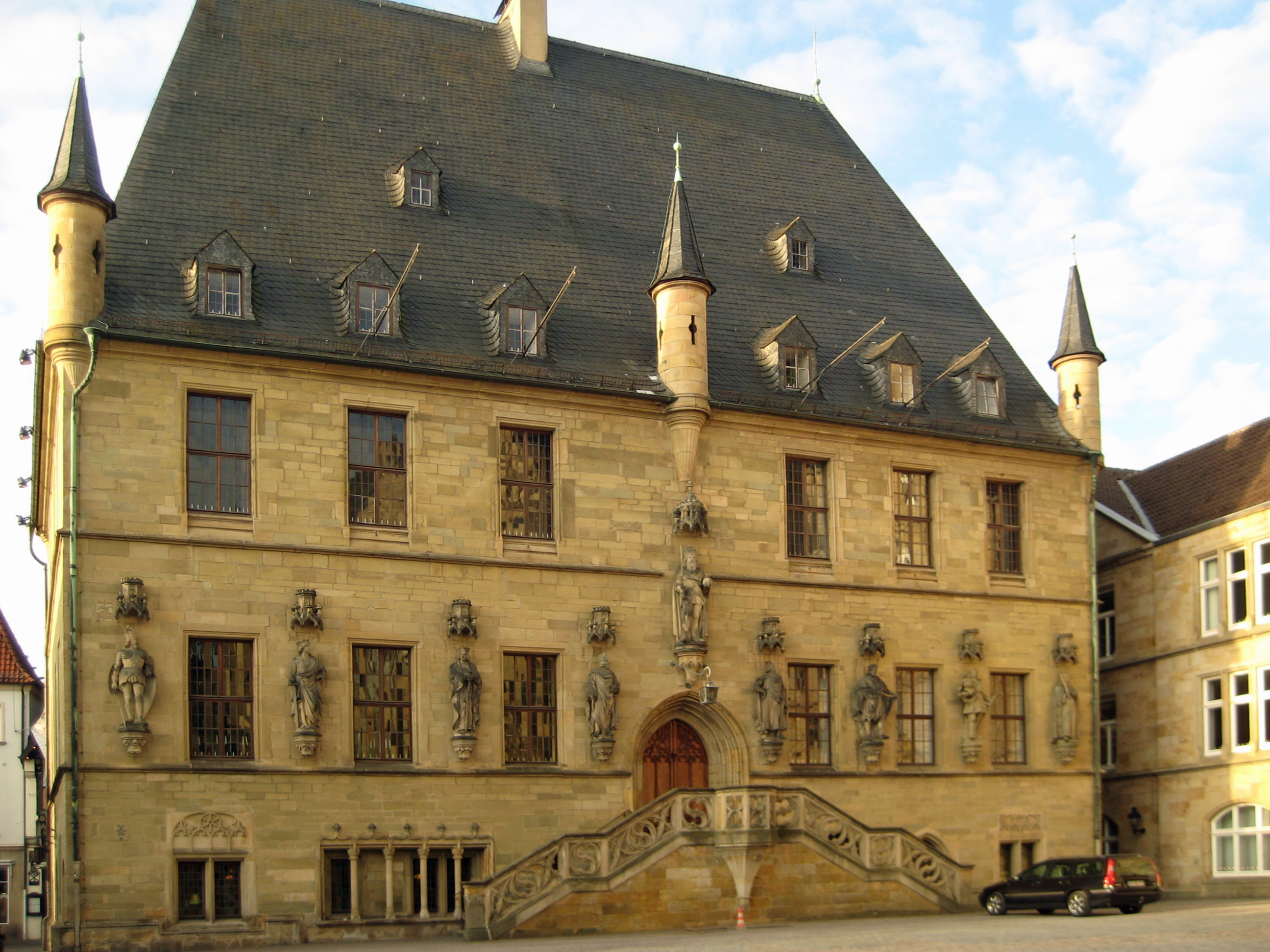
Osnabrück Town Hall
The bronze door handle on the main entrance of Osnabrück's town hall reads, in heavy raised numerals, 1648. Below the year there is a dove. The handle was cast in 1963 by Fritz Szalinski, but the date and the dove together name what happened inside on 24 October 1648, when the envoys of the Protestant powers - the Kingdom of Sweden, the Holy Roman Emperor, the German imperial estates - put their seals to the Osnabrück half of the Treaty of Westphalia (the Instrumentum Pacis Osnabrugensis) and ended the Thirty Years' War. The Catholic half was being signed forty-five kilometres south, at the same hour, in the town hall of Münster. The European order built on that day held for a hundred and forty years. The town hall held longer.
Late Gothic, Slowly Finished
Construction began in 1487 on the Markt, replacing an older town hall that had stood on the same square. The Hanseatic council of Osnabrück had decided it wanted a building that looked like the city's prosperity. They got one. The 18-metre-high hipped roof is almost as tall as the load-bearing structure beneath it. Six towers rise at the lower edge of the roof, reminiscent of the watchtowers and corner turrets of a fortress, which was the point: a town hall that read, from a distance, like the city had armed itself. The shell was topped out in 1505. Completion came in 1512. Interior decoration trailed on until 1575, which is what happens when you build slowly and well in a Hansestadt where the council changes its mind. A great flight of steps was added in front in 1846, replacing a retractable wooden ladder used by visitors and aldermen for three centuries.
Five Years of Negotiation
From 1643 to 1648 the envoys of the Thirty Years' War lived and argued in Osnabrück and Münster. The negotiation was bifurcated by religion: Protestant powers - the Swedes in particular - met the Holy Roman Emperor's envoys and the imperial estates in Osnabrück; Catholic France met the same imperial side in Münster. Sweden's negotiators were the strongest party in the Osnabrück town hall - the country had lost its king Gustavus Adolphus at Lützen in 1632 and was determined to extract a settlement worthy of his death. They got Western Pomerania, the bishopric of Bremen, and a place at the table of every German political question for the next century. The forty-two European envoys at the Friedenskongress now look down from portraits ringing the walls of the Friedenssaal, the Hall of Peace. Three larger portraits hang opposite them: Christina of Sweden, Louis XIV of France, and Emperor Ferdinand III, the rulers of the main combatant nations whose names are signed at the foot of the treaty.
13 September 1944
On the night of 13 September 1944, Allied bombers - principally the RAF - struck Osnabrück's old town centre as part of the air campaign against German rail and industrial hubs. The town hall burned to its foundation walls. The Hotel Walhalla down the street took an incendiary that destroyed its attic. The cathedral was hit. The town hall's furnishings, however, were saved: the council had foreseen what was coming and had moved nearly everything portable into storage some time before. The chairs and tables of the Friedenssaal, the portraits of the envoys, the bronze door handle's iron predecessor, the imperial goblet from the thirteenth century, the medieval treasury silver - all of it survived in some warehouse on the outskirts while the building above them disintegrated. Reconstruction began as soon as the war ended. The town hall was officially reopened on 24 October 1948 - exactly on the three-hundredth anniversary of the Peace of Westphalia, signed in this room, in 1648.
Charlemagne and the Emperors at the Door
Above the entrance stands a statue of Charlemagne, founder both of the city and of the Catholic Diocese of Osnabrück in 772. On either side march the so-called Kaiser-Plastiken, the emperor sculptures: Sigismund, Frederick II of Hohenstaufen, Rudolf of Habsburg, Wilhelm I, Frederick Barbarossa, Arnulf of Carinthia, Maximilian I, and Ludwig the Bavarian. The presence of Wilhelm I - Prussian king, then German Emperor from 1871, dead in 1888 - in a row of medieval Holy Roman rulers gives away the date the sculptures were commissioned: they were gifted to the town hall by the Prussian royal family in the late nineteenth century, when Prussia was busy writing itself into every available history. The bronze door handle below them, with its 1648 and its dove, makes a different claim: that this is the building where peace was made, regardless of who has tried to take credit since.
The Treasury and the City in 1633
Across the entrance hall from the Friedenssaal sits the town hall treasury, a small chamber holding the surviving civic regalia: the silver, the coins, the embossing stamps, the documents. The imperial goblet from the thirteenth or fourteenth century is the showpiece. A replica of the Osnabrücker Friedensinstrument, the Osnabrück instrument of peace, lies among them - the original is in the city archives, still intact, still legible. Also on display is a copy of the document by which Frederick Barbarossa granted the people of Osnabrück the right to exercise their own jurisdiction in 1171. Upstairs, on the upper floor, sits a model of Osnabrück as it looked in 1633, mid-war, before the bombing of 1944 and the reconstruction afterwards. The model was built between 1955 and 1957 by the sculptor Heinrich Bohn from a city map drawn by the copperplate engraver Wenzel Holler in the year the model depicts. Looking down at Bohn's miniature, then looking out the window at the actual city, becomes the simplest history lesson Osnabrück offers: this is what was lost, this is what was rebuilt, this is what 1648 was for.
From the Air
Osnabrück Town Hall sits at 52.28°N, 8.04°E on the Markt in the heart of the old town, between the cathedral and St Mary's Church (Marienkirche). EDDG (Münster/Osnabrück International) is 30 km north. From 4,000-6,000 feet on a south-to-north pass over the Altstadt, the six-towered hipped roof and the adjacent twin spires of the Marienkirche on the same square are the easiest medieval skyline to identify. The town hall's roof is approximately 30 metres tall.