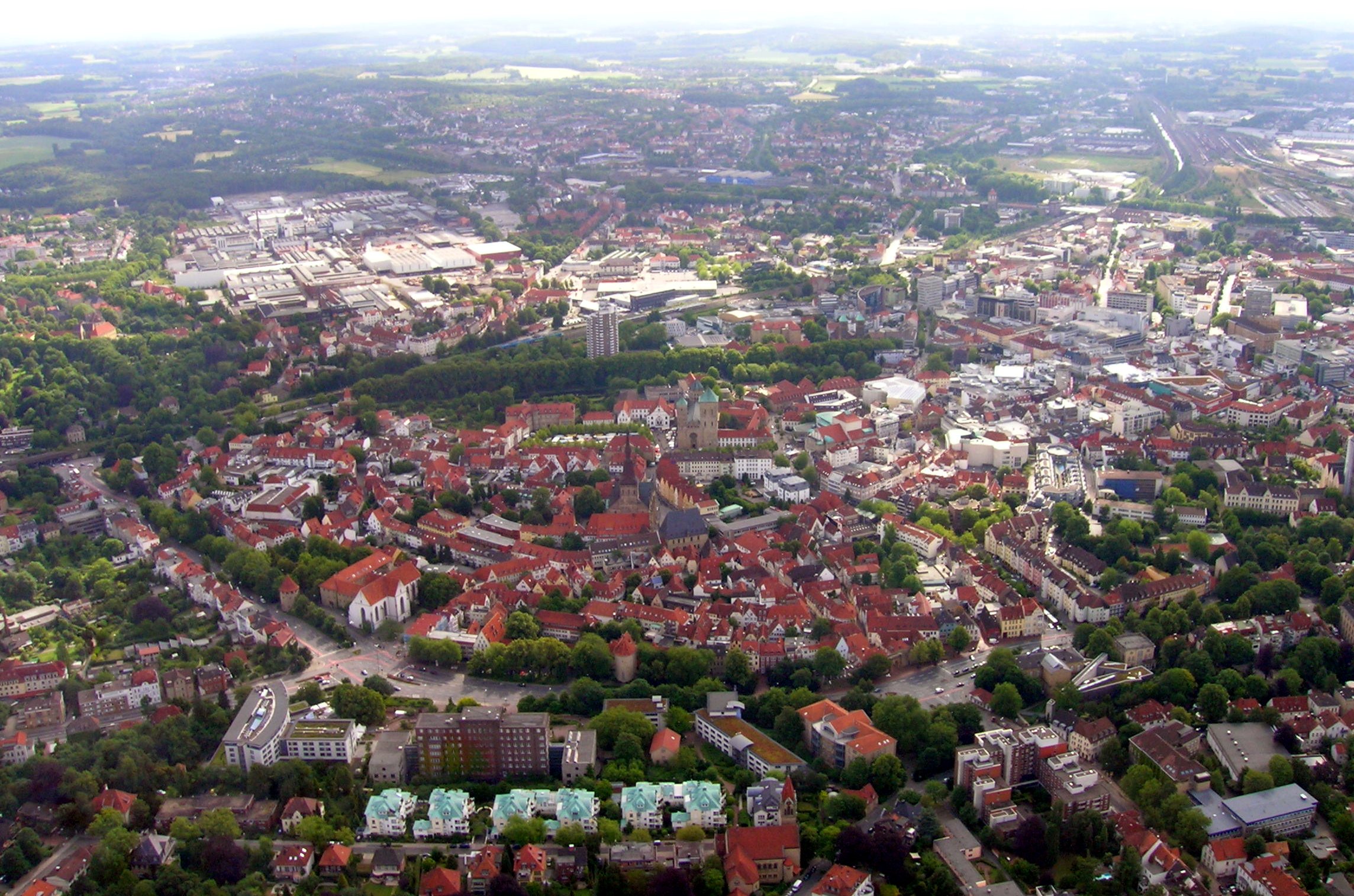
Osnabrück
On October 24, 1648, riders carried news from Osnabrück's town hall that would redraw a continent. Inside, Protestant diplomats had spent five years arguing with Catholic counterparts forty kilometers away in Münster - two cities, two confessions, one unprecedented experiment in negotiating peace. The Thirty Years' War had killed perhaps a third of the German population. When the ink finally dried on what history calls the Peace of Westphalia, the modern idea of the sovereign state was effectively born here, in this Lower Saxon city of stepped gables and steep church towers tucked between the Wiehen Hills and the Teutoburg Forest.
City of Two Confessions
Osnabrück grew up around a bishopric founded by Charlemagne in 780, and the rhythms of medieval Catholic life shaped it for centuries. Then in 1543, the first Lutheran services were held inside its walls. The city refused to choose. For the next hundred years it lived in confessional ambiguity, sometimes Protestant, sometimes Catholic, depending on which army had marched through last. The Westphalian peace that ended this chaos in 1648 enshrined that ambiguity as policy: the prince-bishopric of Osnabrück would alternate between a Catholic bishop and a Lutheran one, the latter drawn from the House of Brunswick-Lüneburg. It was a uniquely Osnabrück solution - awkward, pragmatic, and remarkably durable.
What the Witch Hunts Cost
The same century that produced the peace also produced one of its darkest chapters. Between 1561 and 1639, fear of witchcraft swept the city. In a single year - 1582, during Mayor Hammacher's rule - 163 women were executed as alleged witches, most burned alive in public. By the time the trials ended, 276 women had died this way, along with two men charged with sorcery. They were neighbors, midwives, widows, women whose age or independence or sharp tongue made them suspect. The city that would later host history's most famous peace conference was the same city that had killed its own citizens by the hundreds in waves of religious panic. Both facts belong to its story.
The Boy Who Wrote the War
On June 22, 1898, a child named Erich Paul Remark was born in Osnabrück to a working-class Catholic family. He grew up here, attended school here, and at eighteen was conscripted into the Imperial German Army and sent to the Western Front. He came back wounded and changed. A decade later, working under the slightly Frenchified name Erich Maria Remarque, he published Im Westen nichts Neues - All Quiet on the Western Front - a novel so honest about the trenches that the Nazis would later burn it and strip him of his citizenship. Remarque wrote about young soldiers from a town much like Osnabrück who marched away believing in glory and discovered something else entirely. The book sold millions and gave the twentieth century a vocabulary for what industrial war does to ordinary boys.
Fire from Above
Remarque's warnings did not stop the next war. Osnabrück suffered some of the heaviest Allied bombing of any city its size in northern Germany. The medieval Altstadt was shattered. St. Catherine's Church burned on Palm Sunday 1945. St. Mary's lay gutted. Jewish and Romani residents - the people the Nazi regime had marked for death - were deported from the city's stations to camps from which most never returned. On April 4, 1945, the XVII Corps of Bernard Montgomery's Second Army entered Osnabrück with little resistance. The city that survived the Thirty Years' War to broker peace had been all but destroyed by the war that followed it.
Friedensstadt
Modern Osnabrück calls itself the Friedensstadt - the city of peace - and the title is more than a slogan. The town hall where the 1648 treaty was negotiated still stands on the market square, rebuilt to its medieval lines, displaying portraits of the diplomats who hammered out a continent's compromise. The reconstructed Altstadt rises around it: St. Mary's Gothic gables, St. Catherine's 103-meter tower, narrow lanes that follow their medieval grid. The Felix Nussbaum Haus, designed by Daniel Libeskind in jagged angles of zinc and concrete, holds the paintings of a Jewish artist born in Osnabrück who was murdered at Auschwitz in 1944. The city does not pretend its history was easy. It pretends nothing at all. It simply keeps the buildings standing and the names spoken.
From the Air
Osnabrück sits at 52.28°N, 8.04°E in Lower Saxony, near the Dutch border. Recommended viewing altitude: 4,000-6,000 ft AGL. The Hase river valley is pinched between the Wiehen Hills to the north and the Teutoburg Forest to the south - both clearly visible on approach. Nearest airport: Münster Osnabrück International (EDDG / FMO), about 30 km southwest. Population about 168,000.