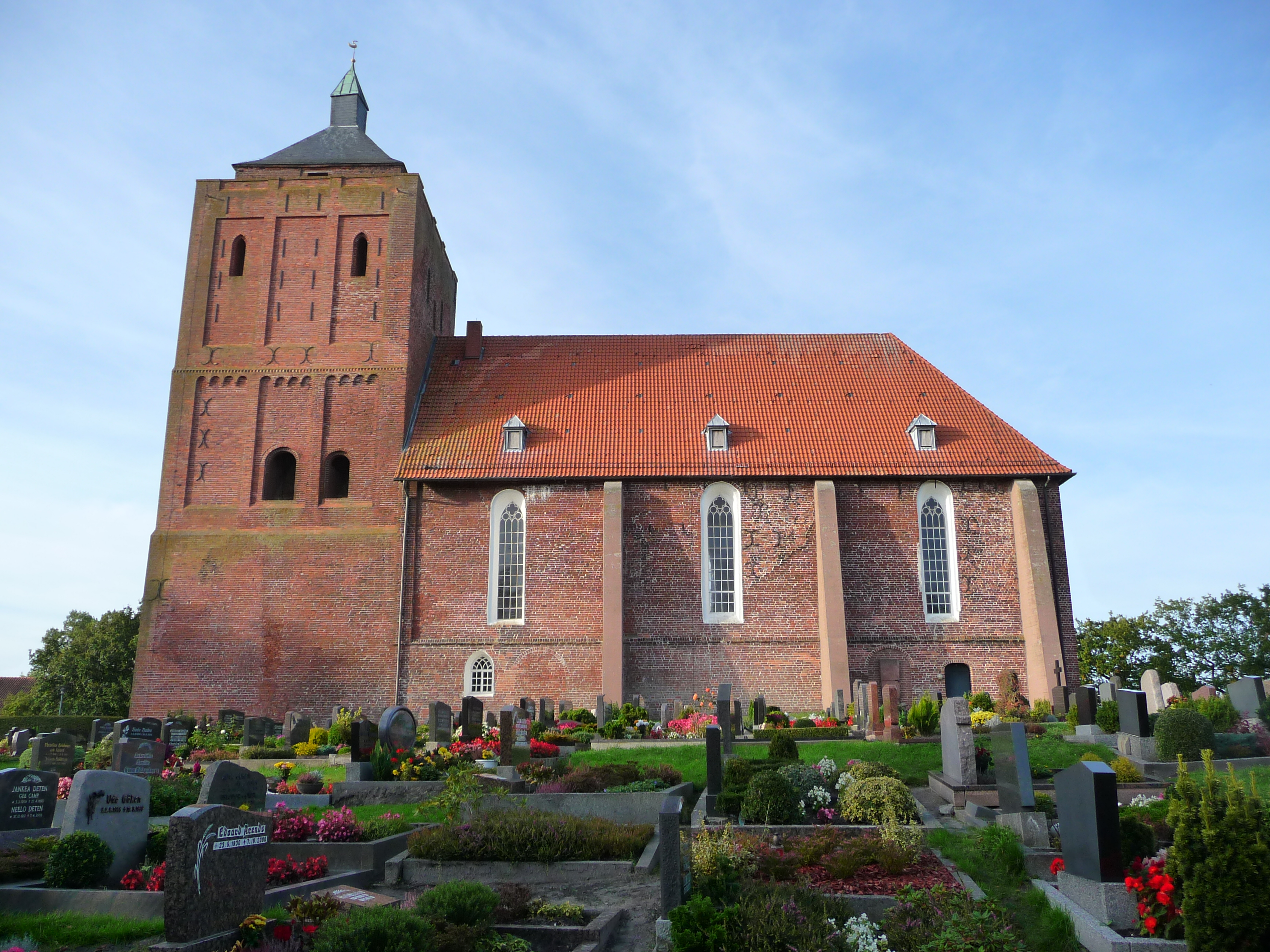
Osteel
In 1611 a young man named Johannes Fabricius pointed a telescope at the rising sun from his father's house in Osteel and saw something nobody had recorded before: dark patches drifting across the solar disc. Sunspots. He projected the image through a camera obscura to spare his eyes and watched the spots move from one side of the sun to the other over days, which meant the sun itself was turning. His father David, a Lutheran pastor and astronomer with his own substantial reputation, helped him publish the discovery that June. Five years later Johannes was dead, felled by illness in March 1616 at just twenty-nine. His father David was murdered the following year, in May 1617. The monument outside Warnfried Church remembers them together.
Two Astronomers, One Parsonage
David Fabricius was born in 1564 and trained as a Lutheran minister, but his real obsession was the sky. From small Frisian parishes he correspond with Tycho Brahe and Johannes Kepler as equals, contributed observations that helped Kepler refine the theory of elliptical orbits, and documented a previously unrecognised variable star - Mira Ceti - in 1596. He also drew one of the first maps of East Frisia, surveying the region himself. Johannes, born in 1587, studied at Helmstedt and Leiden and brought a Dutch-made telescope home to Osteel. Together, father and son turned this small village parsonage into a working observatory of the late Renaissance. The discovery of sunspots was Johannes's, but the collaboration was constant.
A Church Older Than the Reformation
Warnfried Church rises in the centre of Osteel, sixty-three metres long and dedicated to Saint Werenfried, an eighth-century Anglo-Saxon missionary. The building dates to the twelfth century, brick-built in the style of the Frisian marsh churches, with a separate bell tower planted nearby like a chess piece. Inside, the organ is the second oldest in East Frisia - constructed in 1619 by Master Edo Evers, the same builder whose earlier work would later be partly incorporated into Arp Schnitger's masterpiece in nearby Norden. The Osteel organ has been restored and is still in use; its temperament, like that at Norden, follows historically informed practice and gives Frisian Baroque a continuous, living thread.
The Hammer and the Clover
Osteel's coat of arms tells you what the village has been for most of its history. A golden hammer in the centre, golden trifoliate clovers to either side, all on blue, topped with a golden crown. Hammer for craftsmanship, clovers for the farming that has dominated this landscape since the moor's edge was first settled. The village was first mentioned in writing in 1164, and the original community sat where dry ground met bog - a transition zone that gave settlers reed for thatching, peat for fuel, and grazing for cattle once the wettest parts were drained. The old station closed in 1978, and travellers now catch trains three kilometres south at Marienhafe.
The Murder of David Fabricius
The end came strangely. In May 1617 David Fabricius accused a local farmer named Frese of stealing a goose. From the pulpit, by some accounts, he hinted at the man's guilt without naming him. Frese, recognising himself in the denunciation, attacked Fabricius with a peat spade and killed him. The astronomer who had corresponded with Kepler was dead at fifty-three, struck down in his own parish over poultry. Johannes had died the year before - in 1616, cause uncertain, possibly tuberculosis - so he never saw his father's end. They are commemorated together outside the church in stone. Two men who looked at the heavens and changed what they knew, each gone before fifty.
A Quiet Modern Village
Today Osteel is a municipality of a few hundred residents in the district of Aurich. The main settlement is six miles south of the old town centre on the Bundesstraße 72, and most visitors pass through without registering the place. Those who stop come for the church, the organ, and the monument. The actor Siemen Rühaak, born here in 1950, brings occasional Tatort recognition. The 19th-century Reichstag deputy Friedrich Vissering was born here. None of them dim the central glow: in a parsonage no longer standing, a father and son trained the new technology of the telescope on the sun and found what no one had seen before.
From the Air
Osteel lies at 53.53°N, 7.27°E in the East Frisian polderland, about 5 nm south-southeast of Norden. From 2,000-3,000 feet look for Warnfried Church and its separate bell tower in the centre of the small village, with the surrounding flat farmland threaded by drainage ditches. Nearest airfields: Norden-Norddeich (EDWS) about 6 nm north, Emden (EDWE) about 17 nm southwest. Marshland weather, frequent low cloud.