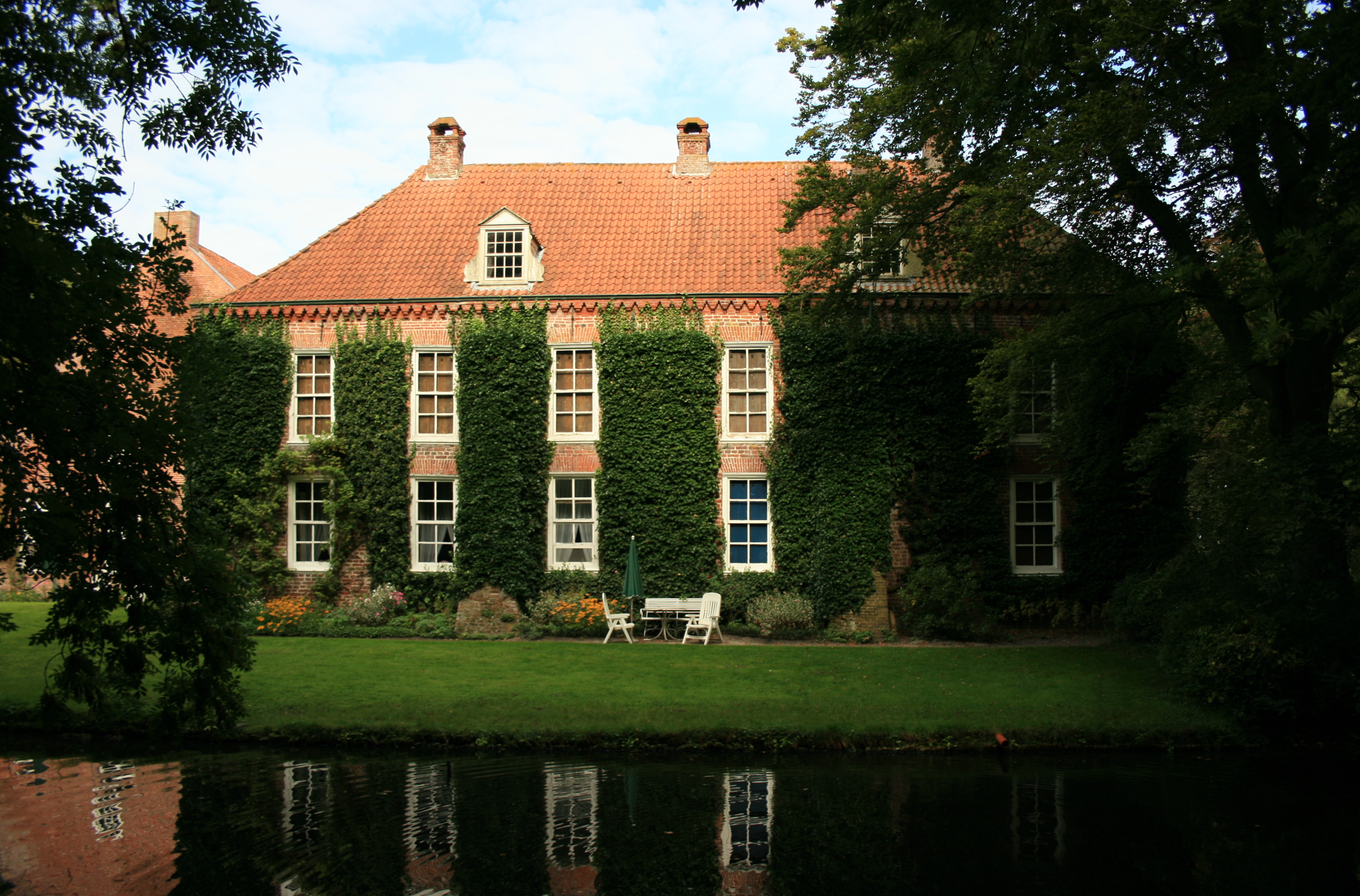
Osterburg (Groothusen)
Three castles once stood in Groothusen. Two were destroyed - one in 1400, the other in 1432 - smashed by raiding parties from Hamburg during the chaotic feuds that consumed late-medieval East Frisia. The Osterburg is what remains. It sits at the eastern end of the village, surrounded by a moat and shaded by lime trees that have leaned over the same water for generations, the lone survivor of a town that once had three.
The Village on the Warft
Groothusen was built on a warft - one of those long, artificial dwelling mounds the Frisians piled up against the North Sea before dikes existed. In the early Middle Ages this mound rose at the edge of a tidal bay, and ships could sail right up to the village. That changed everything for a tiny dot on a marsh. Groothusen became a trading centre, a meeting place in the Frisian Emsigerland, the seat of a provost who oversaw twelve parishes. Three castles defended the wealth that the tides brought in. The bay has long since silted and been diked away, leaving Groothusen stranded inland - a quiet farming village whose importance now lies entirely in what survives from when the water was its highway.
The Beninga Hall
What you see today began around 1490 as a single long, two-storey hall built by the Beninga family, one of the East Frisian chieftain clans whose feuds and alliances ran this corner of the coast. Around 1550 the hall sprouted wings on either side, turning it into a three-winged manor house. Then in 1700 the right wing was torn down to make way for something the Frisians had perfected by then: a Gulfhaus, the enormous barn-house hybrid where livestock, harvest, and family shared one giant pitched roof. Walk around to the back of the Osterburg and the centuries peel away - you can still read the original 1490 hall in its bricks. From the front, a hallway added in 1900 muddies the view. The building is honest about its layers; it just makes you walk around to see them all.
Five Centuries of Faces
Inside, the Beninga descendants who still own the Osterburg have kept what their family kept. Furniture from generations of dinners. Weapons from feuds that history has otherwise forgotten. A library, items of Old East Frisian culture, and most striking of all - a wall of ancestral portraits spanning five centuries. The painted Beningas stare across the room at each other in their ruffs and stiff collars and 19th-century military coats, a family tree rendered in oil. Tours run by appointment, arranged by telephone, which feels appropriate for a place this stubbornly continuous. The left wing has been quietly converted into guest rooms; bed and breakfast in a chieftain's hall, with lime trees outside and a moat below.
From the Air
53.4353 N, 7.0689 E, in the flat Krummhörn west of Emden. From cruising altitude the lime tree avenue makes an unmistakable green spine pointing to the castle. Nearest airport is Emden (EDWE), about 12 km southeast. Bremen (EDDW) and Groningen Eelde (EHGG) are the closest larger fields. Clear coastal weather and flat terrain make this an easy visual landmark.